
Some of the most beautiful minerals on Earth are also radioactive. The electric green of torbernite, the silky needles of the rarest uranium arsenates, the warm sands of a tropical beach — all of them quietly emit radiation, and all ask the same thing of us: a little respect, and a little physics. This is the guide behind every ☢ warning on this site.
The word "radioactive" tends to switch off the thinking part of the brain. We picture meltdowns and mushroom clouds. But radiation is not a yes-or-no switch — it is a question of dose. The very same word covers a banana you ate this morning, a transatlantic flight, a dental X-ray, and the inside of a reactor core. The difference between them is not kind but quantity, by a factor of millions.
This page is about that nuance. It is about how to handle radioactive minerals safely and sensibly, what makes a few of them genuinely dangerous, and — perhaps most surprising of all — the serious, ongoing scientific case that low exposures are not the cartoon villain popular culture makes them out to be. The evidence comes from radioactive beaches where people happily sunbathe, from one of the most radioactive inhabited cities on Earth, and from a snow-covered palace in Bohemia where doctors have prescribed radioactivity as medicine for over a century.
Before the specimens, a short and genuinely useful primer. Two ideas unlock almost everything.
The becquerel (Bq) measures how busy a sample is: one becquerel is one atomic disintegration per second. It tells you about the rock. The sievert (Sv) measures how much that radiation affects living tissue — it accounts for the type of radiation and the biological damage it does. It tells you about the danger to you. Collectors mostly care about sieverts (and the handheld dose rate in microsieverts per hour, µSv/h); regulators writing ownership limits mostly use becquerels per gram. Keep the two straight and most confusion dissolves.
Uranium and thorium minerals are not single emitters — they sit at the head of long decay chains (the U-238 and Th-232 series), each step producing a new radioactive "daughter" and its own mix of alpha, beta, and gamma. One daughter deserves special attention: radon, a radioactive gas. Because it is a gas, it can drift out of a specimen and be breathed in, where its own short-lived progeny lodge in the lungs. And radon is heavy — roughly eight times denser than air — so it does not disperse upward and away; it sinks, settling and accumulating in the lowest, stillest part of a building: a cellar, a basement, a closed ground-floor room. For the home collector, radon is the single most important practical risk — far more so than the gamma dose from simply having the stone on a shelf. As we will see, where you keep a specimen matters more than the fact that you keep one at all.


▼ 207 → 1.57 µSv/h · the whole argument for sensible storage, in one comparison ▼
Torbernite (historically chalcolite, and once charmingly called "cupro-uranite") is a hydrated copper uranyl phosphate, formula Cu(UO2)2(PO4)2·12H2O. It is named after the eighteenth-century Swedish chemist Torbern Bergman. It grows as crisp, square tabular crystals of an unmistakable emerald-to-grass green — the colour coming from copper — and forms as a secondary mineral in the oxidised zones of uranium-bearing deposits, often in or near granites. Its calcium cousin is autunite; a quick field test distinguishes them, because autunite glows brilliantly under ultraviolet light while torbernite, its fluorescence quenched by the copper, generally does not.
Torbernite is one of those species that does not stay put. As it slowly loses water it transforms into metatorbernite (Cu(UO2)2(PO4)2·8H2O), a dehydration pseudomorph. The change can dull a glassy crystal into an opaque, powdery one, the lattice fracturing into microcrystalline grains. Many collectors take it as a rule of thumb that a torbernite specimen more than a few years old has at least partly become metatorbernite. (This matters for handling: a powdery surface is a dust-shedding surface.)
The two photographs above are the most instructive thing on this page. Bare, the specimen reads 207 µSv/h in contact. For perspective, a single chest X-ray is about 100 µSv — so pressed directly against this crystal, you would accumulate roughly two chest X-rays' worth of dose every hour. That sounds alarming until you remember two things. First, dose rate falls off steeply with distance (roughly with the inverse square of it) — step back even 30 cm and the reading collapses. You do not live with your face against the specimen. Second, look at the lead-lined box: the same stone now reads 1.57 µSv/h, barely above an ordinary room's background. The lead has absorbed essentially all of the beta radiation and the great majority of the gamma.
One caveat the photographs cannot show: lead blocks beta and gamma, but it does not contain radon gas unless the container is genuinely sealed. A lead box on an open shelf shields the rays beautifully while still letting the gas escape. The fix is simple, and we cover it below.
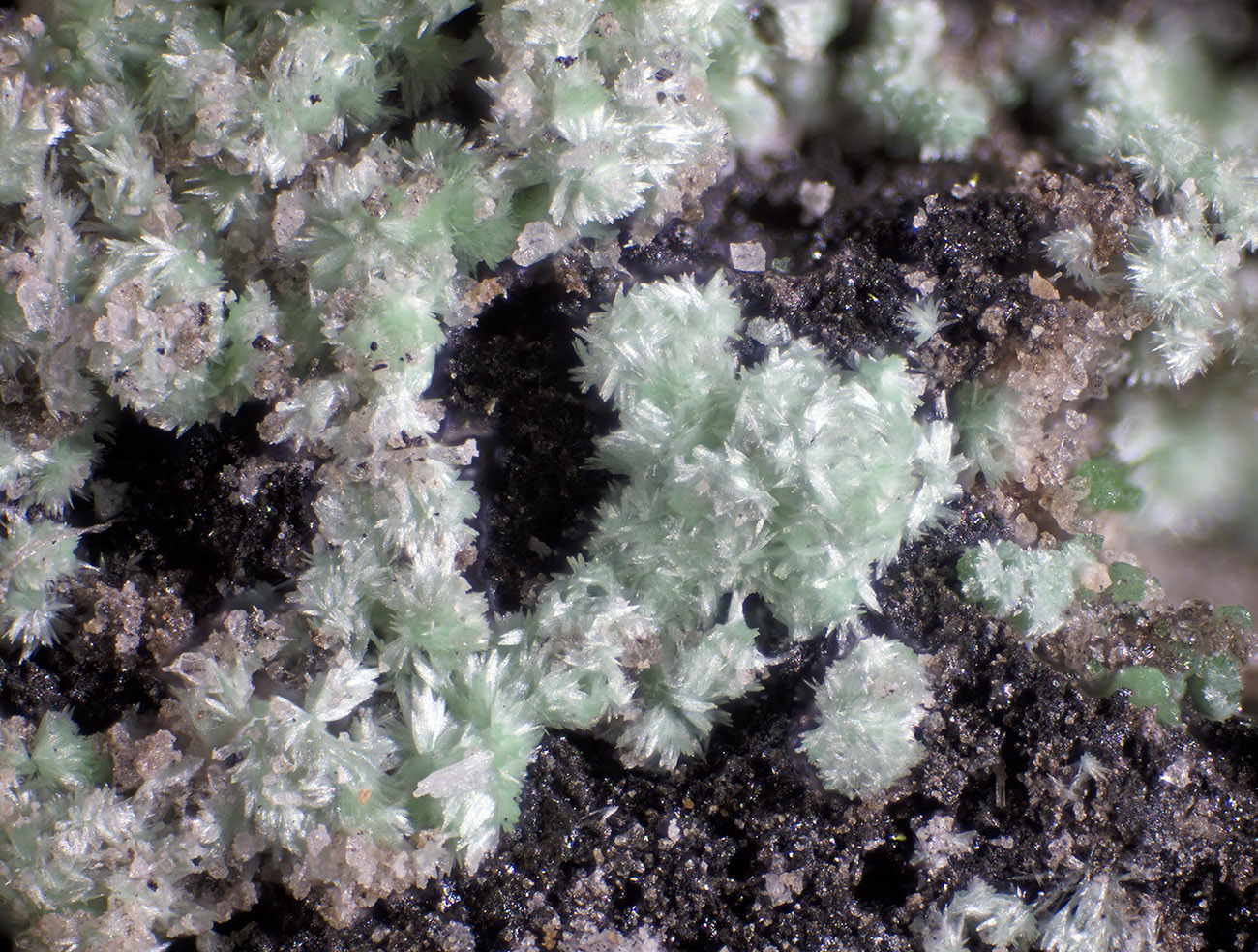
How dangerous can a crystal be? Meet vysokýite — arguably the single most hazardous mineral a person can hold. Most radioactive minerals carry one risk. Vysokýite carries three at once, and that is what makes it exceptional.
Radioactive and asbestos-like and toxic — a rare and genuinely formidable combination.
Vysokýite is a very rare oxysalt of tetravalent uranium — itself unusual, since most secondary uranium minerals contain the fully oxidised, six-valent uranyl ion. Its formula is U4+[AsO2(OH)2]4·4H2O. It was discovered roughly thirty years ago by the collector Jan Hloušek on the "Arsenic lens" in the southern part of the Geschieber vein, between the Svornost and Josef shafts of the legendary Jáchymov ore district in the Czech Republic, and formally described by Jakub Plášil and colleagues in 2013. It forms pale green fibrous crystals up to about 8 mm long, packed into tiny clusters, growing on altered native arsenic — the black mineral beneath. It keeps remarkable company: the darker emerald-green crystals beside it are often štěpite, and the same pocket has yielded běhounekite, kaatialaite, claudetite, and arsenolite.
There is a quiet, almost poetic thread here. Štěpite is named after Josef Štěp, the mining engineer remembered as the father of the world's first radioactive spa — which sits directly above these mines. The very same ground that produces the deadliest minerals on Earth also gave birth to the idea of radioactivity as medicine. We follow that thread to its end below.
You do not need to fear these stones. You need to respect them, the way you would respect a sharp tool or a strong solvent. The guiding principle of all radiation safety is delightfully simple: time, distance, and shielding — minimise the first, maximise the second and third — plus one extra rule for radon and dust.
First, the reassuring physics. The radon a uranium mineral produces is radon-222, and its half-life is just 3.82 days. It therefore cannot pile up forever: inside a sealed container the level climbs for about three weeks, then production and decay balance and it plateaus. Remove the crystal, or open the lid to fresh air, and what is there simply decays away — half gone in under four days, about 97% gone in three weeks, essentially nothing left within a month. Radon is only ever a problem while it is being made and trapped and breathed, all at once.
Now the arithmetic, for a small specimen — say a couple of grams of actual torbernite (the mineral is about 47% uranium by weight). At secular equilibrium that holds roughly 12,000 Bq of radium-226, so it generates about 12,000 radon atoms every second deep inside the crystal. But most never escape the solid: with a typical emanation fraction of around 10% (and often far less for an intact crystal), only on the order of ~1,000 Bq actually reaches the surrounding air. Where that radon then goes is everything:
And the perspective the Radium Palace gives us: Bad Gastein's therapy galleries run at roughly 40,000 Bq/m³ of radon, and Jáchymov's spring water at 5–20 kBq per litre — concentrations people deliberately breathe and bathe in as medicine. The contribution of one small crystal to a real, ventilated room is on the order of tens of thousands of times lower than the dose patients travel to a healing spa to receive on purpose. If sustained, supervised radon at the Palace heals rather than harms, the trace a sealed-and-aired crystal adds to a normal room is simply not in the same conversation.
These are order-of-magnitude estimates: the emanation fraction and a specimen's actual radium content vary widely (secondary minerals like torbernite are often radium-deficient, which lowers the figure further), so treat them as a generous upper bound rather than a measurement. The direction of the answer, however, is not in doubt.
Here is where it gets genuinely interesting, and where the popular story breaks down.
Almost everything we know about radiation harm comes from high doses — above roughly 100 mSv — most importantly the long-term studies of the survivors of Hiroshima and Nagasaki. In that high-dose region the data are clear: as dose goes up, cancer risk goes up, in a straight line. The unresolved question is what happens below that line, at the small doses relevant to a collector, an airline passenger, or a few days at a spa. The brutally honest answer is that we cannot see it directly — at low doses, any extra cancers are statistically swamped by the enormous natural background rate of cancer. So scientists model the low-dose region, and they disagree about the shape.
Crucially, the official bodies themselves describe this as an open, lively debate rather than settled fact. The ICRP's own review concluded that while a threshold cannot be ruled out for some cancers, the evidence does not support a universal one — and so LNT remains, in their words, a prudent basis for protection. Note the phrasing: it is chosen for caution, not because the science is closed. The hormesis hypothesis has not gone away — because of places like the next two.

On the Atlantic coast of Brazil, the resort town of Guarapari is built on and beside sands rich in monazite, a reddish-brown rare-earth phosphate that also contains uranium and thorium. The dark "black sand" of Praia da Areia Preta is the hottest: the beach background runs around 20 µSv/h, and the most concentrated black-sand spots have been measured far higher — figures up to ~130 µSv/h appear in surveys. For context, the United States averages about 0.34 µSv/h, so the hottest patches read hundreds of times the typical background. Over a year, residents living on the monazite ground accumulate an estimated 3.65–10.95 mSv — several times the global average.
The monazite was first noticed in 1880 by the Austrian chemist Carl Auer von Welsbach, hunting thorium for his incandescent gas mantles. The health story began in 1972, when the physician Silva Mello began promoting "sand therapy" — lying on or covering oneself with the radioactive sand to treat rheumatism. To this day, thousands of visitors do exactly that.
Now the part that matters. A recent peer-reviewed study compared cancer mortality and birth-defect rates in Guarapari against several Brazilian cities with ordinary background radiation. It found no increase in cancer or genetic damage in Guarapari — and the authors concluded their data pointed to a dose threshold, directly contradicting the linear no-threshold model. Decades of people sunbathing on measurably radioactive sand, and the expected harm does not show up.
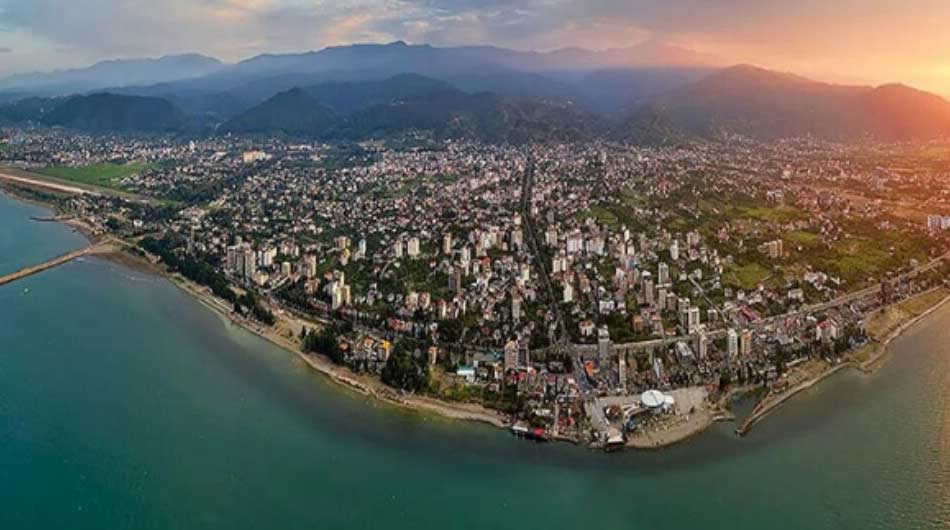
If Guarapari is striking, Ramsar is astonishing. This city of tens of thousands on Iran's northern coast holds the record for the highest natural background radiation anywhere on Earth. The cause is radium-226 carried to the surface by the region's hot springs, which deposit it through the soil and building stone. At the most extreme hotspots, dose rates reach an extraordinary ~260 mSv per year — against a world average of about 2.4 mSv. (Realistically the highest actual doses received by residents are estimated nearer 80 mSv/year, with many living around 10 mSv/year — still far above the 20 mSv/year limit set for radiation workers.)
People have lived in these houses, bathed in these springs, for many generations. And here is the consistent finding across study after study: cytogenetic surveys show no significant difference in chromosome damage, cancer, or accelerated ageing between Ramsar's high-background residents and people in normal areas. More provocatively still, several studies report an adaptive response — when the blood cells of long-term Ramsar residents are deliberately hit with a large radiation challenge in the lab, they show roughly 44–56% fewer chromosome abnormalities than cells from people raised on ordinary background. As if a lifetime of low-level exposure had trained their cellular repair systems.
This is not a tidy, closed case — the data are genuinely debated, and at least one study found higher baseline DNA damage in the high-background group, so honesty demands we not overstate it. But the central, repeated observation stands: one of the most radioactive inhabited places on Earth is a thriving, ordinary, populated city, and the catastrophe LNT might predict simply has not materialised.

Nowhere is the "radiation as medicine" idea older or more institutionalised than at Jáchymov — in German, Sankt Joachimsthal, "St. Joachim's Valley." The name itself is woven into history: the silver coins minted here in the sixteenth century, the Joachimsthaler, were shortened to thaler — the direct ancestor of the word dollar.
The town has held the status of a free mining town since 1520. Its mines yielded silver, then other metals, and from the mid-nineteenth century the prize became pitchblende (uraninite) — used first for uranium paints and glazes, then as the source of radium. It was from Jáchymov's pitchblende residues that Marie and Pierre Curie isolated radium and polonium in 1898 — making this valley, quite literally, the cradle of radioactivity science.
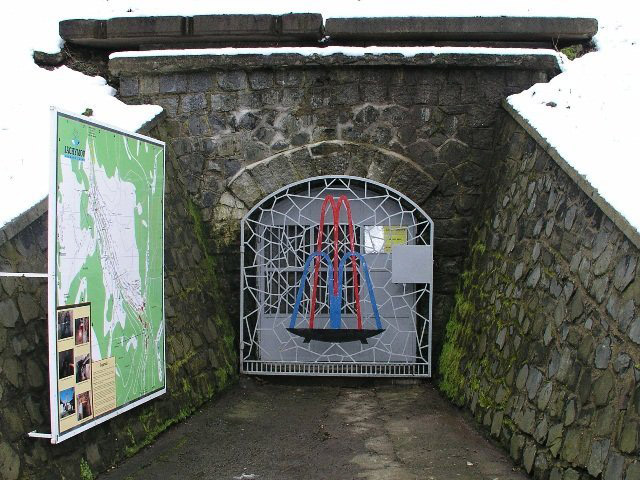

The town sits in the foothills of the Krušné Hory at 560–750 m altitude, in a region with one of the richest mineral occurrences on the planet — around 250 distinct mineral species, including the vysokýite and štěpite we met earlier. At its centre is the Svornost mine, founded with the town itself, which today serves not industry but health: from here radon-bearing water is collected and distributed to the spa's bath houses. The grand Radium Palace is its flagship.
Jáchymov is the only radon spa in the Czech Republic, and its waters carry the highest healing radon activity per litre of any spa in the world — its springs run at roughly 5–20 kBq of radon per litre. The therapy takes two classic forms: bathing in the radon water, and resting in warm thermal galleries where radon-rich air is breathed in (the approach also made famous at Bad Gastein in Austria, whose healing tunnels — the Heilstollen — have treated patients for over fifty years).
The principal indication is ankylosing spondylitis and related rheumatic and musculoskeletal conditions. The evidence is more substantial than sceptics expect: a body of randomised controlled trials and long-term patient registries — particularly the well-studied Austrian programmes — report meaningful reductions in pain, lower painkiller use, and improved quality of life, with benefits that can persist for up to about 40 weeks after a course of treatment. Researchers have measured changes in inflammatory and immune markers consistent with a real biological effect.
This is the apparent contradiction of the whole page: how can radon be the home collector's chief hazard and a prescribed medicine at once? The resolution is entirely in dose, duration, and where the gas is allowed to gather. The hazardous case is slow, continuous accumulation — a heavy gas sinking into a low, sealed, lived-in room and being breathed night after night for years. The spa is its deliberate inverse: a brief, measured, well-ventilated, medically supervised exposure that you then walk away from. Same gas; opposite dose; opposite outcome. The danger was never simply "radon" — it was radon left to pool, unventilated, exactly where someone sleeps.
None of this means radon is harmless. Radon is a recognised carcinogen — over a lifetime of domestic exposure it is the second leading cause of lung cancer after smoking — and trials that try to separate the radon contribution from the warmth and immersion of the bath alone have produced mixed results. The therapeutic case rests on the fact that spa exposure is short, controlled, and medically supervised, a very different thing from breathing radon in a poorly ventilated basement for decades. It remains, fairly, a debated therapy — but a century-old, regulated medical practice with genuine clinical data behind it, not folklore.
These are real, non-trivial doses — and they sit comfortably within the range that the populations of Guarapari and Ramsar absorb simply by living at home.

The dosage chart is worth a long look, because it makes the central point visually. At the top, a banana. Far, far below — separated by a factor of a million — the dose that kills within hours. Everything a careful mineral collector encounters lives near the top of that chart, in the realm of bananas, flights, and X-rays.
Radioactive crystals therefore sit at a genuine and fascinating intersection. On one side is real hazard, demanding real respect: vysokýite's triple threat, the radon that any uranium mineral exhales, the alpha-emitting dust you must never breathe or swallow. Handle minimally, store wisely, shield for display, keep them from children and sleeping spaces, and check your local law. None of that is optional.
On the other side is a truth that pop culture has buried: that low, brief exposures are not the monster we imagine. Whole cities are built on radioactive ground and thrive. People queue to lie on radioactive sand and rest in radioactive tunnels, and for some conditions they come away genuinely better. The most rigorous studies of the most exposed natural populations keep failing to find the harm the most cautious model predicts.
Respect the physics. Honour the stone.
Enjoy its beauty — at a distance, with awareness.
Doses cited are approximate and drawn from the published literature; figures from individual specimens reflect direct measurements with a SOEKS 112 detector. This article is for education and is not medical advice — radon therapy and any radiation exposure should be discussed with a qualified clinician.