
UO₂
The most powerful root anchor in the mineral kingdom
The name uraninite derives from the element uranium, which in turn was named after the planet Uranus — itself named after the ancient Greek deity of the sky, Οὐρανός (Ouranos). Uranium was discovered in 1789 by the German chemist Martin Heinrich Klaproth, who isolated it from a black mineral known since the Middle Ages as "pitchblende" (German: Pechblende, meaning pitch-black mineral). Klaproth named the new element in honor of Uranus, which had been discovered just eight years earlier in 1781. The formal mineral name "uraninite" was established later in the 19th century to distinguish the pure uranium dioxide phase from the more general term pitchblende, which refers to massive or botryoidal varieties.
Uraninite adopts the fluorite structure (CaF₂ structure type) — one of the most common and important structure types in oxide mineralogy. Uranium(IV) cations are in cubic eight-fold coordination by oxygen, while the oxygen atoms occupy tetrahedral voids. This highly symmetric structure belongs to the hexoctahedral class (point group m3̄m) — the highest symmetry class in crystallography, with 48 equivalent symmetry operations. The ideal formula is UO₂, but natural specimens invariably contain variable amounts of U⁶⁺ (from oxidation), thorium, rare earth elements, lead (from radioactive decay), and helium (from alpha decay trapped in the structure).
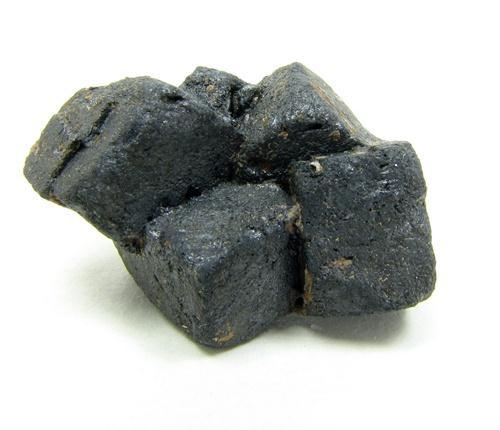
Uraninite is black to grey-black with a metallic to adamantine luster and is typically opaque. Well-crystallized specimens form cubic, octahedral, or cubo-octahedral crystals. Its very high specific gravity (10.6 g/cm³ for pure UO₂) makes even small specimens noticeably heavy in the hand.
Pitchblende (the massive variety of uraninite) has been mined in the Erzgebirge (Ore Mountains) of Bohemia since the Middle Ages, originally as a waste product from silver mines — its use was unknown and it was discarded. Martin Klaproth discovered uranium in it in 1789, but the true nature of uraninite as the world's primary uranium ore mineral was only appreciated in the late 19th century. Marie Curie used pitchblende from the Joachimstal mines of Bohemia (now Czech Republic) in her pioneering research on radioactivity (1898), from which she isolated both polonium and radium.
Significant occurrences of crystalline uraninite are found in granitic pegmatites worldwide — notably in Canada (Ontario, Manitoba), Norway, the Democratic Republic of Congo (Shinkolobwe), South Africa, and the Czech Republic. The mineral is the world's most important ore of uranium.
This crystal contains naturally radioactive elements and emits low-level radiation. Owning radioactive minerals may be restricted where you live — some countries regulate them strictly, with legal limits as low as 1 becquerel per gram. Check your local law before acquiring or shipping one.
All radiation safety comes down to three words: time, distance, and shielding. Handle a specimen only briefly, keep it at arm's length, and store it behind glass or lead. Enjoy it visually, or for energy work at a distance — never worn as jewellery, slept beside, or held in prolonged contact.
The chief practical risk is not the dose from the shelf but radon — a heavy radioactive gas that sinks and pools in low, unventilated spaces. Keep specimens well-ventilated, or sealed in a gas-tight container; with radon's 3.8-day half-life it never builds without limit and clears within weeks. Stored sensibly, the real dose is tiny — far below what people willingly absorb at a radon spa.
How dangerous are radioactive crystals really? Usually far less than people fear — and the science of low-dose radiation is genuinely surprising. Our full guide covers safe handling and storage, how to read a dose, the truth about radon, and the radioactive beaches and century-old healing spas where people seek radiation out on purpose.
Read the full guide →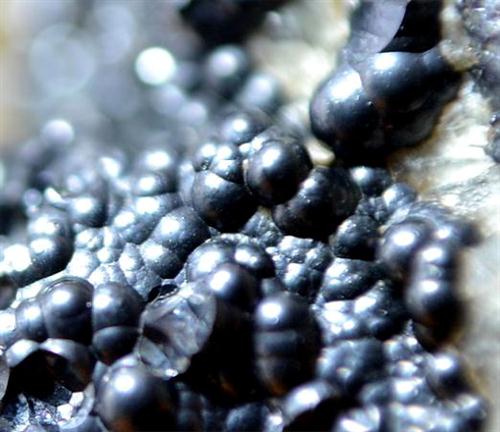
Uraninite adopts the fluorite structure type — point group m3̄m, the holohedric class of the cubic system. This is the maximum symmetry possible in any crystal, with 48 equivalent symmetry operations. The uranium cations sit at face-centered cubic positions coordinated by 8 oxygen atoms in a cubic arrangement; the oxygen atoms occupy all tetrahedral holes in the cubic close-packed cation sublattice. This same structure type is shared by CaF₂ (fluorite), CeO₂, ThO₂, and PuO₂ — the nuclear fuel oxides — making uraninite structurally identical to the fuels used in nuclear reactors.
Uraninite is a mixed-valence semiconductor — natural specimens contain both U⁴⁺ and U⁶⁺, and electron hopping between these two oxidation states makes the mineral electrically conductive. The U⁴⁺ ion (5f² electron configuration) is paramagnetic, giving uraninite a measurable magnetic susceptibility. The combination of semiconductor behavior, paramagnetism, and extreme density (10.6 g/cm³) makes uraninite physically and electronically unlike any other naturally occurring oxide mineral.
Over geological time, the intense radioactive decay within uraninite progressively destroys its own crystal structure. The alpha particles from decay displace atoms from their lattice positions, accumulating structural damage until the mineral becomes amorphous — a glass-like non-crystalline state called metamict. Completely metamict uraninite (pitchblende) has lost all crystallographic order while retaining its external cubic form. This unique self-destruction process is a property shared with thorite and other actinide minerals, and has no analogue in stable mineralogy.
"Love everyone, serve everyone, remember God, and tell the truth."— Neem Karoli Baba
One of the best grounding crystals and the single best muladhara (root chakra) opener on the planet. However it is also the most radio-active crystal on the planet. This little piece gives 83 μSv / hour at 1cm.
The Root AnchorWhere most high-frequency crystals work by drawing consciousness upward — opening higher chakras, expanding awareness into subtler dimensions — uraninite works in the opposite direction with equal force. It is the deepest anchor in the mineral kingdom. The root chakra governs survival, embodiment, the sense of being physically present and safe in a body on the earth. Uraninite activates this center not gently but completely — like a spike driven all the way to the center of the earth.
Distance WorkDue to the radioactivity, uraninite is best used at a distance. The energetic effects of the crystal can be felt without direct physical contact — place it at arm's length or further and allow its influence to work without the body being exposed to radiation. The energetic field extends well beyond the range at which the radiation poses any measurable risk, making distance work not only possible but the recommended approach for sustained practice.