

(UO2)2(SiO4)·2H2O
a radiant yellow vitality that feeds the will from a respectful distance
Soddyite was named in honour of Frederick Soddy (1877–1956), the English radiochemist and physicist who, along with Ernest Rutherford, demonstrated that radioactivity is caused by the transmutation of one element into another. Soddy is also credited with coining the word "isotope" in 1913 to describe atoms of the same element with different atomic masses — a discovery that transformed our understanding of matter and atomic structure. He was awarded the Nobel Prize in Chemistry in 1921.
The mineral was described as a valid species in 1922, shortly after Soddy's most celebrated contributions to science, making it a fitting tribute to the man who pioneered the study of radioactive decay — the very process responsible for soddyite's own radioactivity.
Soddyite belongs to the uranyl silicate group of minerals. Its structure is built around UO22+ uranyl ions — uranium atoms flanked by two tightly bonded oxygen atoms forming a characteristic linear unit — linked to isolated SiO4 tetrahedra with water molecules occupying interstitial positions. The result is a framework that crystallises in the orthorhombic system, typically producing short prismatic crystals, granular masses, or powdery crusts of canary yellow to amber yellow colour. The vivid yellow hue is a direct expression of the uranyl ion, which strongly absorbs blue wavelengths and often fluoresces a weak greenish-yellow under ultraviolet light.
Soddyite forms as a secondary alteration product in oxidised zones of uranium ore bodies, typically as a weathering transformation of primary uraninite (UO2) in the presence of silica-bearing groundwaters.
Soddyite was first described and validated as a mineral species in 1922, with its type locality at the Shinkolobwe uranium mine in Haut-Katanga Province, Democratic Republic of the Congo (then the Belgian Congo). Shinkolobwe is one of the most remarkable uranium deposits ever found — extraordinarily rich in secondary uranium minerals, it yielded specimens of soddyite alongside curite, uraninite, and other rare uranium phases. The mine also supplied uranium ore that would later play a decisive role in the Manhattan Project.
Soddyite forms wherever primary uranium minerals such as uraninite are subjected to oxidising, silica-bearing groundwaters over long geological timescales. Beyond the Congo, it has been documented in uranium deposits across Africa, Europe, and North America, often occurring as crusts or granular coatings mixed with other secondary uranium minerals such as curite, kasolite, and phosphuranylite.
This crystal contains naturally radioactive elements and emits low-level radiation. Owning radioactive minerals may be restricted where you live — some countries regulate them strictly, with legal limits as low as 1 becquerel per gram. Check your local law before acquiring or shipping one.
All radiation safety comes down to three words: time, distance, and shielding. Handle a specimen only briefly, keep it at arm's length, and store it behind glass or lead. Enjoy it visually, or for energy work at a distance — never worn as jewellery, slept beside, or held in prolonged contact.
The chief practical risk is not the dose from the shelf but radon — a heavy radioactive gas that sinks and pools in low, unventilated spaces. Keep specimens well-ventilated, or sealed in a gas-tight container; with radon's 3.8-day half-life it never builds without limit and clears within weeks. Stored sensibly, the real dose is tiny — far below what people willingly absorb at a radon spa.
How dangerous are radioactive crystals really? Usually far less than people fear — and the science of low-dose radiation is genuinely surprising. Our full guide covers safe handling and storage, how to read a dose, the truth about radon, and the radioactive beaches and century-old healing spas where people seek radiation out on purpose.
Read the full guide →
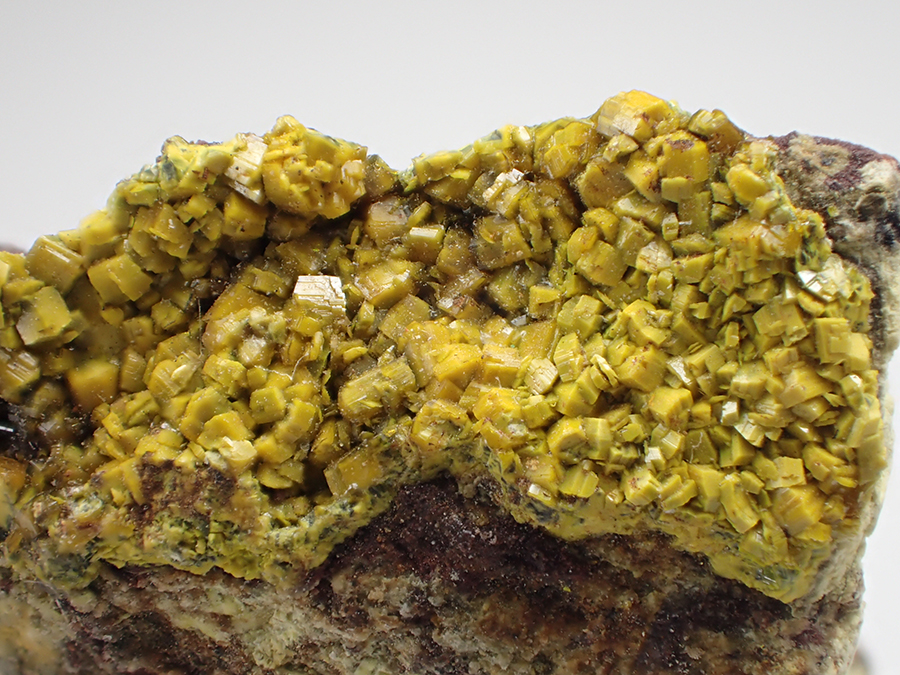
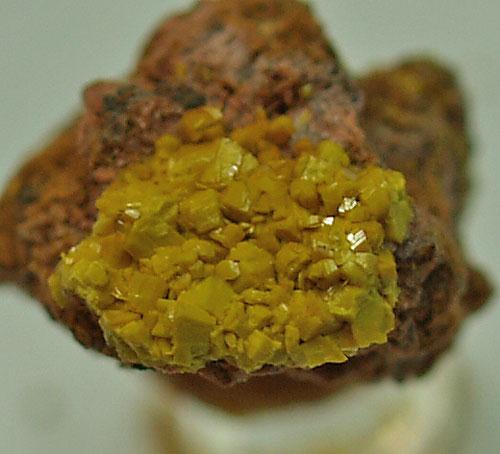
The canary-yellow to amber-yellow colour is an intrinsic chemical property of the uranyl (UO22+) structural unit — not a surface coating or impurity. Many soddyite specimens also show a faint greenish-yellow fluorescence under short-wave ultraviolet light, a behaviour shared across the broader uranyl mineral family.
Soddyite is inherently radioactive due to its uranium content. This gives it a measurably elevated radiation field compared to non-uranium minerals — detectable with a Geiger counter even at short distances. The alpha-particle decay of uranium within the crystal structure also causes slow, cumulative self-irradiation damage over geological time.
Unlike most crystals that form from primary magmatic or hydrothermal processes, soddyite is a secondary mineral — born from the chemical weathering and oxidation of primary uraninite in the presence of silica-rich groundwater. It is, in a sense, the transformed afterlife of ancient uranium ore, bearing the record of slow, deep geochemical change over millions of years.
"The Guru is not a person of flesh and blood; the Guru is the awareness-wisdom that dwells in the center of your heart. To find the Guru, you must first find yourself."— Khenchen Tsewang Rigdzin
There is a particular kind of brightness that does not ask you to come closer. It simply radiates, steady and unhurried, from wherever it sits — and you feel it from across the room, through glass, through distance, through the gap between seeing and touching. Soddyite carries that quality. Its yellow is not soft or ambient; it is concentrated, solar, like the midpoint of a flame, like the first warmth of morning that wakes the abdomen before the mind has fully arrived. Something in the gut begins to quicken.
That centre — the one where the breath collects, where decisions form before they become words, where hunger lives and where will gathers itself to act — this is the territory soddyite addresses. It does not coax or suggest. It feeds. When that fire in the belly has grown dim through depletion, through years of giving without replenishing, through the slow fatigue of a life lived outward, this stone offers a direct infusion of vitality into the very place that runs the body. Not courage as an idea, but the physical sense that there is something there again — fuel, presence, the capacity to stand in the morning and mean it.
The outward radiance of soddyite mirrors its inner action. What begins as a concentrated warmth at the centre does not stay contained. It moves outward in expanding rings, pressing gently into the surrounding fields of the body — the emotional layers, the mental ones, the deeper strata that hold the shape of who we believe we are. In this way it can loosen long-standing contractions: the held posture of someone who has been bracing against life, the subtle armour that keeps vitality managed rather than lived. It does not do this dramatically. The expansion is quiet, lateral, like light spreading at dusk — so gradual that by the time you notice it, the room has changed.
"The body is a treacherous friend. Give it its due; no more."— Shri Yukteswar
Because of what it carries — the same force that moves through stars, through deep geological time, through the slow transformation of one element into another — soddyite asks to be met from a considered distance. The wise approach is not to hold it, not to wear it, but to let the gaze do the work. Seen, contemplated, held lightly in awareness, it accomplishes what it accomplishes. Proximity is not required for transmission. The light reaches.
Worked with in this way — through image, through attention, through the quiet fact of knowing it exists — soddyite teaches something about the nature of nourishment itself: that the deepest replenishment sometimes comes not from what we grip but from what we simply allow to shine nearby. The will does not need to strain. It needs to be fed. This stone, bright as the centre of a living sun, does the feeding well.