
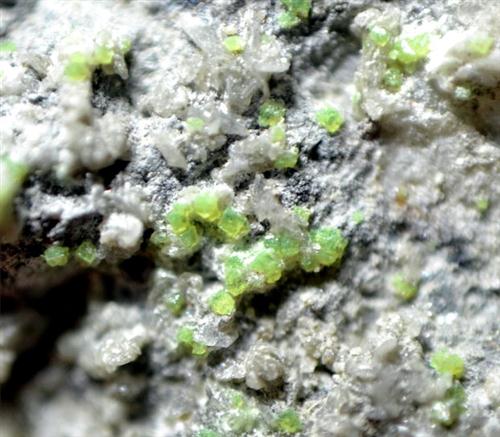
NaCa3(UO2)(CO3)3(SO4)F · 10H2O
Aliveness rising and radiating through the open throat
Named in honour of Josef von Schrockinger-Neudenberg (1820–1895), an Austrian mining official and mineralogist who served as director of the Imperial-Royal Court Mining Office in Vienna. The standard mineral suffix -ite was appended to his family name. Schrockinger was a significant figure in the documentation of uranium mineralogy during the nineteenth century, and the naming commemorates his contributions to the study of secondary uranium minerals from the Bohemian mining districts.
The formula combines four distinct anionic groups in a single crystal: uranyl (UO₂²⁺), carbonate (CO₃²⁻), sulfate (SO₄²⁻), and fluoride (F⁻) — an exceptional degree of chemical complexity that is rare even among secondary uranium minerals. Calcium and sodium occupy large coordination polyhedra between these groups, while ten structural water molecules fill the remaining framework positions, making schrockingerite one of the more hydrous members of the uranyl carbonate family.
Schrockingerite was first described from the historic Jáchymov (Joachimsthal) mining district in Bohemia, Czech Republic — one of the world's most historically important uranium mining localities and the source of much early uranium and radium mineralogy. The Jáchymov district produced many of the uranium mineral species that Marie Curie worked with in her isolation of radium and polonium.
Additional occurrences have been documented in the arid American Southwest, notably near Delta, Millard County, Utah, and in the San Rafael Swell, Utah, where it forms as a surface efflorescence in oxidised zones of uranium-vanadium deposits. Outside these localities it remains very rare, always occurring as a secondary mineral formed by the surface oxidation of primary uranium ores.
This crystal contains naturally radioactive elements and emits low-level radiation. Owning radioactive minerals may be restricted where you live — some countries regulate them strictly, with legal limits as low as 1 becquerel per gram. Check your local law before acquiring or shipping one.
All radiation safety comes down to three words: time, distance, and shielding. Handle a specimen only briefly, keep it at arm's length, and store it behind glass or lead. Enjoy it visually, or for energy work at a distance — never worn as jewellery, slept beside, or held in prolonged contact.
The chief practical risk is not the dose from the shelf but radon — a heavy radioactive gas that sinks and pools in low, unventilated spaces. Keep specimens well-ventilated, or sealed in a gas-tight container; with radon's 3.8-day half-life it never builds without limit and clears within weeks. Stored sensibly, the real dose is tiny — far below what people willingly absorb at a radon spa.
How dangerous are radioactive crystals really? Usually far less than people fear — and the science of low-dose radiation is genuinely surprising. Our full guide covers safe handling and storage, how to read a dose, the truth about radon, and the radioactive beaches and century-old healing spas where people seek radiation out on purpose.
Read the full guide →It is extraordinarily rare for a single mineral species to incorporate four distinct anionic groups — uranyl, carbonate, sulfate, and fluoride — simultaneously in its crystal lattice. Most minerals are defined by one primary anion class. Schrockingerite's unusual multi-anion chemistry reflects highly specific and localised oxidation conditions and places it in a small category of mineralogical curiosities that challenge the usual rules of crystal chemistry.
The uranyl ion (UO₂²⁺) is one of the most efficient natural fluorescent centres known in mineralogy, and schrockingerite's crystal structure positions it in a way that produces exceptionally vivid yellow-green emission under UV light. This fluorescence is active under both shortwave and longwave UV, which is less common than single-wavelength response, and makes schrockingerite specimens dramatically visible under ultraviolet inspection even in very small amounts.
"If you keep a light before a thousand people, it reaches all without making any distinction."— Bhagawan Nityananda
Schrockingerite is a brief, bright thing. It opens at the throat, and what it brings is aliveness — the drained, foggy, going-through-the-motions feeling lifting off, the channel of expression clearing, a current of plain energy moving where there had been a kind of flatness. It does not dig deep or stay long; it is a clean, short opening, more a window thrown wide than a fire lit.
"There is neither past nor future; there is only the present."— Ramana Maharshi
Because it works in a short window, it gives the most inside a deliberate sitting — meditation, inquiry, a quiet half-hour set aside — where its quick lift can be met and used rather than spent unnoticed across a busy day. And within that window it does not stay contained: the brightness radiates outward, reaching past you the way a single lamp fills a whole room without choosing whom to light.
Because the mineral carries a faint radioactivity, it is kept at a little distance, or worked with through its image and its frequency rather than against the skin; the lift is reported to come through either way.