
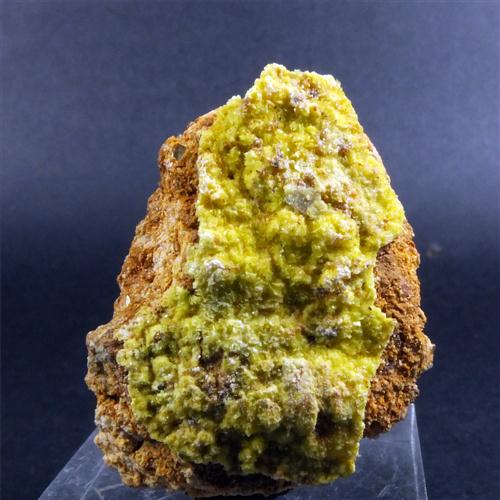
Mg(UO2)2(PO4)2·10H2O
A small sun stored in stone, rekindling the fire of the will.
Saleeite was named in 1932 by the Belgian geologist Johannes Thoreau in honour of Achille Salée (1883–1932), professor of geology at the University of Louvain. As with most minerals, the personal name takes the customary -ite ending.
Saleeite is built from flat sheets of uranyl-phosphate squares, with magnesium ions and ten water molecules cushioned between the layers. This mica-like layering gives it one perfect cleavage, so it peels into thin, flexible-looking flakes — and the loosely held interlayer water is exactly why it dries out and alters so readily.
Saleeite was first described in 1932 from the Shinkolobwe uranium deposit in Katanga, in the present-day Democratic Republic of the Congo — one of the richest uranium sources of the twentieth century. It is a secondary mineral that crystallises wherever uranium ore weathers in the presence of magnesium and phosphate, forming yellow crusts in the oxidised zones of uranium veins and granite pegmatites in many countries.
This crystal contains naturally radioactive elements and emits low-level radiation. Owning radioactive minerals may be restricted where you live — some countries regulate them strictly, with legal limits as low as 1 becquerel per gram. Check your local law before acquiring or shipping one.
All radiation safety comes down to three words: time, distance, and shielding. Handle a specimen only briefly, keep it at arm's length, and store it behind glass or lead. Enjoy it visually, or for energy work at a distance — never worn as jewellery, slept beside, or held in prolonged contact.
The chief practical risk is not the dose from the shelf but radon — a heavy radioactive gas that sinks and pools in low, unventilated spaces. Keep specimens well-ventilated, or sealed in a gas-tight container; with radon's 3.8-day half-life it never builds without limit and clears within weeks. Stored sensibly, the real dose is tiny — far below what people willingly absorb at a radon spa.
How dangerous are radioactive crystals really? Usually far less than people fear — and the science of low-dose radiation is genuinely surprising. Our full guide covers safe handling and storage, how to read a dose, the truth about radon, and the radioactive beaches and century-old healing spas where people seek radiation out on purpose.
Read the full guide →As a uranyl mica it holds ten loosely-bound water molecules; in dry air or near heat it dehydrates to meta-saleeite, dulling and flaking along its single perfect cleavage. Keep it at stable, moderate humidity, out of direct sun and away from heat sources.
Under ultraviolet light it glows an intense yellow-green; the light comes from the uranyl ion absorbing UV and re-emitting it as visible green — the same chemistry that makes antique uranium glass shine.
One perfect, mica-like cleavage lets it split into paper-thin yellow plates — a habit shared across the uranyl micas of the autunite group.
"The Guru is not a person of flesh and blood; the Guru is the awareness-wisdom that dwells in the center of your heart. To find the Guru, you must first find yourself."— Khenchen Tsewang Rigdzin
Saleeite sits at the solar plexus — the body's furnace of will, drive, and personal power. Its work is vitality: it feeds life-force into that centre and burns off the fog, the lethargy, the sense of being quietly drained. Where the will has gone slack and grey, it rekindles the small inner sun behind the navel and the simple capacity to act returns.
The Rekindled SunIt does not reach the deepest, subtlest roots of a problem; it works the nearer layers — the everyday tiredness, the loss of nerve, the self-doubt that sits just under the surface — and clears them with a steady, moderate strength that warms rather than forces. Used over a span of hours it does more than lift the mood: it finds and dissolves the cause of the drain, so the energy it returns tends to stay.
"Man is a miniature sun. Within the human body lies the same energy that fuels the stars; the goal of Yoga is to ignite that inner light until the body itself becomes luminous."— Vishuddhananda Paramahansa
The rekindled warmth does not stay penned at the navel. It radiates outward through the surrounding energy bodies, so you feel larger, more present, more able to take up your own space in a room. Because the stone is radioactive, you work with it at a little distance — set near you on the desk or altar, or use its image — and the warming reach still arrives at the centre without any need to hold it against the skin.