
Pb2(CO3)Cl2
The most earthed of stones — both feet on solid ground
Phosgenite takes its name from phosgene (carbon oxychloride, COCl2) — itself named from the Greek phos, "light," and -genes, "born," because the gas was first produced by the action of sunlight on carbon monoxide and chlorine. The German mineralogist August Breithaupt coined the name in 1820, not because the stone is in any way poisonous, but simply because it is built from the very same three elements: carbon, oxygen and chlorine.
The mineral was first recognised at Cromford, near Matlock in Derbyshire, England, and for many years carried the rival name cromfordite after that locality before "phosgenite" became the accepted term.
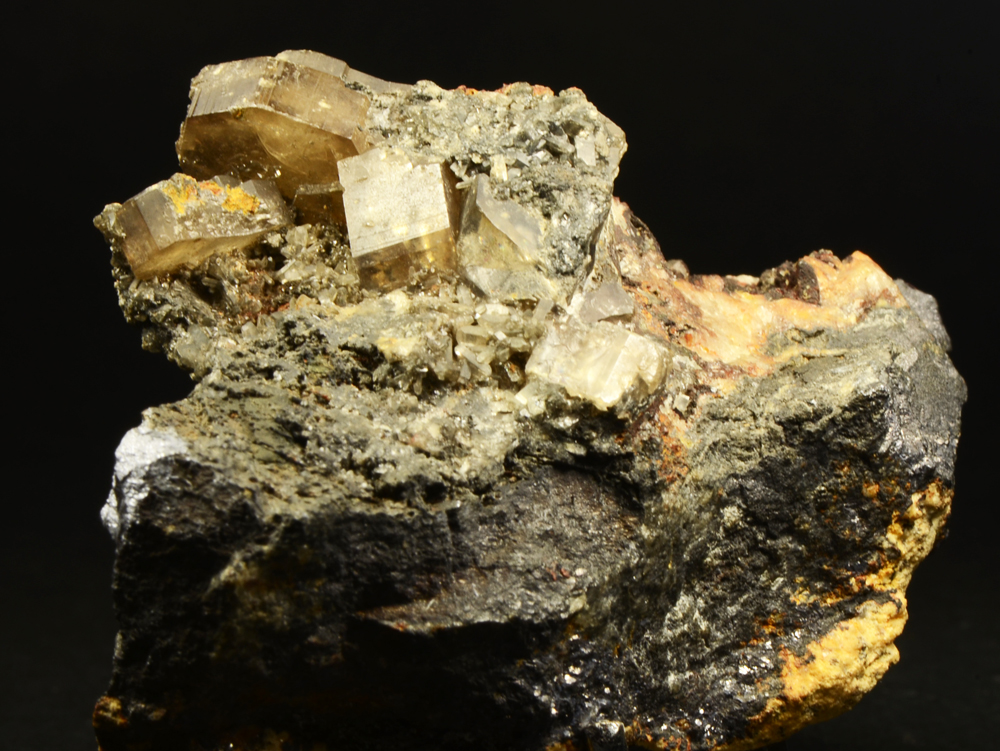
Phosgenite is a lead carbonate-chloride, Pb2(CO3)Cl2, crystallising in the tetragonal system. Its structure threads flat carbonate groups and chloride ions among heavy lead atoms, which gives the mineral a very high density, a high refractive index, and a brilliant adamantine-to-resinous lustre. It is soft (Mohs 2–3) and even sectile — it can be sliced with a knife — and ranges from colourless and white through honey-yellow to smoky brown.
Like cerussite and anglesite, phosgenite is a secondary mineral: it forms in the oxidised zone of lead deposits, in cavities within altered galena (lead sulfide), and the three lead minerals often grow side by side on the same specimen. As a lead mineral it should be handled cleanly, not ingested, and hands washed after handling.
Phosgenite is an uncommon secondary lead mineral, appearing in small quantities wherever lead ores have weathered near the surface. Though first recognised at Cromford in Derbyshire, its most celebrated crystals come from elsewhere.
The finest specimens by far are the large, gemmy, honey-coloured prisms from the Monteponi and Montevecchio mines in Sardinia, long regarded as the world's best. Fine crystals also come from Tsumeb in Namibia, the Tiger and Mammoth–St Anthony mines of Arizona, Touissit in Morocco, and the old lead workings around Matlock in Derbyshire. Well-formed phosgenite is prized by collectors, and rare clean material is occasionally faceted as a soft, brilliant collector gemstone.
Phosgenite is a lead compound. Lead is a cumulative neurotoxin — absorbed through ingestion or inhalation of dust, not through normal skin contact with intact specimens. The risk during ordinary handling is low, but basic precautions apply.
Wash hands thoroughly after handling. Do not grind, sand, or polish phosgenite dry. Do not make crystal water or elixirs from this mineral — it is also slightly water-soluble (see below). Keep it away from children and pets, and do not wear it directly against the skin for long periods.
Phosgenite is slightly soluble and will very slowly dissolve in water, so it should never be wet-cleaned, soaked, or used to make crystal elixirs. Dust it dry with a soft brush, keep it out of damp rooms and bathrooms, and avoid prolonged high humidity, which can etch and dull its brilliant surfaces over time.
Lead gives phosgenite an unusually high density and refractive index, so even colourless or honey-coloured crystals blaze with a bright, almost diamond-like adamantine fire — remarkable for so soft a mineral.
As a tetragonal crystal phosgenite is strongly birefringent, splitting light into two rays so that edges seem to double, and it commonly fluoresces a soft yellow under ultraviolet light — a quietly luminous stone.
At Mohs 2–3 it is soft enough to mark with a fingernail and sectile enough to be sliced cleanly with a knife — a delicacy that, with its slight solubility, asks for gentle, dry handling.
"Spiritual practice is not about changing what is outside of you; it is about recognizing the unconditioned nature of what is inside. If you do not recognize your own mind, your rituals are like painting on water."— Khenchen Tsewang Rigdzin
Phosgenite is the most grounding of the heavy lead stones — the sober, steadying cousins of cerussite and anglesite. Where those two steady the will and settle the mind, phosgenite takes that same calm, truthful energy and pulls it further down, toward the root and the earth, until the whole system feels anchored. Its frequency rests at the solar plexus — the body's fire-centre of will and personal power — but its real work is to carry that centre's steadiness downward and earth it, so that strength is felt not as restlessness but as weight, as the simple fact of standing firmly on the ground.
This is the stone for facing reality with both feet on the earth. It does not lift you into bright, airy states; it does the opposite, drawing you down into the solid, the actual, the here. In that downward settling the nervous edge of fear loses its grip — there is suddenly ground beneath you, and from ground, courage becomes simple and undramatic. What dissolves is the anxious confusion that keeps a person hovering above their own life, unable to land.
"The purpose of Dharma is to pacify and eliminate the delusional ignorance that causes suffering."— Rangjung Rigpe Dorje
There is also a quiet balancing in it, a meeting of opposites. The bright, outward, solar reach of the will and the cool, inward, lunar pull toward rest are drawn into a single steady line, so that one is neither scattered upward nor sunk in heaviness, but simply, plainly here. Phosgenite asks nothing dramatic. It returns you to the bare ground of being — standing on something solid, able to meet what is true without flinching.
Phosgenite belongs to a small family of heavy, powerful, grounding lead minerals that often grow on the same specimens and sit together in the ranking — each working in its own way:
✦ Anglesite — the highest frequency of the heavy stones; steadies the will at the solar plexus.
✦ Cerussite — calms and settles, opening the third eye.
✦ Sphalerite — love and joy at the heart.
✦ Smithsonite — among the most beautiful; gently expanding.