
(Ce,La,Nd,Th)PO4
A solitary stone, the steady ground beneath the search
Monazite takes its name from the Greek monazein, “to be solitary,” a reference to the rare, isolated crystals in which it was first found. The species is usually specified by its dominant rare earth — most commonly monazite-(Ce), in which cerium prevails.
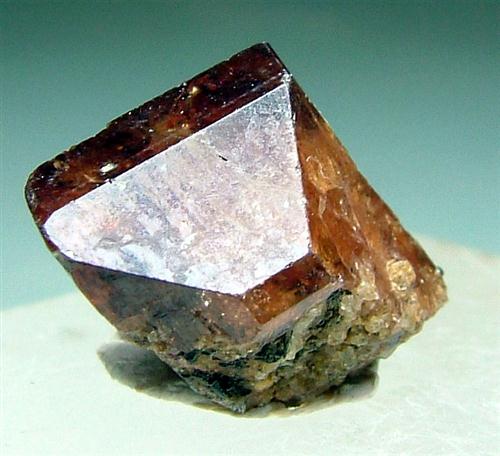
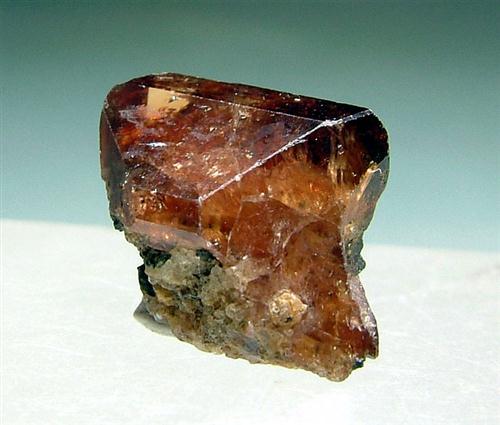
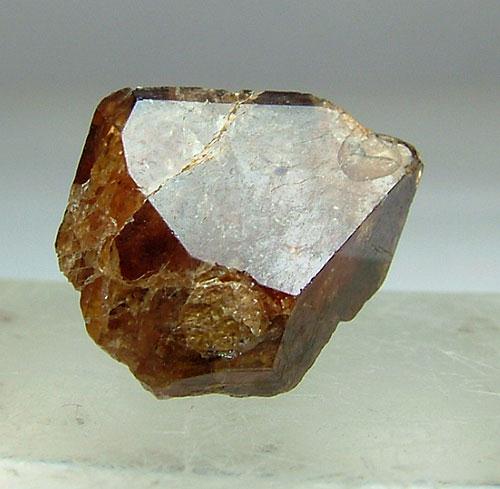
Monazite is a rare-earth phosphate, (Ce,La,Nd,Th)PO4, crystallising in the monoclinic system. It is reddish-brown to yellow-brown, sometimes nearly resinous, of moderate hardness (about 5 to 5.5), and dense. Its structure readily takes thorium — and often a little uranium — in place of the rare earths, which is why the mineral is naturally radioactive.
It is one of the world's chief ores of the rare-earth elements and of thorium, and being hard and chemically tough, it survives weathering to concentrate in placer “heavy-mineral” sands.
Monazite was described in the early nineteenth century from the Ilmen Mountains of Russia, by the mineralogist August Breithaupt. It is a widespread accessory mineral of granites, pegmatites and gneisses.
Because it is hard, heavy and durable, monazite weathers free of its parent rock and gathers in river and beach sands, where it is mined as a major source of rare earths and thorium.
This crystal contains naturally radioactive elements and emits low-level radiation. Owning radioactive minerals may be restricted where you live — some countries regulate them strictly, with legal limits as low as 1 becquerel per gram. Check your local law before acquiring or shipping one.
All radiation safety comes down to three words: time, distance, and shielding. Handle a specimen only briefly, keep it at arm's length, and store it behind glass or lead. Enjoy it visually, or for energy work at a distance — never worn as jewellery, slept beside, or held in prolonged contact.
The chief practical risk is not the dose from the shelf but radon — a heavy radioactive gas that sinks and pools in low, unventilated spaces. Keep specimens well-ventilated, or sealed in a gas-tight container; with radon's 3.8-day half-life it never builds without limit and clears within weeks. Stored sensibly, the real dose is tiny — far below what people willingly absorb at a radon spa.
How dangerous are radioactive crystals really? Usually far less than people fear — and the science of low-dose radiation is genuinely surprising. Our full guide covers safe handling and storage, how to read a dose, the truth about radon, and the radioactive beaches and century-old healing spas where people seek radiation out on purpose.
Read the full guide →A reddish-brown rare-earth phosphate that is one of Earth's chief sources of cerium, lanthanum and their kin.
Its thorium and uranium make it naturally radioactive — and turn it into one of geology's most trusted minerals for dating rocks.
Hard and dense, it outlasts the rocks that bore it, gathering in placer sands as a durable grain of the deep crust.
"To be relaxed and let go in the moment of recognizing — that is the most important thing."— Tulku Urgyen Rinpoche
Monazite works at the solar plexus — the fire-centre of will and the body's reservoir of stored energy, kept there like a battery. Its frequency is modest and works the nearer layers, but its transmission carries good strength and stays a fair while. This is the ground of its blurb: a stable base for spiritual exploration and grounding — fitting for a mineral so hard and dense that it outlasts the very rock it grew in, settling and enduring where lighter things wash away.
It is a Kundalini stone, and the two work together: kundalini is the awakened energy that rises through the spine and burns away karma, stress and blockage, but it rises safely only when there is a firm foundation beneath it. Monazite gives that foundation, feeding the fire at the solar plexus while holding the centre steady, so the exploration has a stable place to stand. Because it also carries Love, the rising energy is drawn into the heart and softened, and beneath it waits Joy, the unforced gladness that surfaces once the centre is fed and grounded.
"If you meditate for one hour daily, your mind will come under control."— Shivabalayogi
That is its quiet counsel: a stable base is built the way the mineral itself was — slowly, steadily, by staying put. Exploration of the heights is safest when something deep and enduring holds you to the ground.