
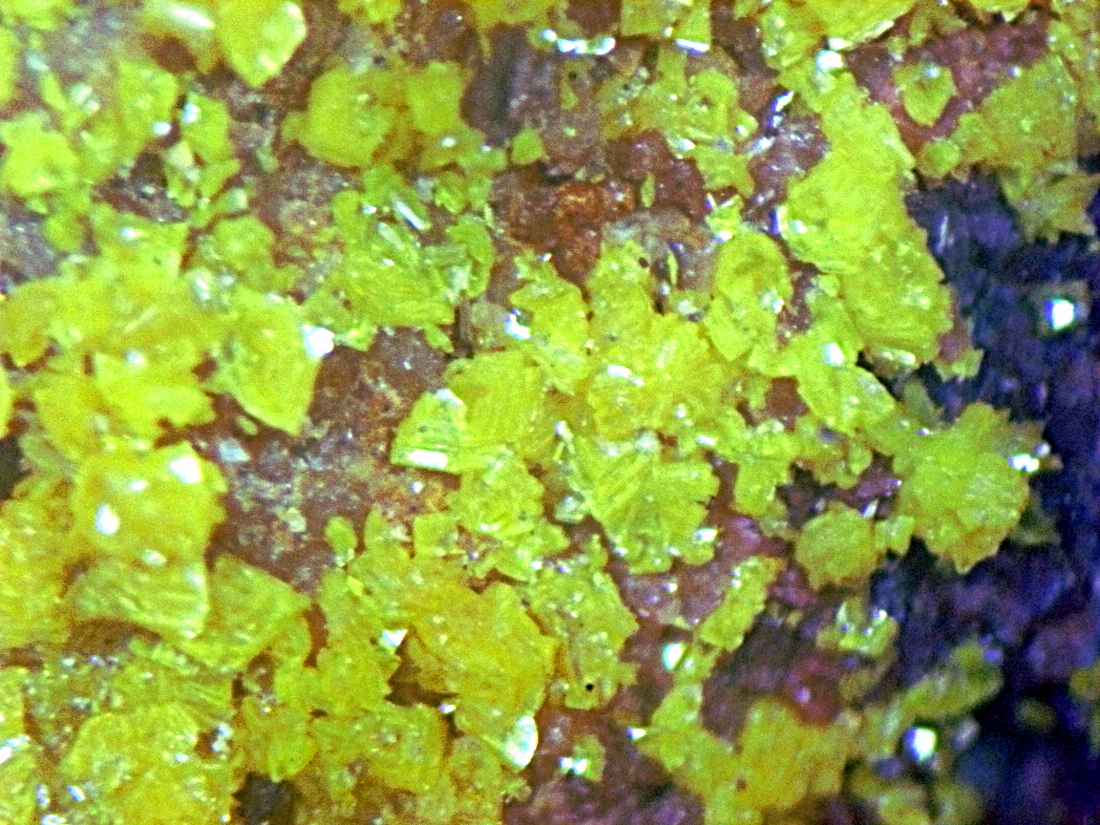
(Ba,Pb)(UO2)2(VO4)2·5H2O
The heart's own fire, raised and refined
Francevillite is named for its place of origin: Franceville, in the Haut-Ogooué province of south-eastern Gabon, near the Mounana uranium deposit where the mineral was first identified. The locality itself recalls the era of French colonial mapping of equatorial Africa, and the mineral has carried the town's name since its description in the late 1950s.
It belongs to the small francevillite group of layered uranyl vanadates, and forms a chemical series with curienite, its lead-dominant counterpart — the two differing chiefly in whether barium or lead occupies the large interlayer site.
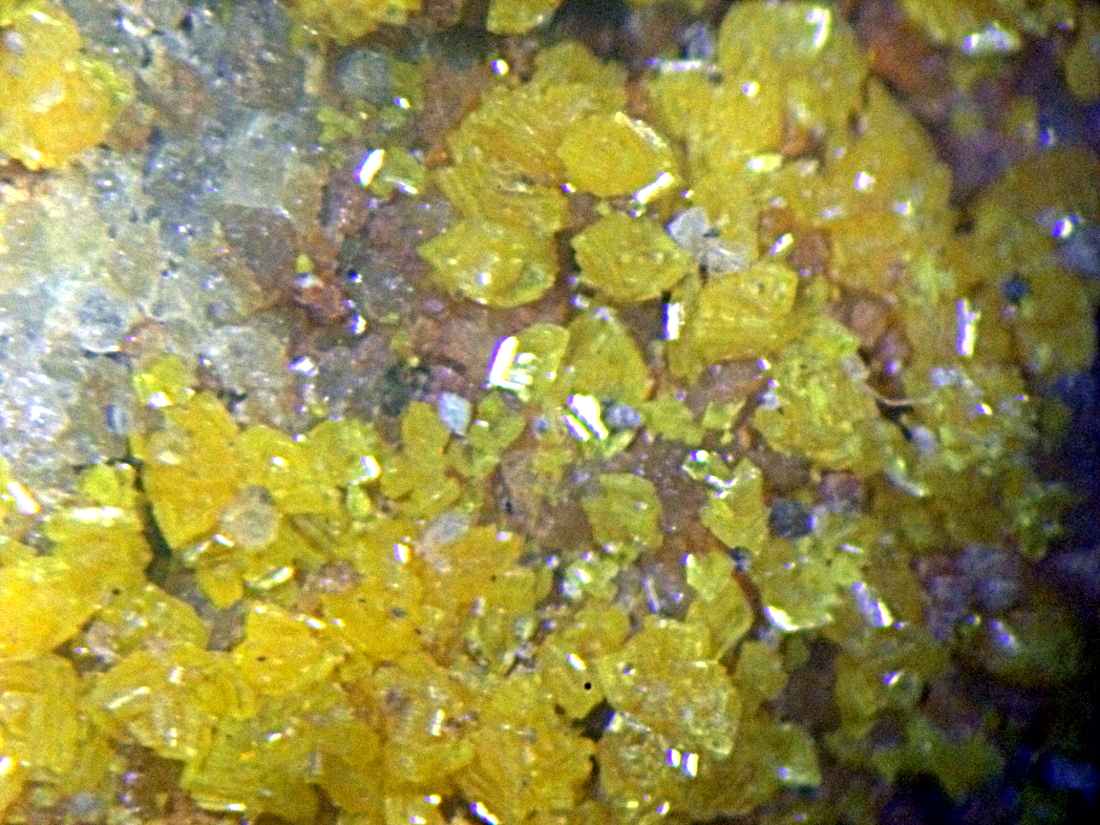
Francevillite is a hydrated barium-uranyl vanadate, (Ba,Pb)(UO2)2(VO4)2·5H2O, crystallising in the orthorhombic system. Its structure is built from sheets of uranyl and vanadate polyhedra, between which barium ions and water molecules are housed — a layered architecture typical of the uranium-vanadium secondary minerals. It is soft (Mohs 2–3) and forms bright yellow, orange-yellow to reddish micro-crystalline crusts and tabular crystals.
It is a secondary mineral, formed where uranium- and vanadium-bearing primary ores are weathered and oxidised near the surface. Francevillite is strongly radioactive and should be handled with care, stored away from living and sleeping spaces, sealed against dust, and never ground or ingested.
Francevillite was described in 1957 from the Mounana mine near Franceville, Gabon, one of the great uranium districts of central Africa. It occurs in the oxidised zone of the sandstone-hosted uranium ores of the Franceville basin.
That basin holds a geological marvel: at nearby Oklo, around two billion years ago, natural concentrations of uranium sustained self-running nuclear fission — the only known natural nuclear reactors on Earth. Francevillite is one of the colourful secondary minerals that crystallised as these ancient uranium bodies later weathered. Beyond Gabon it is known only from a handful of uranium localities worldwide, which keeps it firmly in the realm of the rare and collectable.
This crystal contains naturally radioactive elements and emits low-level radiation. Owning radioactive minerals may be restricted where you live — some countries regulate them strictly, with legal limits as low as 1 becquerel per gram. Check your local law before acquiring or shipping one.
All radiation safety comes down to three words: time, distance, and shielding. Handle a specimen only briefly, keep it at arm's length, and store it behind glass or lead. Enjoy it visually, or for energy work at a distance — never worn as jewellery, slept beside, or held in prolonged contact.
The chief practical risk is not the dose from the shelf but radon — a heavy radioactive gas that sinks and pools in low, unventilated spaces. Keep specimens well-ventilated, or sealed in a gas-tight container; with radon's 3.8-day half-life it never builds without limit and clears within weeks. Stored sensibly, the real dose is tiny — far below what people willingly absorb at a radon spa.
How dangerous are radioactive crystals really? Usually far less than people fear — and the science of low-dose radiation is genuinely surprising. Our full guide covers safe handling and storage, how to read a dose, the truth about radon, and the radioactive beaches and century-old healing spas where people seek radiation out on purpose.
Read the full guide →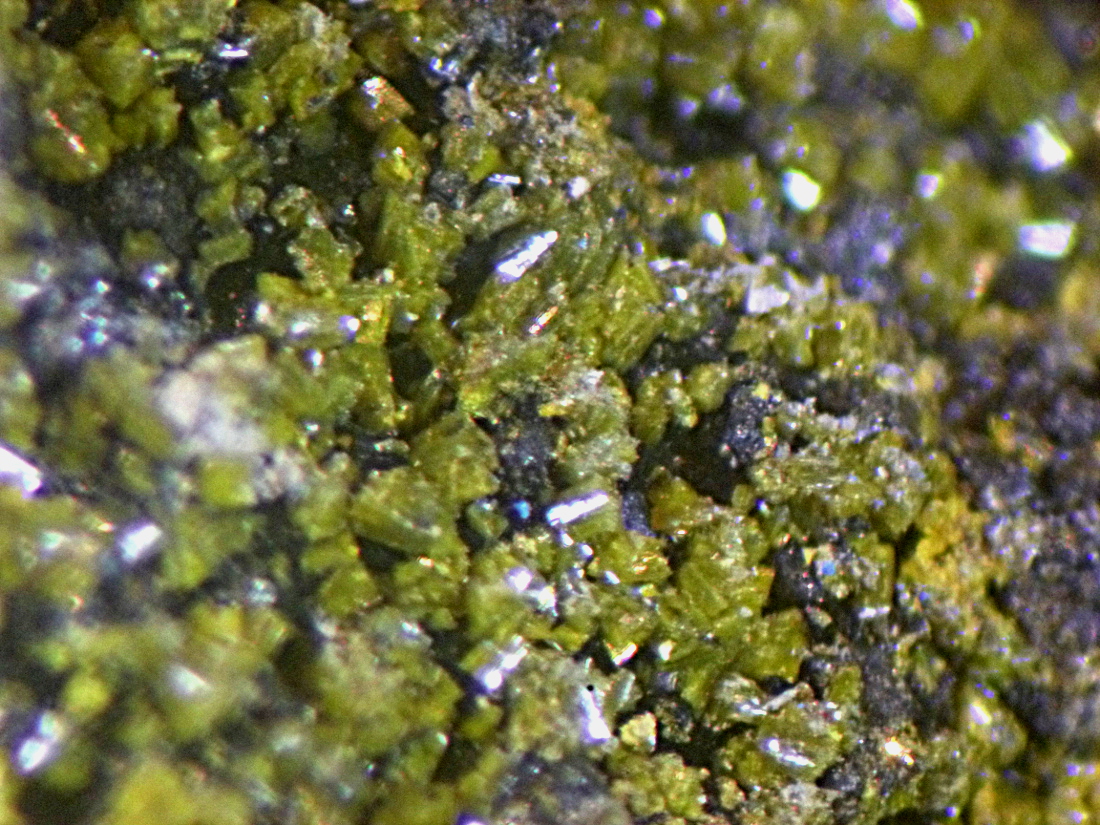
Francevillite carries uranium in its very formula, making it genuinely radioactive. That same uranyl chemistry gives it both its vivid colour and an unusually dense, insistent energetic signature — a stone to respect and to store with care.
Its bright yellow-to-reddish hue is the uranyl ion at work, the same ion that lights up uranium glass. The colour is a direct visual fingerprint of the radioactive element at the heart of the crystal.
Known from only a few uranium localities and tied to one of the most extraordinary geological sites on Earth, francevillite is a true rarity — the kind of stone whose scarcity itself raises a sense of abundance and having in the one who finds it.
"The essence of warriorship, or the essence of human bravery, is refusing to give up on anyone or anything."— Chogyam Trungpa Rinpoche
Francevillite is a heart-frequency stone with an unusually strong charge. Its energy centres in the heart — the connecting chamber where the lower and upper chakras meet, and where the great knot of stored emotion, the Vishnu Granthi, blocks the rising current. As a Life stone at that centre it floods the heart with vitality, clearing the drained, foggy heaviness that gathers there and feeding the channel so the energy can move.
What makes it remarkable is its Kundalini nature. The descriptions of the rarest uranium-bearing crystals speak of a stone that does not nudge but ignites — it blows the whole energetic system open, raising the frequency at the heart until the stored emotional density there begins to loosen and burn. The kundalini works indiscriminately, cleansing whatever it meets as it rises; francevillite lends it heat. Because of that intensity it is a stone to meet with respect, used in measure, and — being radioactive — kept safely apart from the body and the sleeping place.
It is also a rare stone, and rarity here is part of its medicine: the perseverance it takes to find and hold such a thing mirrors the perseverance the heart needs to refuse to give up on its own opening.
"Man is a miniature sun. Within the human body lies the same energy that fuels the stars; the goal of Yoga is to ignite that inner light until the body itself becomes luminous."— Vishuddhananda Paramahansa