
Apatite — Ca5(PO4)3(F,OH,Cl) — is one of mineralogy's classic "geochemical sponges." Its lattice is unusually tolerant of foreign ions, which is exactly why geochronologists lean on it for U–Pb, fission-track and (U–Th)/He dating — and why even clean, gem-grade crystals carry a faint radioactive payload.
Most "slightly hot" gem apatite owes its activity to the first; the second adds localized hotspots in some specimens.
Apatite is hexagonal (space group P63/m) with two distinct Ca positions — a 9-coordinated columnar site, and a 7-coordinated site that lines wide channels running down the c-axis (those channels capped by the F/Cl/OH anions). The channel site is large, irregular and chemically forgiving — the main doorway for oversized trivalent and tetravalent cations — and the open channels plus the flexible PO4 framework give the structure room to relax around mis-sized, mis-charged guests and to charge-compensate nearby. That structural slack is the whole reason it tolerates so much.
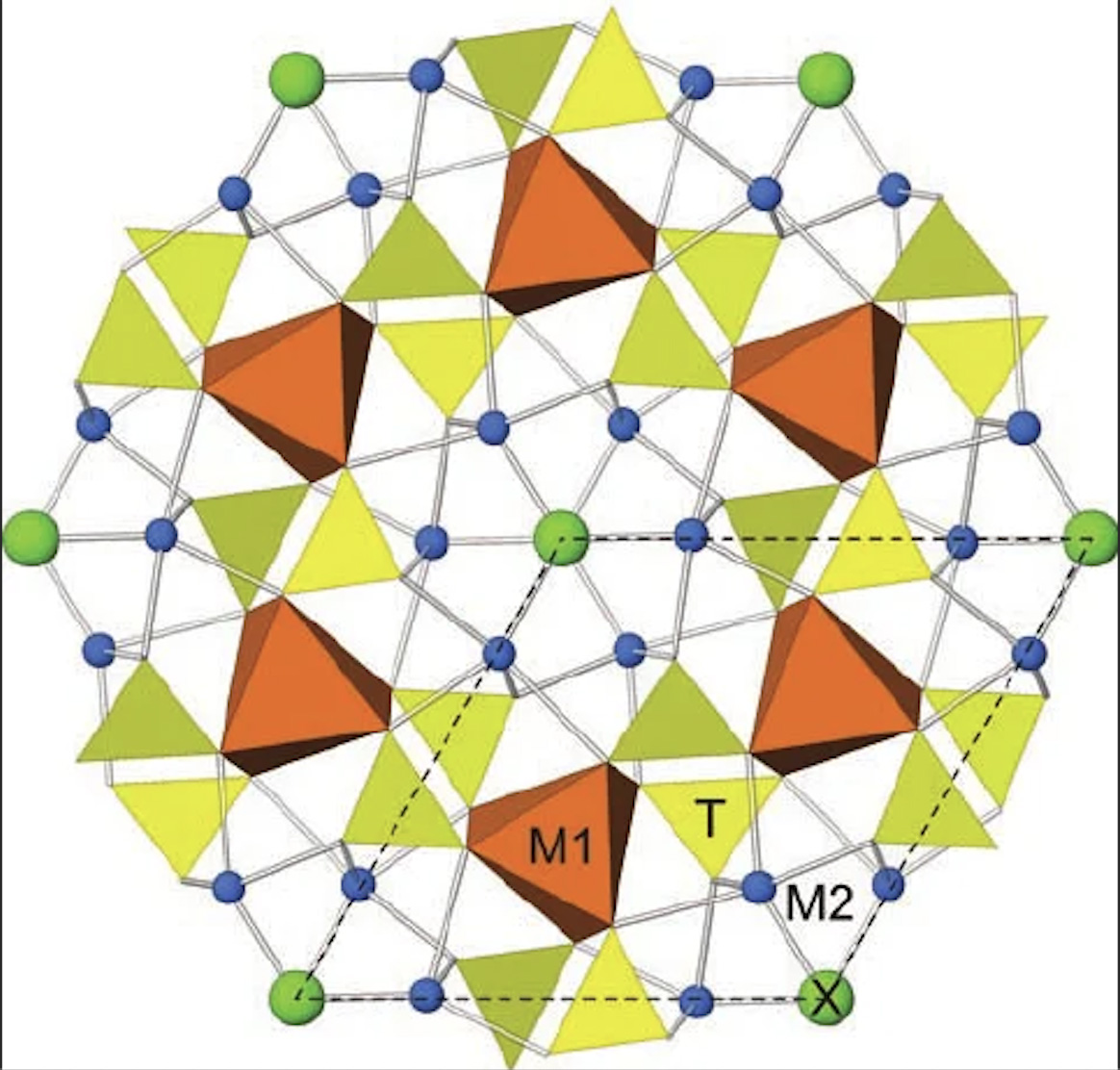
For an ion to substitute, two rules have to be met: roughly the right size, and balanced charge. For Th and U, size is no obstacle — charge is the only real hurdle.
On size, Th⁴⁺ and U⁴⁺ sit within a few percent of Ca²⁺ — squarely inside Goldschmidt's ~15% window — so they fit the site essentially regardless of conditions. On charge, the +2 surplus left by a tetravalent ion on a divalent site gets mopped up by one of several coupled substitutions. The most important is the britholite-type silicate swap, where SiO44− replaces PO43− to donate the balancing negative charge; the others are a calcium vacancy or, for trivalent rare-earths, an alkali pairing. Because the structure offers all of these routes, the actinides get in readily.
This is a real chemical affinity, not just a quirk of apatite. Three angles converge on the same conclusion:
Thorium has essentially a single natural oxidation state, Th⁴⁺, so it always presents as a roughly Ca-sized 4+ ion and slots into the calcium site under virtually all conditions. Uranium is redox-sensitive:
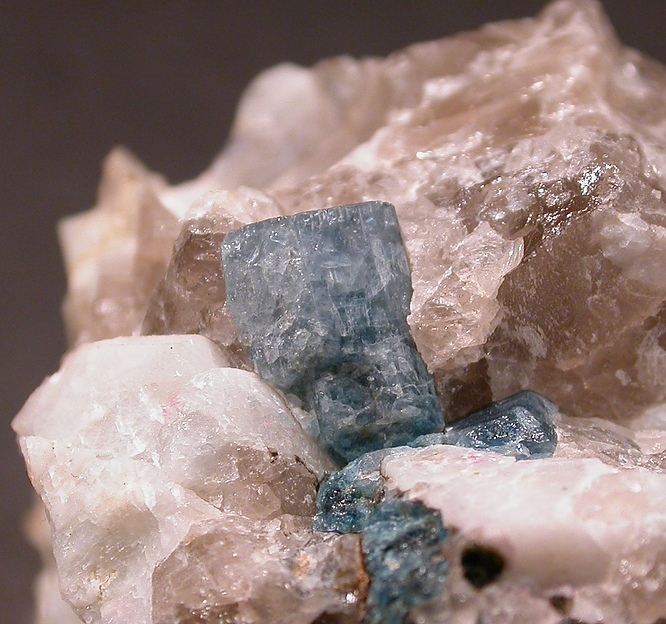
Madagascar's vivid blue-to-teal apatite (fluorapatite) comes out of its Precambrian basement — high-grade granulite-facies metamorphic terrains and associated alkaline and pegmatitic systems. Those are precisely the REE- and Th-fertile environments: alkaline melts and late-stage pegmatitic fluids concentrate the incompatible elements, so the apatite crystallizing there inherits an elevated actinide load relative to, say, ordinary sedimentary apatite. The same geology gives you both the gem-quality crystals and the trace radioactivity.
The blue colour — the honest version — is not fully settled. The leading explanations involve trace REE (and possibly minor transition metals), and there is good evidence that colour centres (lattice defects) are involved, because the colour is heat-sensitive: gentle heating shifts blue toward green or colourless, which is characteristic of defect colour centres rather than a simple ionic chromophore.
Here is the tie-in: colour centres are created by ionizing radiation — including the internal α/β/γ dose from the very Th and U the crystal hosts, accumulated over millions of years, plus any external geological radiation. So the same trace-element chemistry that makes Madagascar apatite faintly radioactive is plausibly part of what gives it that electric blue.
Low. Gem apatite typically runs from a few ppm up to low hundreds of ppm combined Th + U — enough to register on a sensitive scintillometer and to be useful for dating, but far below anything hazardous for a specimen in a collection. The exceptions are crystals with monazite or thorite micro-inclusions, which give localized hotspots that read much higher right at the inclusion.
Normal display and handling are fine. The only sensible precautions are the usual ones for any mildly radioactive mineral: do not grind or inhale dust, and do not keep a large radioactive collection in a small, occupied room.
An educational summary of apatite's crystal chemistry; concentrations and mechanisms are drawn from the mineralogical literature and are necessarily generalised — any individual specimen varies with its source. Not medical or safety advice.