

BiAl3(PO4)2(OH)6
Small enough to hold in one palm. Heavy enough to anchor a heart.
Named in honor of John Walter Wayland, a British mining geologist who worked across Central and East Africa during the early-to-mid twentieth century. Wayland spent much of his career investigating the complex geology of the African Great Rift region and its associated mineral deposits — the same broad geological province in which Waylandite was first identified. The species was described in 1953 by R. W. Harding and M. H. Hey, following the convention of honoring geologists whose fieldwork directly opened up the geological territory from which new species emerge. In naming the mineral, they placed Wayland's name in the permanent record of the crystalline world he helped map.
Waylandite belongs to the crandallite–plumbogummite supergroup — a family of trigonal aluminum phosphate hydroxides sharing the formula AB₃(PO₄)₂(OH)₆, where A is a large cation and B is aluminium. The same structural framework accommodates a range of large cations at the A site: calcium (Crandallite), barium (Gorceixite), strontium (Goyazite), rare-earth elements such as cerium (Florencite), lead (Plumbogummite), and bismuth (Waylandite). In each case, the three-fold symmetry of the trigonal system reflects the arrangement of three AlO₄(OH)₂ octahedra grouped around the central large-cation site, linked by phosphate tetrahedra into a stable, compact framework.
Waylandite is the bismuth end member of this series — and bismuth (Bi³⁺, atomic number 83) is not merely another large cation but the largest and heaviest stable cation that the A site can accept. The consequence is a specific gravity of approximately 4.2–4.5 g/cm³, far above the average for phosphate minerals (typically 2.5–3.5 g/cm³) and above every other member of the crandallite family. This exceptional density is the direct signature of the bismuth within: Waylandite is physically heavier than it looks, and the weight is genuine and elemental.
First described in 1953 from specimens associated with oxidized zones of ore deposits in Central Africa, Waylandite has since been confirmed at several localities worldwide — including mineral-rich sites in Portugal, Bolivia, and Australia — wherever the specific geochemical conditions for its formation coincide: a source of bismuth, aluminium in solution, phosphate-bearing groundwater, and sufficient time for the slow crystallization that produces its compact trigonal form. All occurrences are secondary minerals in the oxidation zones of bismuth-bearing ore bodies.
Specimens are characteristically small. Waylandite does not form the large, dramatic crystals of some other phosphate species; individual crystals are typically measured in millimeters rather than centimeters, and fine examples are correspondingly rare in the mineral trade. Yet small size and exceptional rarity do not diminish the mineral's energetic character — if anything, the concentrated mass of bismuth packed into a tiny crystal form intensifies what is delivered per gram of material.
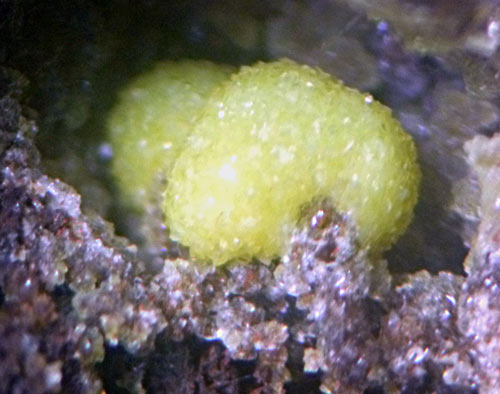

No phosphate mineral that is both safe to handle and non-radioactive is denser than Waylandite. The bismuth in its structure — element 83, the last stable element in the periodic table — gives it a specific gravity of approximately 4.2–4.5, exceeding every other safe phosphate. This is not a marginal distinction: Waylandite is meaningfully, noticeably heavier than it appears. The weight in the hand is information — it tells you immediately that something chemically unusual is present in a very small space.
Waylandite occupies the maximum-density endpoint of the crandallite–plumbogummite group — a family of minerals built on the same structural template but differentiated by the large cation at the central site. Calcium, strontium, barium, lead, bismuth: each successive member is heavier and denser than the last. Waylandite is the last in this series that stable chemistry allows. Beyond bismuth, the next elements are radioactive. Waylandite stands at the boundary between the stable world and the unstable one, carrying as much mass as safe mineralogy permits.
Kundalini crystals are typically high-frequency and relatively brief in their action — they accelerate and dissolve. Waylandite is different: its Kundalini energy works at the Heart chakra with a duration (D=8) that extends through sleep and daily life, building a sustained devotional quality rather than delivering a concentrated energetic spike. Combined with Love, Life, and Joy, this creates something unusual — Kundalini not as an upward surge but as a long, grounded burn at the center of the chest, warming the whole being from the inside rather than lifting it from below.
Waylandite is one of the most potent and unusual stones in this collection — small, rare, physically heavy beyond expectation, and carrying a combination of energies that has no close parallel among the phosphates or anywhere else at the Heart chakra. Love, Life, Joy, and Kundalini together, sustained for D=8 (the Longest duration), with a specific grounding quality that comes directly from the bismuth at its core: this crystal does not lift the Kundalini upward through the chakra column in the conventional sense. It anchors it at the Heart and lets it burn there — steadily, deeply, across the hours of a full day and through the night.
Kundalini at the Heart — The Devotional FireIn the bhakti traditions — the devotional paths of India — Kundalini is not always a serpent that rises from the base of the spine. It can be a fire that ignites at the heart when love becomes total. This is the Kundalini of Ramakrishna Paramahamsa, who entered samadhi through devotional love, through song, through the overwhelming recognition of the divine in every form. His states were not produced by breath-work or posture but by the heart opening so completely that ordinary consciousness dissolved in the current of love that replaced it. Waylandite works in this register: the energy that opens here is not the ascending Kundalini of technical yoga but the igniting Kundalini of the heart overcome by devotion.
What Waylandite adds to this — and what makes it comparable in power to some of the strongest crystals in this collection while remaining its own distinct character — is the grounding. The bismuth is not merely an interesting chemical detail: it is the reason the energy, once opened, does not dissipate into the ethers. It stays in the body. The Kundalini fire burns at the Heart and then circulates downward through the physical frame rather than rushing upward and dispersing. This is the quality of D=8 combined with Grounding energy: the love that opens here becomes structural, not episodic. It rebuilds the heart's relationship with the world rather than temporarily lifting it away from the world.
"God alone is real, and all else is illusory."— Ramakrishna Paramahamsa
Neem Karoli Baba — Maharajji — never taught transcendence as the goal. He fed people. He sat with them in their grief. He covered the sick with blankets. He laughed at the pompous and wept at the suffering of sparrows. His entire teaching was Love lived downward into the physical world rather than upward away from it — and the people in his presence reported exactly the quality Waylandite opens: a sense that everything is alive with a love that is not going anywhere, that is simply and permanently present in every person, every creature, every stone. "Love everyone. Serve everyone. Remember God." Three instructions, all three pointing at the ground of ordinary life as the place where the divine is found.
With D=8, Waylandite is a crystal that does not ask for dedicated practice time. Worn or carried through the day, it works quietly and continuously — warming the heart during work, during meals, during sleep — not spiking into dramatic experiences but gradually rebuilding the heart's baseline orientation toward Life, Joy, and Love. It is particularly suited to people whose spiritual life tends to be episodic — intense in practice and then forgotten — because it maintains the thread of connection across the gaps. The duration does not fade at night; it continues in the unconscious and returns with the waking body as a quality already present before the day's choices are made.
Small and rare, Waylandite asks for nothing other than proximity. The smallest piece carries the full character. The heaviness in the palm is part of the teaching: this is love that has weight, that stays, that has sunk deep enough into the earth of the body that it has nowhere left to fall — it has arrived at the bottom and rests there, warm and permanent, a fire that does not need feeding because it is itself the fuel.
"Love everyone. Serve everyone. Remember God."— Neem Karoli Baba (Maharajji)