

ZnO
Primal power expanding from the root of being
In 1810 the American physician and mineralogist Archibald Bruce described the mineral from Franklin, New Jersey, calling it red oxide of zinc — a purely descriptive name reflecting both its deep red colour and its simple chemistry. The name was later formalised to zincite, derived straightforwardly from zinc, the element it almost entirely consists of. "Zinc" itself entered European languages via the German Zink, of uncertain older origin, possibly related to the pointed, prong-like shapes that zinc crystals form during smelting.
Zincite adopts the wurtzite structure — a hexagonal close-packed arrangement in which every zinc atom is tetrahedrally coordinated by four oxygen atoms and vice versa. Critically, this arrangement lacks a centre of symmetry, which is the atomic prerequisite for piezoelectric and pyroelectric behaviour. The deep red to orange-yellow colour of natural specimens is caused by trace manganese impurities; pure synthetic ZnO is white or colourless.
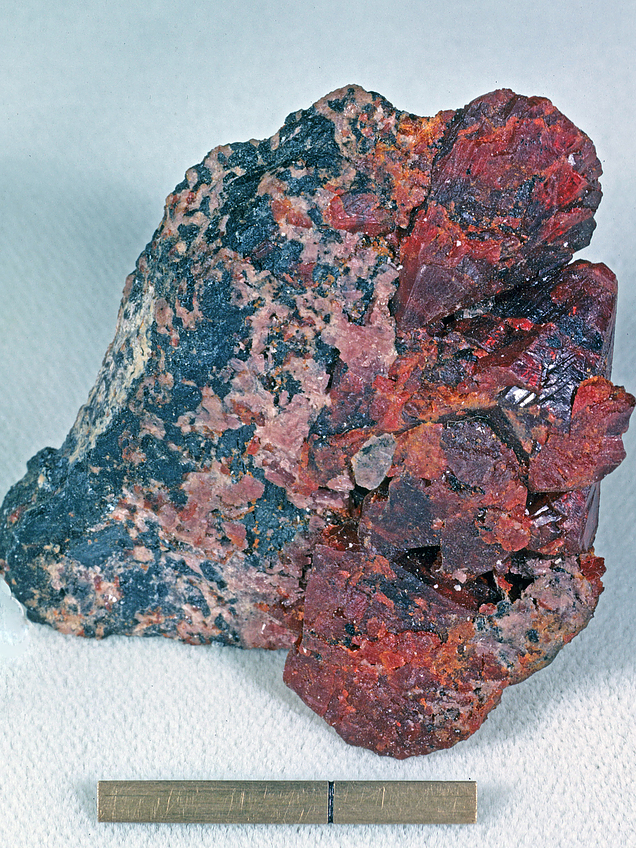
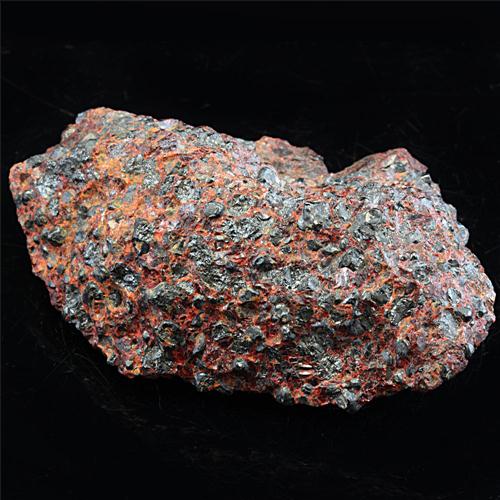
Natural zincite occurs in the metamorphic zinc-manganese deposits at Franklin and Sterling Hill, Sussex County, New Jersey, USA — the same legendary locality that hosts willemite and franklinite and is world-famous for its spectacular fluorescent mineral assemblage. The Franklin specimens are typically massive or granular and deep red, associated with black franklinite and green willemite.
The most beautiful and best-developed crystals in existence, however, are not geological at all. They formed as accidental by-products inside the zinc smelter at Tarnowskie Góry in Upper Silesia, Poland. During the 19th and early 20th centuries, the smelter processed sphalerite (zinc sulfide) ores from the rich Upper Silesian zinc belt. As zinc vapour rose through the furnace flues and encountered cooler zones, it condensed and oxidised on the flue walls, slowly growing into large, perfectly formed hexagonal crystals in vivid shades of orange-red, yellow, and green. These smelter-grown crystals — some reaching several centimetres — display a perfection of form that geological processes rarely produce, and they account for virtually every fine display-quality zincite specimen in major museum and private collections worldwide. The smelter closed in the early 20th century, ending new production permanently.

Because zincite's hexagonal wurtzite structure lacks an inversion centre, it is both piezoelectric (generates a voltage when mechanically stressed) and pyroelectric (generates a voltage when its temperature changes). These are active electrical properties — not passive — meaning the crystal genuinely converts mechanical or thermal energy into electric charge. ZnO is in fact one of the most studied piezoelectric materials in modern engineering, and zincite is its natural crystalline form.
Zincite from the Franklin Mine fluoresces deep red-orange under shortwave ultraviolet light, an effect caused by manganese activator ions within the lattice. On the same specimens, black franklinite and green willemite glow in their own distinct colours under UV, producing one of the most celebrated multi-mineral fluorescent displays in the world. The Franklin Mine assemblage is the benchmark against which all fluorescent mineral localities are measured.
The finest zincite crystals on Earth were not formed by geological processes but condensed from zinc vapour inside 19th-century industrial furnace flues at Tarnowskie Góry, Poland. Growing slowly in the controlled thermal gradient of a smelter chimney — undisturbed by the fracturing, pressure changes, and competing minerals that complicate geological crystal growth — they achieved a perfection of hexagonal form and transparency that nature alone almost never produces. They are simultaneously industrial artefacts and some of the most geometrically perfect mineral crystals ever documented.
"The ultimate purpose of human birth is not to seek worldly pleasure, but to realize the 'Aham Brahmasmi' (I am the Absolute) state through the control of the life force (Prana)."— Siva Prabakara
Zincite activates and awakens the whole kundalini, and it does so with enormous force — like a shaktipat delivered from the bottom up. With the maximum power and near-maximum duration in the collection (P=10, D=9) behind a root-chakra frequency (F=1), it is sheer raw power concentrated at the base of the body. It is the only crystal that has actually produced a continuous beep-tone in the ears for days — that is the order of intensity being described.
It is also the great wish-fulfiller: it tends either to find a way to make a desire happen, or to dissolve the desire altogether — whichever is genuinely better for you. Walk through a crystal shop feeling each stone and you will usually end up with zincite as the strongest of them all; and if you struggle to feel crystals at all, zincite (or cryolite) is the surest place to start.
"Everything in this universe is a combination of solar rays. By understanding the vibration of these rays, one can decompose and recompose any object at will."— Vishuddhananda Paramahansa
Zincite is the most powerful combined opener of the first and second chakras (Muladhara and Svadhishthana). Pair it with hematite — the best grounding stone — and you have a complete circuit: zincite driving the energy up, hematite drawing it down. For the second chakra alone chevkinite is the strongest opener, and for the first alone uraninite; but for sheer upward power from the root, nothing matches zincite.