

ZnS
Steady in the turning tide, where the inner fire is fed
Wurtzite was named in 1861 by the French chemists Charles Friedel and Édouard Sarasin in honour of Charles-Adolphe Wurtz (1817–1884), the Alsatian-French chemist whose work on organic synthesis and atomic theory made him one of the most influential scientists of his century. The standard mineral suffix -ite was appended to his surname. The type material came from the silver–tin lodes of the San José mine at Oruro, Bolivia, where wurtzite occurs intergrown with other zinc and lead sulphides.
Few mineral names have travelled as far beyond mineralogy. "Wurtzite structure" is now standard vocabulary in solid-state physics and materials science, describing the hexagonal atomic arrangement shared by an entire family of semiconductors and ceramics — gallium nitride, zinc oxide, silicon carbide and more — that have nothing chemically to do with zinc sulphide.
Wurtzite is zinc sulphide (ZnS) crystallised in the hexagonal system — the higher-temperature counterpart of the common cubic mineral sphalerite. In both minerals every zinc atom sits at the centre of a tetrahedron of four sulphur atoms, and vice versa; the only difference lies in how those tetrahedral layers are stacked. Wurtzite repeats them in a two-layer (ABAB) hexagonal sequence, sphalerite in a three-layer (ABCABC) cubic one. This single distinction in stacking is the textbook illustration of polymorphism.
The structure is polar along its principal axis, which makes wurtzite hemimorphic — its opposing crystal faces are differently formed — and gives it piezoelectric and pyroelectric behaviour. Iron commonly substitutes for some of the zinc, deepening the colour from pale resinous brown toward near-black. Natural crystals are typically small, pyramidal or tabular, and frequently occur in fibrous, concentrically banded crusts alongside sphalerite.
The type locality is the San José mine at Oruro, Bolivia, a historic silver and tin district where wurtzite was first identified in 1861. It forms there in low-temperature hydrothermal veins together with sphalerite, galena, pyrite and other sulphides.
Because the hexagonal form is favoured at higher temperatures, wurtzite also turns up in volcanic and fumarolic settings and in metamorphosed ore bodies. Notable localities include Příbram in the Czech Republic, the zinc districts of Joplin (Missouri) and Butte (Montana) in the United States, and Kirki in northern Greece. It is most often a minor associate of sphalerite rather than a stand-alone ore, and clean, well-formed crystals are prized by collectors precisely because the metastable hexagonal form so rarely survives intact.
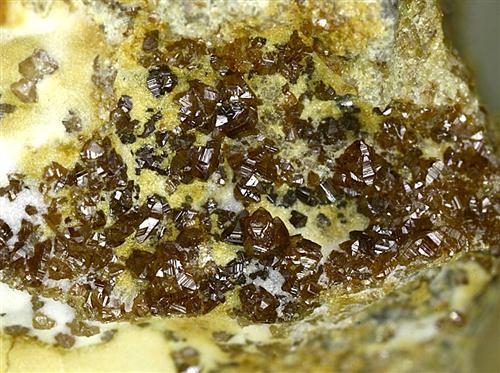
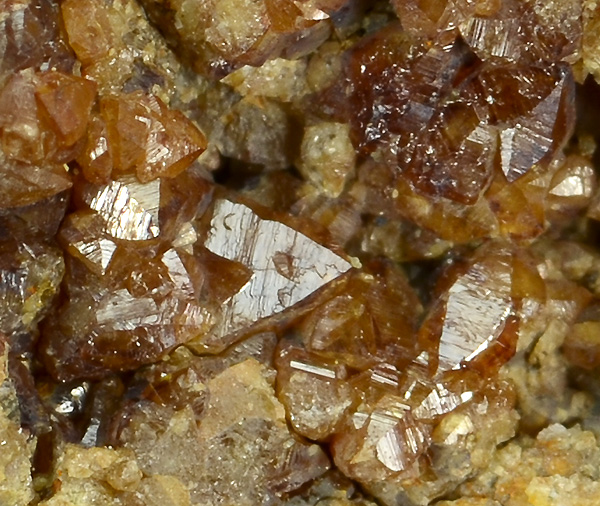
Wurtzite and sphalerite are dimorphs — one composition, two crystal structures. Wurtzite is the form that nature builds when it is hot, and it carries a kind of memory of that heat: a hexagonal architecture that, left to itself at room temperature, would slowly relax back toward the cubic order of sphalerite. Holding that higher-energy arrangement is part of what makes well-preserved wurtzite uncommon and structurally interesting.
Because its crystal structure is polar — the two ends of the main axis are genuinely different — wurtzite is hemimorphic, and that asymmetry makes it piezoelectric and pyroelectric. Pressed or warmed, it generates a measurable electric charge. This is the same property that makes wurtzite-structure materials so useful in transducers, sensors and high-frequency electronics.
A modest, often overlooked sulphide gave its name to one of the most important structure types in materials science. Gallium nitride, zinc oxide, aluminium nitride and many other semiconductors crystallise in the "wurtzite structure," and they sit at the heart of LED lighting, lasers and power electronics. Few minerals can claim to have lent their architecture to so much modern technology.
"I am ever living to help and guide all who come to me, who surrender to me and who seek refuge in me."— Swami Samarth of Akkalkot
Wurtzite is a stone for the times when everything is moving at once. It settles low in the body, into the basin below the navel where feeling and wanting and restlessness tend to pool, and it gives that turning water a floor to rest on. Nothing about it is dramatic. It simply holds steady while the things around you do not — the way a heavy keel keeps a small boat upright in a swell — so that what had been churning slows, finds its level, and stops throwing you around.
"There is one thing that destroys anyone's ability to advance spiritually: the inability to control the mind and emotions."— Swami Rudrananda
It is not a stone you reach for once and set aside. It stays with the work, hour after hour and day after day, sinking a little deeper each time and quietly loosening the older layers that lie underneath the surface upset. And down in that same low place is where the body's deepest heat is banked — the coiled kundalini that, given a clear and settled channel, begins of its own accord to rise up the spine. Wurtzite does not push that rising along; it does the patient groundwork, steadying and clearing the base so the kundalini has somewhere solid to climb from.
It is an easy stone to come by, which suits its whole character — a plain, dependable weight you can keep close when the ground feels unreliable, asking nothing of you and steadying everything around you.