
KCaAl3Si3O12·5H2O
The clearest light of all, and a mind washed clean
Willhendersonite was described as a new mineral species in 1984 and named in honour of William "Will" Henderson, in recognition of his contributions to mineralogy. The given name and surname are run together — Will-Henderson — before the customary mineral suffix -ite, producing the long, distinctive single word by which the species is known.
It is a member of the zeolite family, and like the other zeolites it was identified relatively recently: these open-framework minerals are subtle, often microscopic, and were difficult to characterise before modern X-ray methods made their delicate channel structures legible.
Willhendersonite is a zeolite — a hydrated potassium–calcium aluminosilicate built on an open, cage-and-channel framework of linked aluminium-oxygen and silicon-oxygen tetrahedra. Water molecules and exchangeable potassium and calcium ions sit loosely inside those channels, which is what gives zeolites their characteristic "molecular sieve" behaviour: they can take up and release water and swap ions without the framework collapsing.
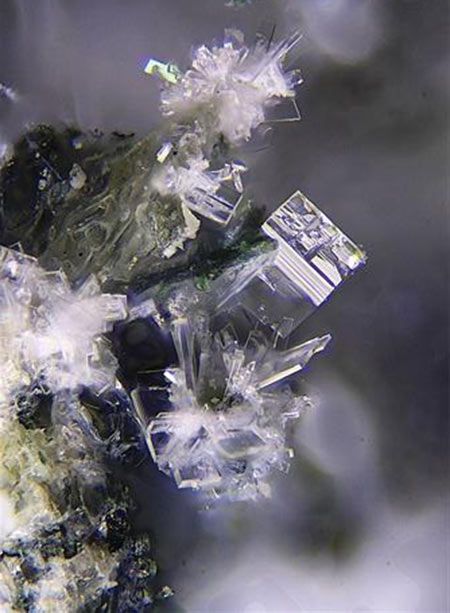
It belongs to the chabazite group but is one of the very few zeolites with triclinic symmetry — most chabazites are trigonal or rhombohedral. Its lower symmetry arises from an ordered arrangement of potassium and calcium within the cavities. Crystals are small, colourless to white, transparent and vitreous, and typically grow in gas cavities of alkaline volcanic rock.
The type localities are the Bellerberg volcano in the Eifel district of Germany and San Venanzo in Umbria, Italy — both alkaline volcanic settings celebrated among mineralogists for the wealth of rare cavity minerals they produce. Willhendersonite forms there as a late-stage mineral lining vugs and gas cavities in the volcanic rock.
It has since been recorded from a handful of other volcanic localities, but it remains a genuine rarity, known only as small crystals from a few specialist sites. It sits within the wider zeolite family alongside chabazite, natrolite, scolecite, stellerite, mazzite, clinoptilolite and amicite — a clan of pale, light, water-bearing minerals prized for the clarity and openness of their crystal structures.


Willhendersonite's defining feature is its open, cage-and-channel structure. Rather than a dense packing of atoms, the framework is mostly empty space threaded with regular channels, loosely occupied by water and exchangeable ions. This is the architecture that lets zeolites absorb, store and release molecules — and it gives the mineral an almost porous, breathing quality quite unlike the solid heaviness of most crystals.
Most members of the chabazite group are trigonal or rhombohedral; willhendersonite is one of the very few that crystallise in the low triclinic symmetry, the result of potassium and calcium settling into an ordered pattern within the framework cavities. That makes it a structural oddity and a sought-after species for collectors and crystallographers alike.
Where many minerals are opaque or richly coloured, willhendersonite is glass-clear and nearly colourless — its substance seems to be mostly light. That physical transparency mirrors its standing in the collection: it is valued not for force or drama but for sheer clarity, the cleanest and lightest energy among all the stones.
"God is the supreme Light that pervades all beings. All humans are one family, united by the light of grace."— Vallalar
Willhendersonite carries the lightest, clearest energy of any stone. It is not the most forceful — it does not push or break things open — but nothing else is quite this pure. A white light, almost weightless, pours in and runs the whole length of the channel that rises through the spine, and wherever it meets something lodged or knotted it does not fight it; it simply soaks in and softens it until it loosens and lets go.
Where it does its finest work is higher up, in the head. The crowded, restless quality of thinking thins out under it and a plain transparency takes its place — the feeling of a window wiped clean, the mind suddenly roomy and quiet and able to see straight through itself. Of all the stones, this is the one to reach for when what is needed is not power but clarity.
"Man is a miniature sun. Within the human body lies the same energy that fuels the stars; the goal of Yoga is to ignite that inner light until the body itself becomes luminous."— Vishuddhananda Paramahansa
At its height the light does not stop at clearing. It keeps pouring until there seems to be more light than body, the edges of things growing porous, a brightness that warms the heart even as it lifts. Where that descending grace meets the kundalini rising from below, the two run clean together up the open channel — the tunnel dug from both ends at once. And the stone itself never tires or clouds — it does not need to be set down to recover or rinsed of what it has passed through; it stays, from first to last, exactly as clear as it began.