
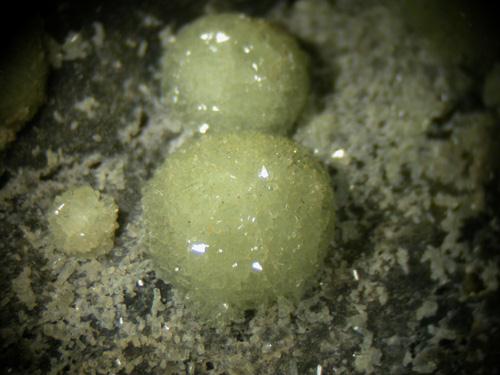
Al3(PO4)2(OH)3·5H2O
The whole universe whispered in one small sphere
Named after William Wavell (c. 1750–1829), an English physician and amateur naturalist who collected the first notable specimens from the aluminous slate deposits of Devon, England. The name was formally assigned by the English mineralogist William Henry Babington when he described the mineral in 1805. "Wavellite" entered scientific literature as a straightforward eponym honoring the collector, following the custom of the era for newly characterised minerals.
Wavellite almost always forms as compact spherical or hemispherical aggregates of fine acicular (needle-like) crystals radiating outward from a common center — a growth habit so consistent and geometrically precise that it has become the mineral's signature across every locality worldwide. Slicing a nodule through its center exposes a perfect starburst cross-section visible to the naked eye, each needle extending from a single point with mathematical regularity. Clear (colorless) Wavellite is the same structure with aluminum fully unsubstituted; the characteristic green color of most specimens is produced by trace Fe³⁺ replacing Al³⁺ in the octahedral sites.
First described in 1805 from specimens found in the aluminous slate and clay deposits around Torbay (Devon), England — the type locality. Wavellite is a secondary phosphate that precipitates in low-temperature hydrothermal veins and the oxidation zones of aluminum-rich rocks, forming wherever aluminum, phosphate, and water meet under the right chemical conditions.
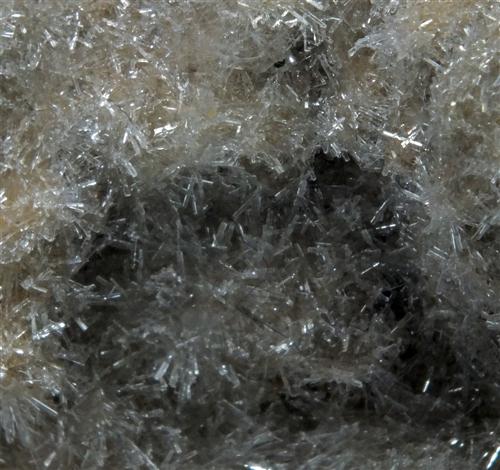
Today significant deposits are found in Arkansas (USA), where the Hot Spring County mines produce some of the world's finest vivid-green radial aggregates; Llallagua (Bolivia); Bavaria (Germany); Minas Gerais (Brazil); and localities in Sweden, Ireland, and the Czech Republic. Clear Wavellite specimens, rare by comparison, have been recorded from several of these same districts, most notably from select pockets in Arkansas.
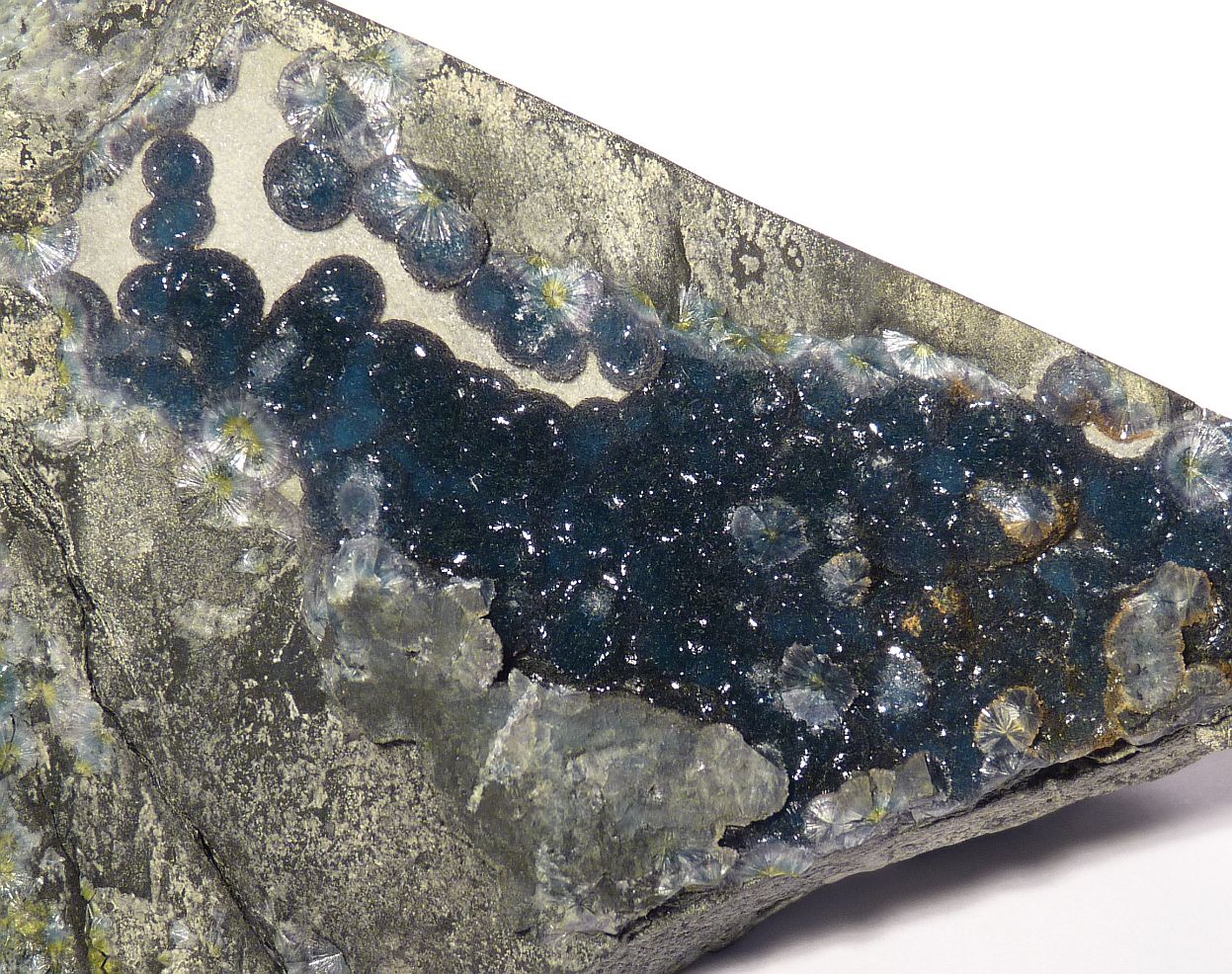
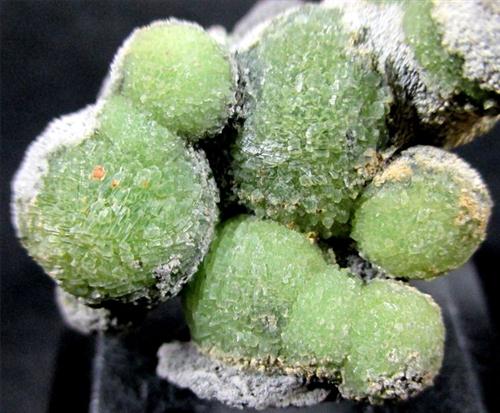

Wavellite forms in spherical clusters of radiating needles that, when cut through their center, reveal a perfectly symmetrical starburst pattern — one of the most geometrically striking displays in the mineral kingdom, visible without magnification. Each aggregate is in effect a miniature cosmos: a single originating point from which everything radiates outward in perfect symmetry.
Some Wavellite specimens exhibit pale cream to yellowish-green fluorescence under shortwave ultraviolet light. The effect is subtle but adds a further dimension to an already optically distinctive mineral — the same structure that glows as a starburst in daylight can reveal a quiet inner luminosity under UV.
Wavellite works at the Third Eye — ajna, the inner point where the inward journey truly begins. Its three active qualities, kundalini fire, life energy, and joy, do not operate as separate forces but arrive as a single current: rising warmth meeting the eye of insight, burning away the habitual overlays through which ordinary perception filters the world. The result is not a dramatic transformation but a steady clarification — a progressive opening of inner sight that deepens with continued contact.
Kundalini Through the Third EyeThe kundalini quality in Wavellite is the refined fire that reaches the ajna rather than the volcanic force of the lower centers. In the sant mat tradition this inner eye is called tisra til — the radiant point behind the forehead where inner sound and inner light can first be perceived, and where the mind, turning fully inward, begins to still. Shivabalayogi, who spent twenty-three years in unbroken tapas, taught that the path is direct: sit daily, let the mind gradually come under control, and through that sustained daily practice samadhi — and from samadhi, God-realization — becomes possible. Wavellite creates conditions for exactly that. At frequency 6, it addresses the moderately subtle layers — habitual thought-patterns, mental overlays, the residue of perception that clouds the inner eye without one's noticing.
The kundalini here does not erupt; it arrives as a slow clarifying warmth that moves through the center of the skull and makes the Third Eye's characteristic pressure palpable — a gentle confirmation that something is present at that location, doing quiet work.
Life and Joy as Inner VisionThe life energy in Wavellite adds an aliveness to the Third Eye that is distinct from stimulation — it is the quality of a mind that has been relieved of some of its habitual weight, present and attentive without effort. The joy quality emerges from this naturally. Osho described it precisely: joy is not happiness added onto experience, but the witnessing state itself — the emptiness that remains when compulsive thinking stops. "Meditation means: be," he said, and Wavellite makes that easier at the level of the inner eye. With duration D=5, the effect continues working for several hours after contact — useful both in and outside of formal sitting. Power P=6 makes it effective without being overwhelming; a medium specimen is fully sufficient for regular practice.
"After continuous meditation, samadhi comes, then God realization — this is tapas."— Shivabalayogi
Clear Wavellite is the rarest and highest-frequency member of the Wavellite family — colorless because the trace iron that greens the common form is entirely absent, the structure distilled to its purest expression. These are the universal crystals. Where the green variety opens and clarifies the inner eye, the clear variety does something qualitatively different: it opens the seeing into the universe itself.
Holding a clear specimen in practice, the sense of personal scale drops away. Awareness, instead of narrowing to a point behind the eyes, radiates outward without boundary — not as an idea but as an actual felt quality of the present moment. You do not think "I am vast"; the smallness simply lifts. What remains is the grandeur of the universe experienced from inside it, not observed from the outside. In Dzogchen, this is dharmadhatu — the basic space of phenomena, the primordial purity underlying all experience. Khenpo Ngawang Palsang pointed at its nature directly.
"The nature of all phenomena is kadag, the primordial purity of emptiness."— Khenpo Ngawang Palsang
The structural signature of Wavellite — every needle radiating from a single central point in perfect symmetry — is not incidental to this quality. The mineral shows you its nature visually: one originating center, the whole universe radiating outward. That geometry is exactly what the clear variety transmits experientially. Quite powerful for its size. Even a small piece is enough.