
NaAl3(PO4)2(OH)4·2H2O
The eternal healer cleanses every layer until only light remains
Wardite was named in honour of Henry Augustus Ward (1834–1906), an American naturalist and entrepreneur who founded Ward's Natural Science Establishment in Rochester, New York — one of the most influential scientific supply companies in American history. Ward's supplied natural history specimens, minerals, fossils, and meteorites to schools, universities, and museums across the United States and beyond, doing much to make scientific education accessible in the nineteenth century. He was Professor of Natural Sciences at the University of Rochester and an important figure in the development of American museum collections.
The mineral was formally described in 1896 by the mineralogist Frank A. Genth, who applied the standard suffix -ite to Ward's name in recognition of his contributions to natural science.
Wardite is a hydrated sodium aluminium phosphate belonging to the tetragonal crystal system — specifically the trapezohedral class (point group 422), which lacks a centre of inversion symmetry. This relatively rare symmetry class produces crystals with a characteristic twisted or screw-like appearance to their faces. The mineral forms through the secondary alteration of primary aluminium phosphates in complex granitic pegmatites, typically in association with other rare phosphates such as augelite, cyrilovite, and crandallite.
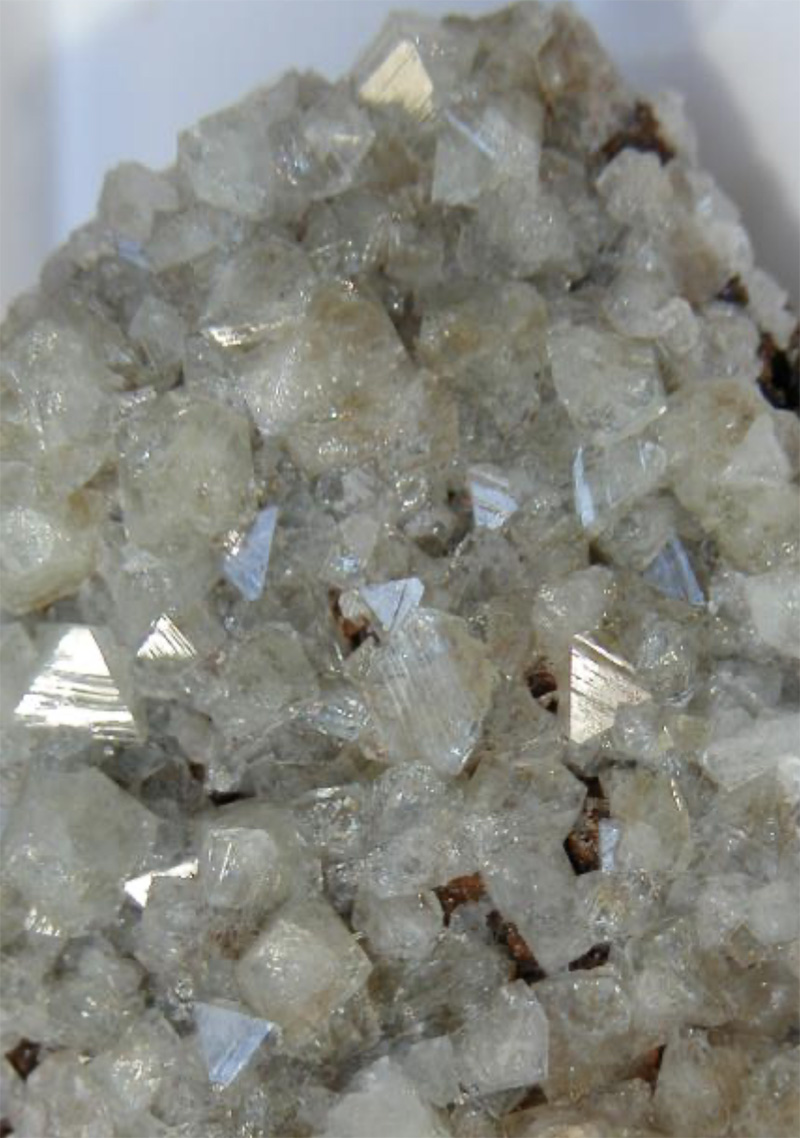
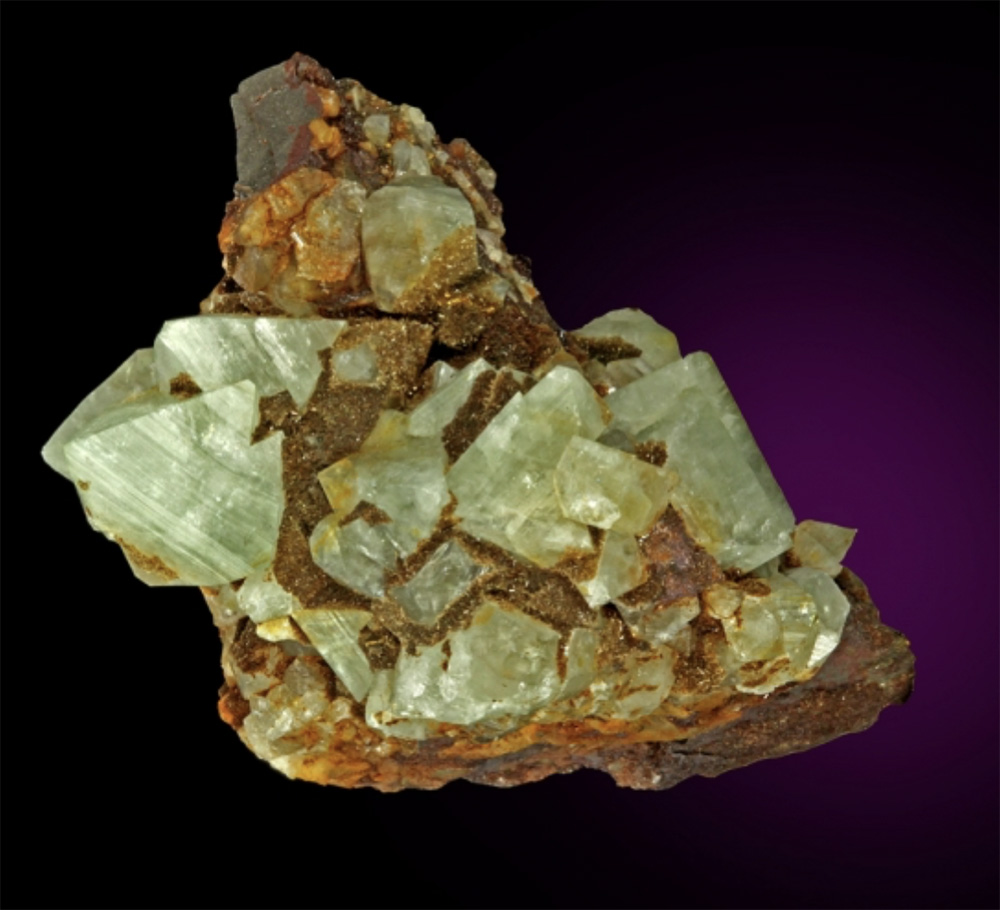
Wardite crystals are typically pyramidal to pseudo-octahedral, colourless to pale green or yellow-green. The pale green coloration common in many specimens arises from trace iron substitution for aluminium. The moderate hardness (5 Mohs) reflects the well-bonded aluminium phosphate framework bridged by hydroxyl groups and water molecules.
Wardite was first described in 1896 from specimens collected at Clay Canyon, Fairfield, Utah County, Utah — its type locality. It is a secondary mineral, forming in the oxidation and hydrothermal alteration zones of phosphate-bearing pegmatites where primary aluminium and sodium phosphates react with circulating groundwater.
Fine crystallised wardite has subsequently been found at several classic localities worldwide: the Rapid Creek and Big Fish River area of the Dawson mining district in Yukon, Canada — one of the world's premier sources, producing crystals up to 4 cm — as well as phosphate-rich pegmatites in Brazil, Spain, and the Palermo Mine in New Hampshire. The green and colourless specimens in the gallery represent the characteristic habit found across these global occurrences.
Cyrilovite is wardite's twin. Set the two formulas side by side — cyrilovite's NaFe³⁺₃(PO₄)₂(OH)₄·2H₂O against wardite's NaAl₃(PO₄)₂(OH)₄·2H₂O — and they are identical in every respect but one: where wardite holds aluminium, cyrilovite holds iron. The same sodium, the same phosphate, the same hydroxyl and water, the same rare tetragonal–trapezohedral architecture with its chiral, screw-like geometry. On paper and under the microscope they are sisters — and they even grow together in the same pegmatite pockets, the iron tinting cyrilovite a golden orange-brown.
And yet that single substitution changes everything that matters. The structure is the same; the energy is not. Where wardite runs at frequency 6, power 8 and an almost unheard-of duration of 10 — the eternal healer that never stops working — cyrilovite measures frequency 1, power 4, duration 2. The framework that carries wardite's tireless cleansing current is present in cyrilovite too, but the iron will not let it sing. It is a faint echo of its aluminium twin: the same shape, holding far less light.
This is one of the clearest lessons in the whole collection. In chemistry, a single element decides whether a mineral is colourless or golden-orange; in the energetic world, that same small substitution decides whether a stone is the eternal healer or barely a whisper. Same recipe — one ingredient changed — and all the difference in the world.



"Silence is truth. Silence is bliss. Silence is peace. And hence Silence is the Self."— Ramana Maharshi
Pick up a piece of wardite and something changes — quietly, without announcement. Not a rush, not a flash. Something simply begins. And here is what makes wardite unlike almost anything else in the mineral kingdom: it does not stop. Long after you have put it down, long after you have gone to sleep, it keeps moving through you, smoothing what it finds, dissolving what has been held for years, doing its patient work in the layers you cannot see.
What wardite touches is everything. The physical body, the emotional residue that clings like old smoke, the mental architecture built from decades of reaction and fear, the deeper causal body where the roots of recurring patterns are buried — wardite moves through all of it in sequence, returns to the beginning when it reaches the end, and starts again. It is the definition of a continuous companion. Place it on the bedside table and it works while you sleep. Slip it into a pocket and it works through the ordinary hours of the day. There is no moment when it is idle. The inner eye — the centre through which it works — does not merely look; it dissolves, gently and persistently, whatever lies in its field of awareness.
What is most extraordinary about wardite is not any single quality but what happens when all its qualities move together. Its strength is deep enough to reach genuinely dense accumulations — the old grief, the inherited wound, the shame that has never found a name. Yet it works from the inner-sight centre, which means it is intelligent rather than indiscriminate: it finds what needs attention and settles there, staying until the thing releases, then moving to the next. Like a quiet, unhurried practitioner with infinite patience and no agenda.
This quality of never-stopping makes wardite the supreme ally for relationship work and for the long ancestral lines. The hurts that pass between people — the misunderstandings that calcify into distance, the inherited patterns carried forward from parents and grandparents and further back than memory reaches — these are not dissolved in a single session. They need exactly what wardite offers: the willingness to return, and return, and return, clearing each layer as it becomes accessible, until the thread that held the wound together simply is no longer there.
"Wisdom is the greatest cleanser."— Shri Yukteswar
Shri Yukteswar's words arrive here with particular precision. Wardite does not cleanse through force; it cleanses through something closer to knowing — a quiet, unhurried intelligence that recognises what is not real and simply refuses to leave it alone. Day by day, the unreality thins. What remains, when wardite has had its long say, is what was always there beneath the layers: the open, unobstructed clarity that needs nothing added to it, and from which everything else can begin again.
There is nothing dramatic in how wardite works. Robert Adams would have recognised it — the stillness that does the work, the "who am I?" that does not demand an answer but simply asks, and asks again, and in the asking, the question and the asker both dissolve. Sit with wardite long enough and you begin to understand that the cleansing was never about acquiring something. It was always only the removal of what had never been you.