

Mg2(PO4)F
a warm voice that says, at last, you are enough
Wagnerite takes its name from Franz Michael von Wagner (1768–1851), a German mining official based in Munich who made significant contributions to mineralogy and the administration of Bavarian mines in the early nineteenth century. The mineral was named in his honour upon its first formal description, following the long-standing tradition in mineralogy of commemorating those who advance the scientific understanding of ore and mineral resources.
The suffix -ite follows the standard Greek-derived convention for mineral names, indicating a naturally occurring crystalline substance. The name has remained unchanged since its original assignment, a sign of the mineral's stable scientific standing across nearly two centuries of study.
Wagnerite crystallises in the monoclinic system, forming elongate, striated prismatic crystals that sometimes appear tabular or occur as granular masses. Its framework couples magnesium atoms to phosphate tetrahedra and fluoride ions — an unusual pairing that places it in its own mineral group rather than with the common apatite-fluorite assemblage. Iron may partially substitute for magnesium (hence the broader formula (Mg,Fe²⁺)₂PO₄F), shifting the colour from pale yellow toward reddish brown. The lustre is vitreous to resinous, and the mineral dissolves readily in acid, a behaviour typical of phosphates.
Wagnerite was first described in the early nineteenth century from its type locality at Höllgraben near Werfen in Salzburg, Austria — an alpine region whose granitic and metamorphic terranes host a variety of unusual phosphate minerals. The Salzburg specimens, typically yellow-grey prismatic crystals, remain among the most representative examples of the species.
The mineral occurs in high-temperature metamorphic and pegmatitic environments where magnesium, phosphorus, and fluorine concentrate together. It is found in association with other phosphates, triplite, lazulite, and occasionally quartz and feldspar. Localities beyond Austria include parts of Germany, Sweden, and several metamorphic belts across Europe and North America, though fine, well-formed crystals are uncommon and collector-quality material is considered scarce.
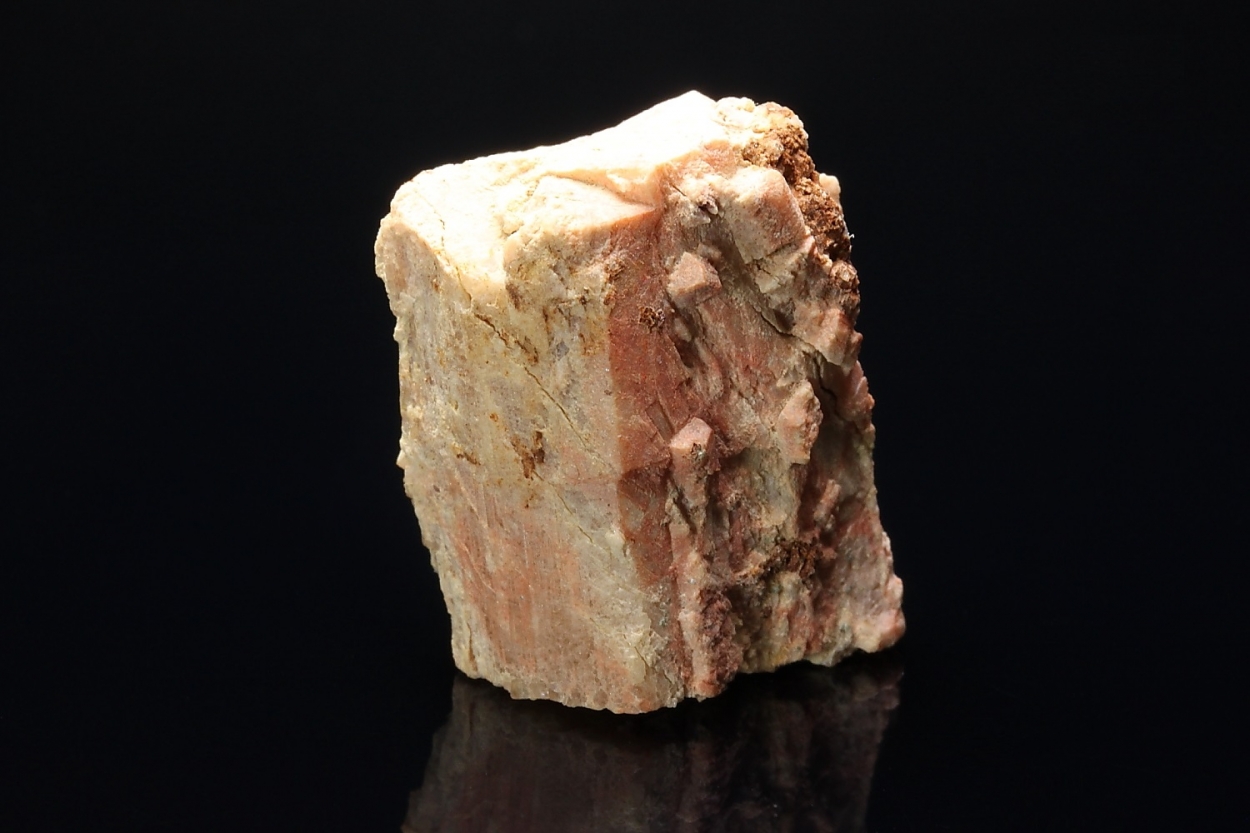
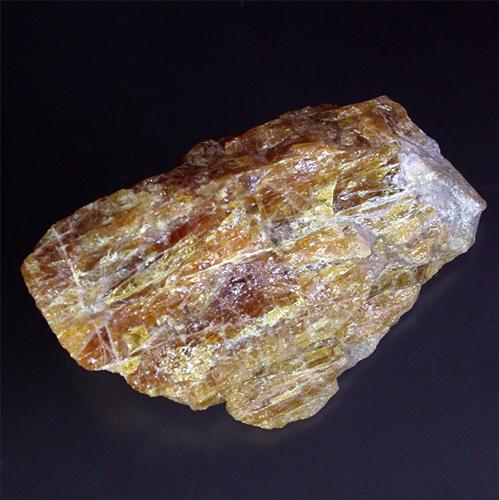
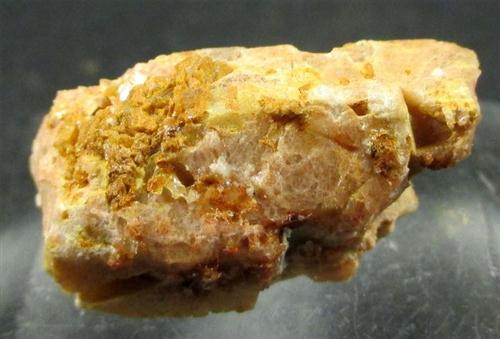
Wagnerite is the type mineral of its own group — an honour held by relatively few species — meaning its crystal structure defines the architectural template against which all related minerals are measured. The combination of phosphate tetrahedra with fluoride ions in a magnesium framework is chemically distinctive, placing it apart from both the common apatite and olivine families despite superficial similarities in hardness and habitat.
Few minerals make their internal chemistry quite so visible as wagnerite. The progressive substitution of iron for magnesium in the structure produces a continuous colour shift — from near-colourless and pale yellow through gold and amber to deep reddish brown — that correlates directly with iron content. A specimen's colour is therefore a direct optical readout of its atomic composition, requiring no instrument beyond the eye.
Wagnerite forms in high-temperature metamorphic and pegmatitic conditions where phosphorus, magnesium, and fluorine are concentrated together — a geochemical confluence that is rare in the crust. Its presence in a rock is thus a marker of unusual metamorphic history, often in alpine belts where deep crustal material has been heated and remobilised. This demanding formation environment contributes to its scarcity as a collector mineral.
"The winds of grace are always blowing, but you have to raise the sail."— Ramakrishna
There is a place in the body where the heart meets the mind — not a physical junction but an energetic one, the narrow passage between feeling and expression. For many people that passage is sealed. Something long ago, a word spoken sharply, a voice made small, a feeling that who they were was too much or not enough, pressed itself into that channel and hardened there. Wagnerite works on exactly this. It does not push or break. It warms. It softens the old seal from within, the way sunlight softens wax, until the block simply eases and expression becomes possible again.
The stone carries a quality that could be described as inner permission — the dawning recognition that what you feel is real, that your voice has weight, that speaking honestly from the inside of your experience is not danger but birthright. People who spend time with wagnerite often notice a subtle shift: things unsaid begin to want saying. Not urgently, not dramatically, but quietly — the way a door that has always been stuck finally swings open when the weather changes and the wood settles back into its true shape.
Overcoming the Sense of InadequacyThe feeling of inadequacy — the low persistent hum that insists you are less than, that your needs do not merit expression, that others will judge what you say before you have finished saying it — lives precisely at this threshold. It is the ego's outermost wall, the structure it built not from strength but from an old fear of being seen and found wanting. Wagnerite does not argue with that wall. It does not tell you the wall is wrong. It simply bathes the whole area in something warm and expansive, and over hours or days the wall stops feeling necessary. A stillness opens behind it. In that stillness, as any quiet sitting will confirm, the question arises naturally: who exactly was afraid? What is here when the fear steps back? There is no answer that needs to be found; the asking itself is enough. The question dissolves the one who asked it.
Coming Into Free ExpressionAs the block softens, something radiates outward from the throat — not loudly, but steadily, the way warmth radiates from a stone that has been sitting in the sun all day. The energy moves in all directions from that centre, neither climbing nor descending but opening, and as it opens the world appears slightly less threatening and slightly more real. Relationships become more honest, not because anything has been forced, but because the old filter has dropped away. You speak from the inside of your experience rather than from behind a careful version of it. This is what wagnerite is for: not to make you more articulate or more confident in any effortful sense, but to make the truth of what you actually feel easier to carry, and easier, at last, to put into words.
"Love everyone, serve everyone, remember God, and tell the truth."— Neem Karoli Baba
Telling the truth — that last instruction, so simple, so rarely easy — is the whole work wagnerite supports. Not the blunt truth that wounds, but the honest truth that comes from having dropped the pretence that you are something other than what you are. The stone's warmth carries love through the whole of its action: love as the ground from which genuine expression rises, love as the atmosphere in which the voice that was silenced learns, slowly and without drama, that it is allowed to speak.