
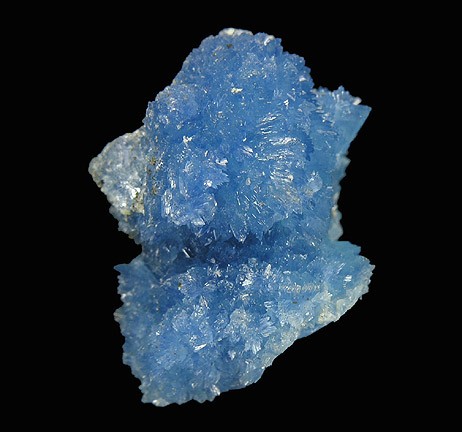
Fe2+Al2(PO4)2(OH)2·6H2O
a high blue light that lifts you whole again after the worst has passed
Vauxite was named in 1922 in honour of George Vaux Junior (1863–1927), an American attorney, amateur naturalist, and avid mineral collector based in Philadelphia. Vaux was a respected figure in early twentieth-century American mineralogy, contributing both financially and intellectually to the documentation of Bolivian mineral deposits. The name follows the tradition of honouring benefactors and collectors whose patronage helped expand the scientific record, and it has been accepted without alteration since the mineral's original description.
Vauxite is a hydrated iron(II) aluminium phosphate belonging to the laueite–paravauxite group. Its structure is built from infinite chains of edge-sharing aluminium octahedra running parallel to the crystallographic c-axis, cross-linked by phosphate tetrahedra and iron coordination polyhedra. The result is an open, water-bearing framework that accounts for the mineral's relative softness and its susceptibility to dehydration in very dry conditions. Crystals are typically tabular to prismatic, and the mineral is strongly pleochroic — colourless along two optical axes and a distinct sky-blue along the third — giving specimens a colour that shifts subtly as they are rotated in light. Despite its chemical similarity to paravauxite and metavauxite, vauxite shares no structural relationship with either; all three form together as secondary alteration products but represent independent crystal architectures.
Vauxite was first described in 1922 from specimens collected at the Siglo Veinte Mine (also known as the Llallagua Mine) near the town of Llallagua in the Potosí Department of Bolivia. This high-altitude tin-mining district, worked intensively through the twentieth century, produced an extraordinary range of secondary phosphate minerals as the primary tin veins were oxidised and altered by hydrothermal and surface waters. Vauxite forms there as a secondary mineral growing from the breakdown of apatite within these veins, typically in association with paravauxite, metavauxite, and wavellite.
The Siglo Veinte Mine remains the overwhelmingly dominant — and for practical purposes the only — world locality for fine vauxite specimens. This extreme rarity of occurrence, confined to a single deposit on a Bolivian mountainside, makes every quality specimen a document of an exceptional geological environment.
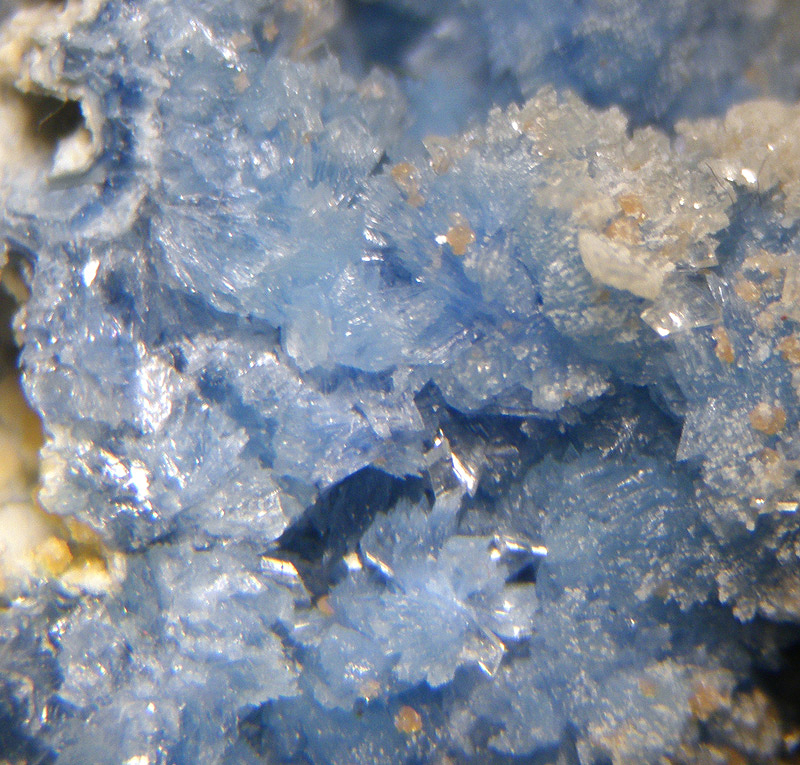

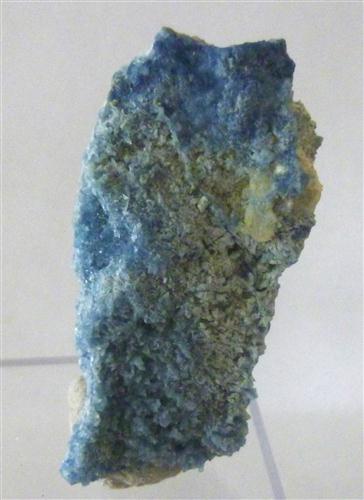
Vauxite is strongly pleochroic: the crystal appears colourless when light passes along two of its optical directions, and a vivid sky-blue along the third. Rotating a specimen in the hand causes its colour to bloom and fade like a slow pulse — a visual property that arises directly from the anisotropic bonding of its triclinic structure.
With six molecules of water built into every formula unit, vauxite carries more structural water than most common minerals. This water is not a surface contaminant but a load-bearing part of the crystal lattice itself, held inside the open phosphate framework. It is this water that gives vauxite its softness and its particular sensitivity to very dry or heated environments.
Fine vauxite is essentially a one-place mineral: the Siglo Veinte Mine at Llallagua, Bolivia. This extreme geographical concentration — a secondary phosphate born from apatite alteration in a single high-altitude tin vein system — means that every collectible specimen in the world traces back to the same Andean mountain. That uniqueness is part of what makes each piece irreplaceable.
As a hydrated phosphate carrying six water molecules per formula unit within its crystal lattice, vauxite is prone to gradual water loss and surface alteration when kept in very dry or heated conditions. Dehydration can dull the lustre and alter the surface chemistry over time. Store at stable moderate humidity — a closed display cabinet away from heating vents, direct sunlight, and dry-air conditioning is ideal. Avoid prolonged exposure to dry heat or desert-dry environments.
"That is enough for this beggar!"— Yogiram
There is a particular kind of darkness that arrives after the worst — after the thing that should not have happened, did. The mind replays it; the body holds the imprint; the sense of a coherent self feels cracked through. Most stones work on the surface of this. Vauxite moves differently. Its energy does not rush in to fix or fill. It arrives at the crown of the head like a slow change in light — barely perceptible at first, then undeniable — and begins to work at the very root of the identification: the belief that what happened defines what you are.
The crown is where identity loosens its grip. Every story we tell about ourselves — I am broken, I am marked by this, I cannot go back to who I was — lives in the thousand-petalled tangle at the top of the skull. Vauxite does not argue with those stories. It simply raises the frequency of the space they occupy until they become lighter than the awareness that holds them. The process is quiet. There is no dramatic shift, no cathartic release. There is instead a kind of thinning — as if the weight of the old definition were slowly becoming translucent.
Resilience · Surviving and ThrivingWhat the blurb names "resilience" is not the hardening of a person against further pain. It is something closer to the opposite: a softening deep enough that the traumatic residue can finally move. The crown-frequency energy in vauxite works close to the root cause of suffering — the identification of the self with the wound. When that identification loosens, even fractionally, the whole architecture of the trauma begins to shift. You do not become someone who was never hurt. You become someone for whom the hurt is no longer the loudest thing in the room.
This is what surviving and thriving means in the language of the crown: not that the past is erased, but that the past is no longer the axis around which the present revolves. The energy is not strong in the sense of force — its power rating is modest, its duration short. But its frequency is high enough to reach the layers where the story lives at its most subtle. It is work done gently, at the level of the root identification, and it is work that leaves the system genuinely different for having happened.
"God is the supreme Light that pervades all beings. All humans are one family, united by the light of grace."— Vallalar
In the aftermath of real trauma, a person often loses the felt sense of belonging to anything larger than their own pain. The world contracts. The light that once moved through daily experience — that quiet, taken-for-granted sense that life has a coherence, that one is held within something — seems to have gone. Vauxite does not restore this by reassurance. It restores it by lifting the frequency of the crown until the Grace-Light, which was never truly absent, becomes perceptible again. The blue that shifts in a vauxite crystal — now vivid, now colourless, depending on the angle — is a physical echo of what the stone does spiritually: it reveals wholeness from directions the eye had not tried yet. Thinking and thinking, reaching and reaching, the light was always there. The stone only changes the angle until you can see it again.