

Ca2Mg5Si8O22(OH)2
a pale fibrous calm that loosens the old grip and lets the long-held thing go
The name tremolite derives from Val Tremola — the "Valley of Trembling" — a high Alpine valley in Canton Ticino, Switzerland, where the mineral was first scientifically described in the late eighteenth century. The locality sits on the Gotthard route, known for its rough terrain, and the name of the valley itself likely reflects the shivering cold of the mountain passes rather than any quality of the stone. Albrecht von Haller and later Horace-Bénédict de Saussure helped bring this mineral to the attention of European naturalists, and the name has remained tied to that Swiss type locality ever since.
Tremolite belongs to the amphibole supergroup — a large family of double-chain inosilicates. Its structure is built from two parallel chains of silicate tetrahedra (Si₄O₁₁ repeating units) cross-linked by calcium and magnesium cations and stabilised by hydroxyl groups. This double-chain architecture is the defining trait of all amphiboles and accounts for the characteristic blade-like or columnar crystal habit. The calcium-rich end-member is tremolite; progressive iron substitution for magnesium leads through the series toward actinolite and eventually ferroan actinolite, so tremolite and actinolite are essentially two ends of a continuous compositional series. Amphiboles are distinguished from pyroxenes (single-chain inosilicates) by their perfect cleavage on two planes intersecting at approximately 60° and 120° — compared to the near-90° cleavage angle of pyroxenes — a classic textbook test used to identify them in hand specimen and thin section.
Tremolite was formally described in the late eighteenth century using specimens from Val Tremola in Ticino, Switzerland — a high Alpine pass on the southern side of the St. Gotthard route. European naturalists, including those in the circle of Horace-Bénédict de Saussure, characterised the pale fibrous and bladed crystals found in metamorphic rocks there and gave the species its enduring name. The mineral is now known from metamorphic terranes worldwide wherever calcium-magnesium dolomitic marbles and ultramafic rocks have been subjected to contact or regional metamorphism.
Significant localities include the Wilberforce area of Ontario, Canada, which yields exceptionally large and well-formed transparent to pale-green crystals; the Gouverneur district of New York State; the Rímini area of Italy; the Trentino–South Tyrol region of the Alps; Campolungo in Switzerland (near the type locality); and various localities in Finland, Pakistan, and Tanzania. In East Africa and parts of South and Southeast Asia, tremolite occurs as the dominant fibrous component in some of the asbestiform mineral deposits historically exploited under the name "tremolite asbestos."
Fibrous and asbestiform tremolite is a recognised asbestos and a known human carcinogen (IARC Group 1). Never inhale dust or fine particles. Do not cut, grind, sand, or break specimens dry. Handle solid, non-fibrous specimens only, and wash hands thoroughly after handling. Fibrous or powdery material should be treated as hazardous waste. Keep out of reach of children.
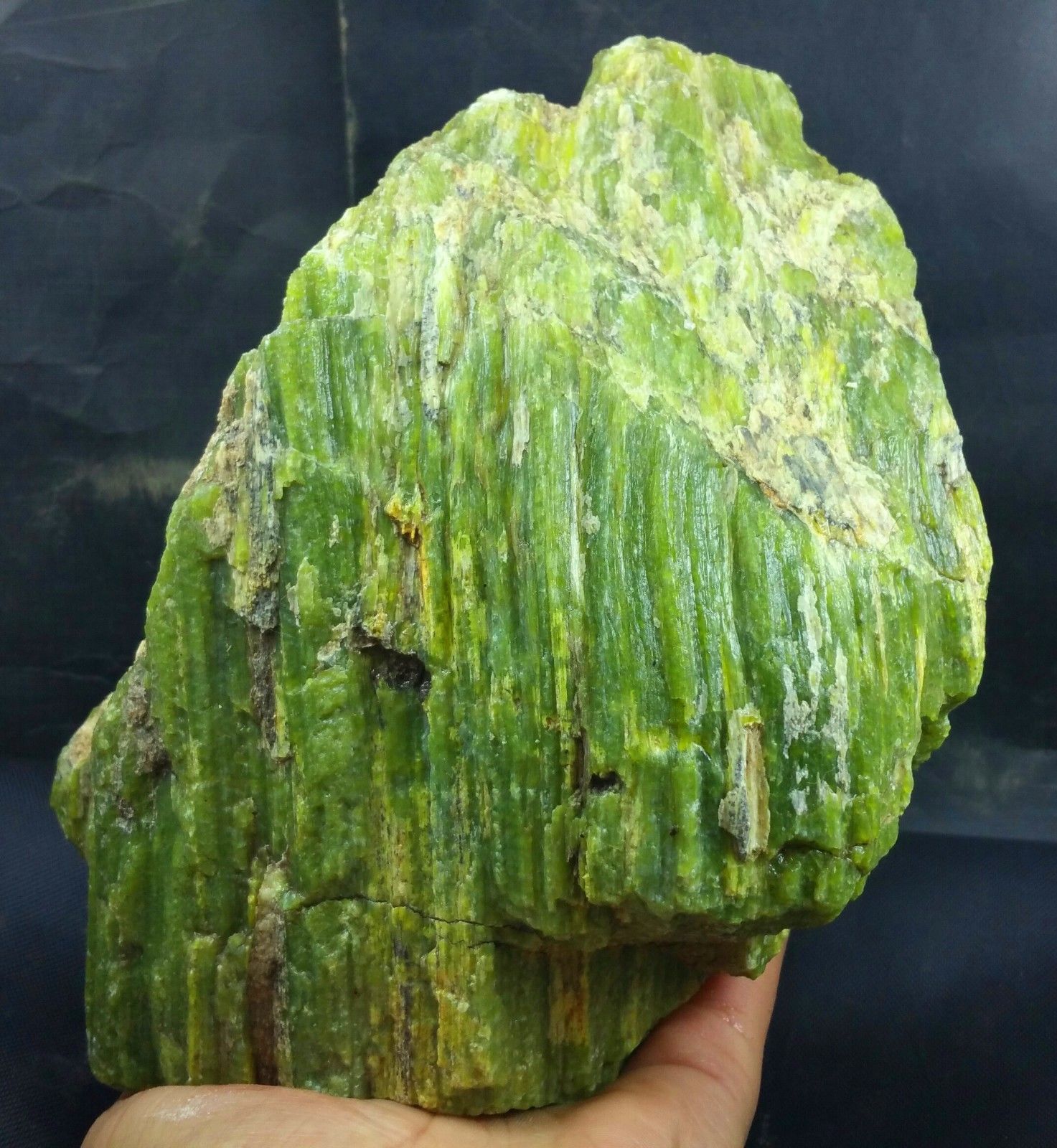

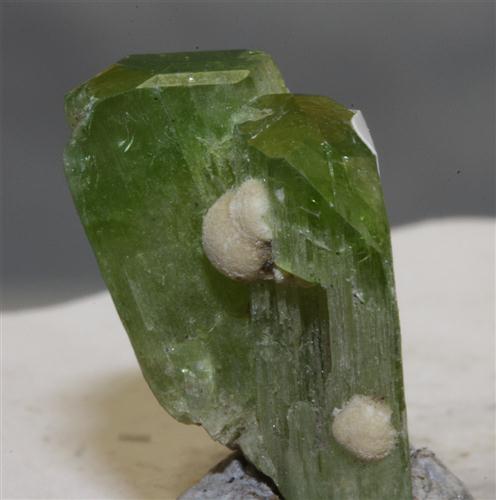
Tremolite grows in long prismatic to bladed crystals with a pronounced elongation along the c-axis, often forming radiating clusters, sprays, or parallel aggregates. At the extreme end of this tendency the crystals become so thin and flexible that they form silky, separable fibres — the asbestiform habit. Massive, granular, and lamellar forms also occur, particularly in metamorphic marbles where it grows in interlocking aggregates. The combination of bladed, fibrous, and blocky habits in the same mineral is unusual and reflects how sensitively the crystal form responds to the precise conditions of metamorphic growth.
Pure, iron-free tremolite is colourless to white or pale grey — one of the palest amphiboles. Any shade of green signals iron substituting for magnesium, and even a small amount of Fe²⁺ gives a delicate, cool green tint. The chromian variety (chrome-tremolite) is a vivid emerald green from trace chromium. Manganese-bearing material can show pale pink or lavender hues. This remarkable sensitivity to trace substitution — the same basic formula producing pure white, soft green, vivid emerald, or blush pink — makes the tremolite–actinolite series a useful field marker for the composition of the rocks in which it grew.
The twin cleavage planes of all amphiboles — intersecting at approximately 56° and 124° in cross-section — are visible as tiny stepped surfaces on broken crystals and are one of the primary features that distinguish amphiboles from pyroxenes in hand specimen. In transmitted light tremolite shows low birefringence and a small extinction angle, and it is optically negative. The lustre of clean crystal faces is vitreous and bright, while fibrous material takes on the characteristic silky sheen seen in asbestiform minerals — caused by the reflection of light from countless parallel fibre surfaces rather than from a single crystal face.
"The world is a dream; the only reality is the Brahman that resides within you."— Trailanga Swami
Hold a piece of tremolite and notice what happens in the chest — not a surge, not a push, but a quiet loosening. Something that had been held in a tight fist simply opens its fingers. The stone is pale, almost without colour, and that absence of colour is the point: it carries nothing forward, no old argument, no stored tension. It only makes room.
There is something in the long habit of the heart — the way we grip old grief, old self-judgements, patterns rehearsed until they feel like fact — that tremolite meets with an unusual steadiness. Not by fighting the held thing, but by making the grip itself feel unnecessary. The question arises on its own, the way Robert Adams described it: who exactly is holding this? And when you look for the holder, it grows quiet. The breath drops. The thing that felt so solid reveals itself as a story told so many times it had become the walls of the room.
The Quality of Letting GoThe heart is the center where the upper and lower worlds meet, and at that meeting point lies the deepest tangle of accumulated experience — emotion pressed flat by time, dramas that have long since ended but whose weight still lives in the body. Tremolite does its quietest work here. It does not require you to revisit anything. It simply sits with the chest until the chest remembers that it does not have to carry every invoice from the past. Day by day, layer by layer, a softening happens. Stress that had calcified into a kind of identity begins to loosen at the edges. Old patterns — the habitual brace, the protective withdrawal, the practiced sadness — start to look a little less like the self and a little more like weather passing through.
"It is always the false that makes you suffer, the false desires and fears, the false values and ideas. Abandon the false and you are free of pain."— Nisargadatta Maharaj
What tremolite asks for is almost nothing — only the willingness to sit with the stone and let whatever is there be seen without immediately rearranging it. The fibrous quality of the mineral, that willingness to separate into thin, flexible threads, seems present in the energy too: it works its way into the tight places not by force but by finding the seam. Over several hours — and it works across the arc of a day, resting through the night with its task — the stone clears what it meets. Not dramatically. It is the kind of change you notice afterwards: you set something down and find later that you have not picked it up again. The long-held thing simply has gone. The palm tree bends in the wind; the roots hold. There is space where the tightness was. And in that space the heart can move again — direct, unfiltered, open to what is actually here.