
K2(Na,Ca)2Li3Be6(PO4)6(OH)2·H2O
Sharpness turns inward and the inner eye sees what was always there
Tiptopite was named after the Tip Top Mine in Custer County, South Dakota, USA — its type locality and primary source. The Tip Top Mine is one of the most celebrated pegmatite deposits in the United States, renowned since the late nineteenth century for producing gem-quality tourmaline, spodumene, and a remarkable array of secondary beryllium and lithium phosphate minerals. The name follows the standard mineralogical convention of honouring the type locality by appending the suffix -ite, abbreviated to "Tip Top."
The mineral was formally described and named in 1984 by Peacor, Dunn, Simmons, Wicks, and Raudsepp, who recognised it as a new species distinct from the related beryllium phosphates found in the same deposit.
Tiptopite belongs to the rare beryllium phosphate family — minerals that form only in highly evolved granitic pegmatites where beryllium, lithium, sodium, and calcium have been concentrated to extraordinary levels through late-stage magmatic crystallisation. The complex formula incorporates six different elements (K, Na/Ca, Li, Be, P, O) into a single structural framework, making tiptopite one of the most chemically intricate phosphates known.
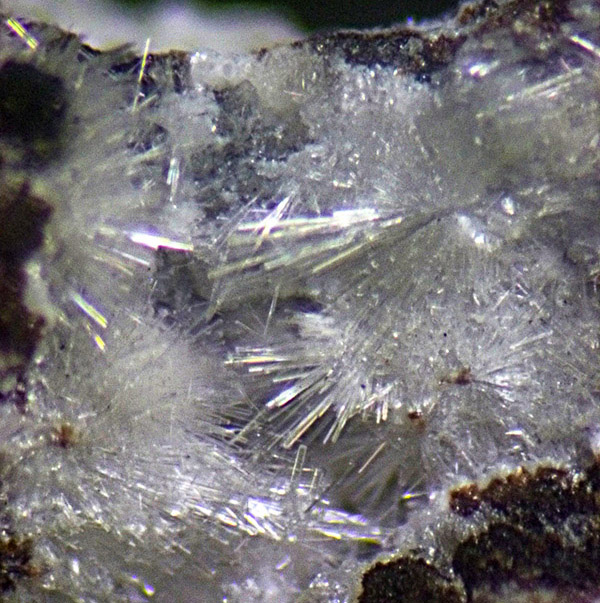
Its hexagonal pyramidal symmetry arises from the six-fold organisation of beryllium-phosphate tetrahedra. Crystals form as small hexagonal prisms or tabular habits, typically colourless to pale white with a glassy to resinous lustre. The moderate hardness (4–5 Mohs) is consistent with its mixed-metal phosphate composition.
Tiptopite was first described in 1984 from specimens collected at the Tip Top Mine, Custer, Custer County, South Dakota. The Tip Top Mine has been worked since the 1870s and is famous for an exceptional suite of secondary phosphate minerals that formed through the hydrothermal alteration of primary lithium and beryllium phases in the granitic pegmatite body. The mine has yielded multiple new mineral species over the decades, and tiptopite is one of several rare beryllium and lithium phosphates either exclusive to this locality or first identified here.
Outside the Tip Top Mine and a small number of closely related South Dakota pegmatites, tiptopite is extremely rarely encountered. Its formation requires the rare convergence of high beryllium, lithium, potassium, sodium, and phosphate concentrations — a geochemical combination that makes its parent pegmatite environments among the most mineralogically unique on Earth.
"The winds of grace are always blowing, but you have to raise the sail."— Ramakrishna
Tiptopite carries Blessing and Life energy centred at the Third Eye, the Ajna. Blessing is the gentlest of all the energy movements — it descends, like grace from above, clearing the path rather than forcing it open. It is the very opposite of the kundalini's upward fire, and it works with it: where kundalini can build pressure and heat, a blessing cools and calms, dissolving blockages from the upper end of the sushumna so the rising energy meets an already-clearing channel. Married to the vitalising quality of Life, tiptopite quietly lights the inner eye from within, adding luminosity to awareness without agitation.
It is lower in frequency yet easily confused with Mazzite, as their energies feel close. Tiptopite keeps the energy more inside the body while Mazzite works far beyond the physical; but do not underestimate tiptopite — its action is direct and sharp.
This inward gathering is its signature. Where some Third Eye crystals scatter awareness outward into wide fields, tiptopite draws it back toward a single concentrated point — the precise location of the inner eye itself. The movement is a convergence rather than an expansion: everything gathered, focused, and sharpened at the centre of perception.
"Silence is the highest form of prayer. In the stillness of the mind, the voice of the Infinite is heard."— Trailanga Swami
Its short duration makes it a session crystal rather than a constant companion. The effect arrives quickly, peaks in a clear, sharp inner seeing, and subsides once the sitting ends — which makes it well suited to deliberate meditation: hold it while you sit, set it down when you are done. The Blessing nature is also its protection. It does not overwhelm or destabilise; it descends with the reliability of grace, and like grace it does not force. It simply makes the inner eye available to whoever is willing to look.