

Zn2(PO4)(OH)
a clear stone that quietly sorts the inner clutter until the heart can breathe
Tarbuttite is named in honour of Percy Coventry Tarbutt, a director of the Broken Hill Exploration Company who played a central role in developing the zinc-rich mining operations at Broken Hill (now Kabwe) in what was then Northern Rhodesia, present-day Zambia. The name was formally proposed by the British mineralogist L. J. Spencer in the journal Nature in 1907, shortly after the mineral was identified in the oxidised zone of the mine. The suffix -ite follows the standard mineralogical convention for honouring a person.
Tarbuttite is a zinc hydroxyphosphate belonging to the triclinic crystal system with pinacoidal symmetry. Its structure is built around zinc atoms coordinated to phosphate tetrahedra (PO4) and hydroxyl (OH) groups, forming equant to short prismatic crystals that can reach up to two centimetres in length. The triclinic system — the lowest-symmetry crystal system, with no axes or planes of symmetry — gives tarbuttite its sharply individuated, asymmetric form, each crystal unique in its exact angles.
Colour varies widely: white and colourless specimens are most common, but copper impurities can tint crystals green, iron hydroxides lend yellow, red, or brown hues, making each locality recognisable by its particular palette.
Tarbuttite was first described in 1907 from the Broken Hill mine — later renamed the Kabwe mine — in what is today Zambia (then Northern Rhodesia). The deposit at Kabwe was one of the richest zinc-lead orebodies ever worked in Africa, and its deep oxidation zone proved a prolific source of exotic secondary phosphate minerals. Tarbuttite forms there as a secondary mineral where phosphate-bearing solutions interact with the zinc-rich primary ores.
Beyond Zambia, tarbuttite has since been confirmed at localities in Australia, Namibia, Algeria, Angola, China, Canada, and the United States, always appearing in the oxidised caps of zinc deposits alongside related phosphates such as hopeite and pyromorphite. It is an uncommon but not excessively rare species — recognised and accepted as a valid mineral species when the International Mineralogical Association was established, grandfathered into the official list on the strength of its 1907 description.
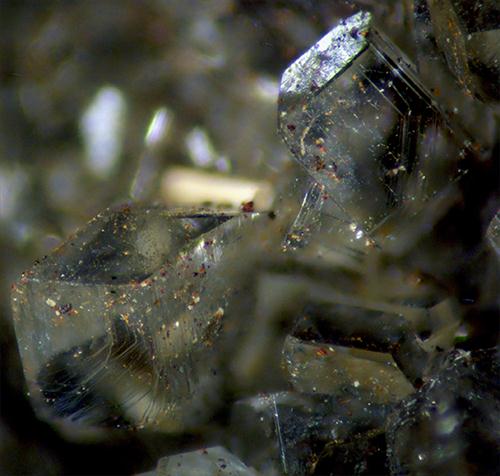
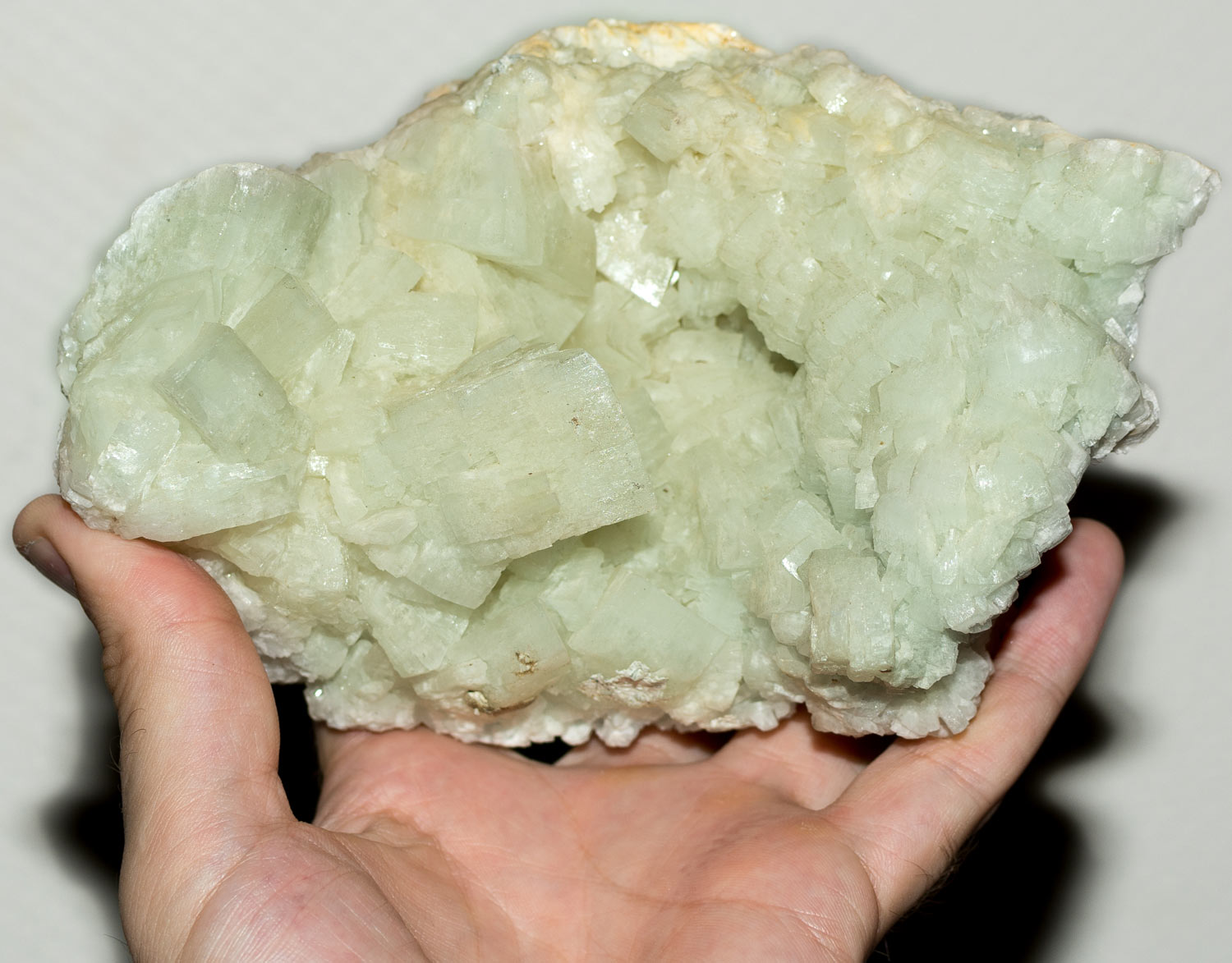
Tarbuttite crystallises in the triclinic system — the geometry of total asymmetry. No face mirrors another; no axis repeats. The result is a sharply oblique prism with a quiet precision to its angles, each crystal its own irreducibly individual form. This structural uniqueness is immediately visible: tarbuttite never looks generic.
Pure tarbuttite is colourless or white, yet specimens are found in yellow, red, brown, and green — each tint the signature of a different trace element. Copper renders the crystals a soft celadon green; iron hydroxides warm them toward amber and rust. The same mineral formula can look entirely different depending on the local chemistry of the deposit, making tarbuttite a living record of its geological environment.
Tarbuttite does not form in primary igneous or metamorphic rock. It is a secondary mineral, born only when oxidising groundwater reacts with zinc-rich primary ores, dissolving and reprecipitating the material into entirely new crystal forms. Every tarbuttite specimen is thus a product of transformation — old ore chemically reorganised into something transparent and precise.
"As the consciousness within a man grows, he must be aware of the life and death cycle that accompanies moving from level to level."— Swami Rudrananda
There is a particular kind of tiredness that has nothing to do with sleep. You wake up already burdened — the unread messages, the half-finished intentions, the low hum of everything that was meant to be addressed and wasn't. The mind is not broken, not dark, just crowded. Tarbuttite enters that crowding the way light enters a cluttered room: it does not demand anything be thrown away. It simply makes the mess visible, and in the seeing, something quietly begins to sort itself.
This stone works at the level where heart and mind are not yet two things. The heart centre — the meeting point of everything above and below, the place where the personal and the impersonal first touch — can become wadded with accumulated noise: small decisions deferred, old arrangements never tidied, the emotional residue of things that were never quite resolved. Tarbuttite's action is patient and unhurried. It does not clear dramatically. It holds the frequency of organisation itself — the felt sense of a drawer that has been sorted, a path that has been swept, a desk cleared enough that the wood grain shows again.
Work with it and you may notice that thoughts arrive less tangled. The interior space becomes navigable. There is a quality of breath returning to the chest — not a rush of energy, not a flood of feeling, but the quiet relief of room. The body notices before the mind names it: the shoulders drop a fraction; the jaw unclenches; something that was held begins to be laid down.
The Quiet WorkBecause its reach extends over several hours and days rather than a brief contact window, tarbuttite has time to find the layers that a passing energy cannot reach. Physical clutter in the outer environment — the pile on the desk, the unresolved corner of the room — often mirrors an inner congestion that pre-dates it. Tarbuttite seems to address both at once, not through any magic of causation but because clarity tends to propagate: one drawer sorted, one thought completed, and the adjacent ones become easier. People who sit with this stone for a session or two frequently report a spontaneous urge to reorganise — not from anxiety, but from a new sense that order is actually pleasant, even restful.
"A quiet mind is all you need. All else will happen rightly, once your mind is quiet."— Nisargadatta Maharaj
Tarbuttite does not push. It does not generate heat or intensity; its pace is closer to the slow settling of silt in water. Ask yourself — gently, the way Robert Adams might — what it is you actually need right now, beneath the list. Usually the answer is simpler than the list suggests. It is to feel like yourself again. To find the thing you meant to attend to and attend to it. To have the heart's attention freed from the clutter of maintenance so that it can do what it is actually built for: to be open, to receive, to connect. When the interior is sorted enough that the heart can breathe again, that breathing is not nothing. It is the beginning of everything.