

Cu3(MoO4)(OH)4
Joy is inward, not outward — the body's own quiet happiness
Szenicsite is named after T. Szenics — the collector who first discovered and collected specimens of this mineral. The same individual is also credited with the discovery of penfieldite specimens from their locality. The naming honours the collector's role in bringing this extremely rare copper molybdate to mineralogical attention, following the tradition of naming secondary minerals after their discoverers when those discoverers are not professional mineralogists but dedicated specimen collectors.
Szenicsite is a copper molybdate hydroxide — a rare secondary mineral formed in the highly oxidized zones of copper-molybdenum ore deposits. Three copper atoms link to one molybdate group and four hydroxide groups in an orthorhombic framework. The vivid emerald-green to grass-green color is produced by the copper chromophore — the same ion responsible for the green colors of malachite, dioptase, and other copper minerals. The combination of molybdate and copper in a single mineral is chemically unusual, explaining its extreme rarity.
Szenicsite was discovered by collector T. Szenics — the same individual who found notable penfieldite specimens. It is among the rarest of the copper molybdate minerals, known from only a small number of localities worldwide. Its formation requires the co-occurrence of copper, molybdenum, and oxidizing conditions — a combination that is mineralogically unusual. The specimens that do exist typically show brilliant green crystals on dark matrix, making them highly sought after by collectors despite their extreme scarcity.
Szenicsite contains copper — a toxic heavy metal that can be harmful in elevated concentrations. Do not handle with bare hands for extended periods, do not crush or grind, and keep away from children and animals.
Wash hands thoroughly after handling. Do not place in water intended for consumption. Store in a sealed display case.
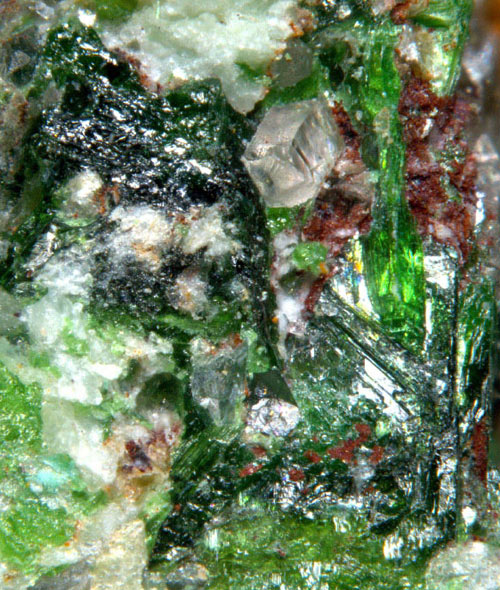

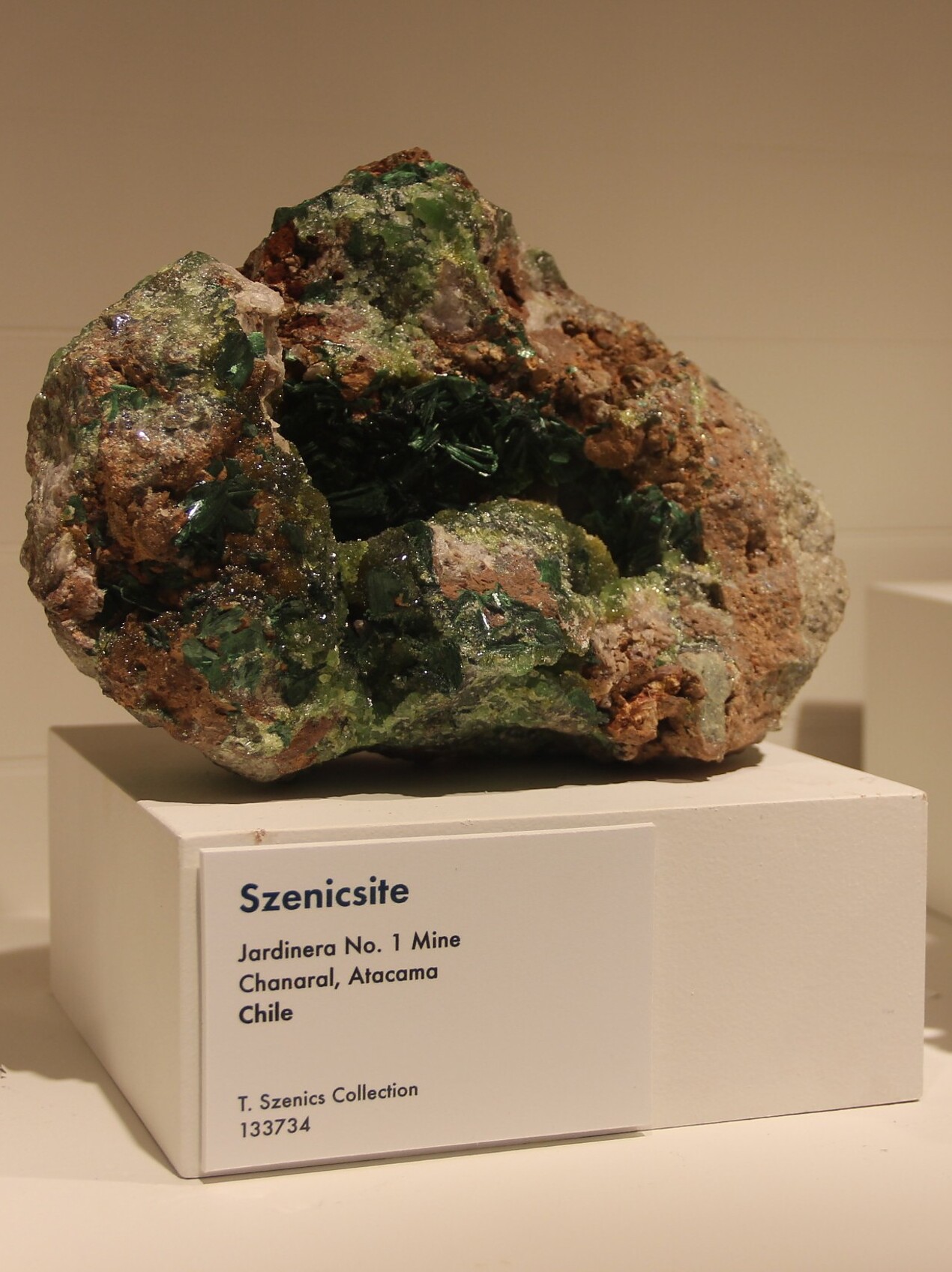
The combination of copper and molybdate in a single mineral is exceptionally rare in nature. The vivid emerald-green color produced by the copper chromophore in szenicsite is among the most saturated greens seen in any secondary mineral, arising from the specific coordination geometry of copper in the orthorhombic molybdate framework.
Szenicsite fluoresces under UV light despite its copper content, which typically acts as a fluorescence quencher in many other minerals. This makes szenicsite optically doubly remarkable: vivid green in visible light, and active under UV — a mineralogical rarity in both domains simultaneously.
"Happiness is your nature. It is not wrong to desire it. What is wrong is seeking it outside when it is inside."— Ramana Maharshi
This crystal brings the energy inwards, making it very direct, light and joyful — it makes the life energy flow inward. Happiness belongs to the mind and faces outward; joy is more inward and more of the body, so this is not so much a happy crystal as a joyful one.
Joy, Not HappinessThe distinction is the key to szenicsite. Happiness is a mental state, arising when outer conditions are favourable and the mind gets what it wants — outward-facing and circumstance-bound. Joy is different: a somatic feeling-tone that rises from within the body itself, regardless of conditions, the vitality present whenever the life-force flows freely and nothing in the system is clenched. As a Life crystal szenicsite feeds exactly that current, and as a Grounding energy it draws it inward and down into the body rather than out into mental activity.
"There is light in the heart; there is no darkness in it."— Nityananda
It works steadily and directly. Its home in the Third Eye, the Ajna, means the inward turning it promotes is not only of the body but of perception — it opens a clear inner seeing, free of mental commentary, the thoughtless pure experiencing in which joy simply remains. The vivid green of the stone mirrors the energetic it carries: active, living, present.