

Ca6Fe3+2(SO4)2[B(OH)4](OH)12·26H2O
a soft golden light that warms the bruised heart and finds words for the wordless
Sturmanite is named in honour of Bozidar Darko Sturman (born 1937), a Croatian-Canadian mineralogist who served as Curator Emeritus of mineralogy at the Royal Ontario Museum, Toronto. His meticulous work cataloguing rare minerals of the Canadian shield and beyond earned him lasting recognition in the field.
The name follows the long-standing mineralogical tradition of commemorating scientists through the minerals they help document. It was formally approved by the International Mineralogical Association (IMA) in 1983, when the species was first described from specimens collected at the Black Rock Mine in the Kalahari manganese field of South Africa.
Sturmanite belongs to the ettringite group of hydrated calcium sulfoaluminate minerals, a family characterised by their columnar or prismatic hexagonal crystals and exceptionally high water content — in sturmanite's case, approximately 26 water molecules per formula unit. The iron (Fe³⁺) in sturmanite replaces the aluminium found in its close relative ettringite, and a borate group [B(OH)₄] distinguishes it further from other members of the group.
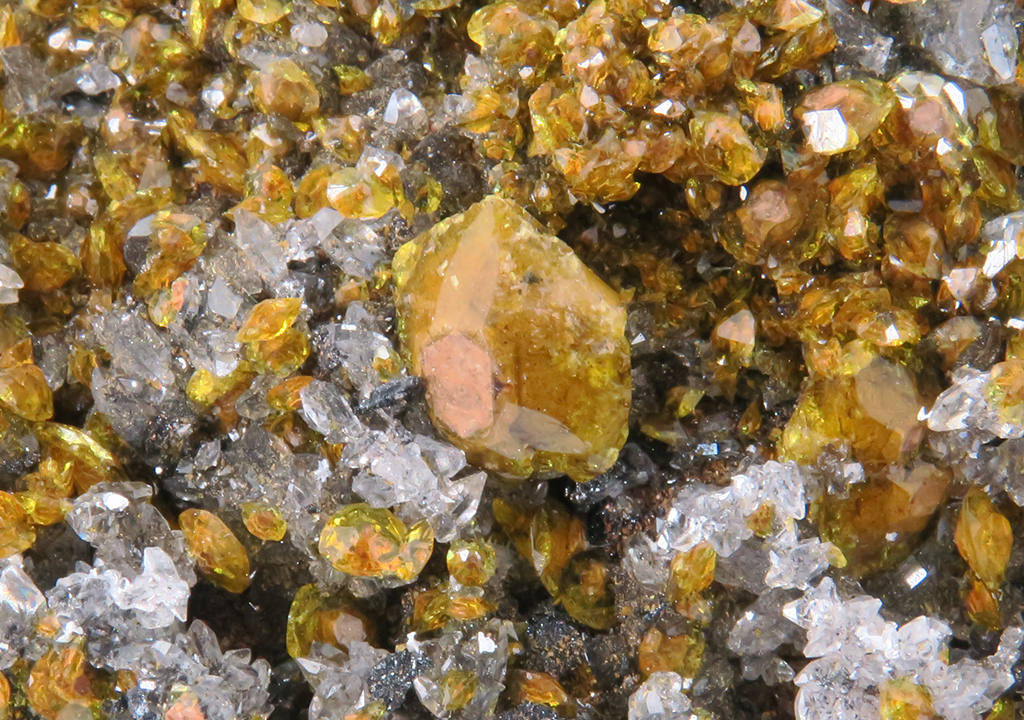
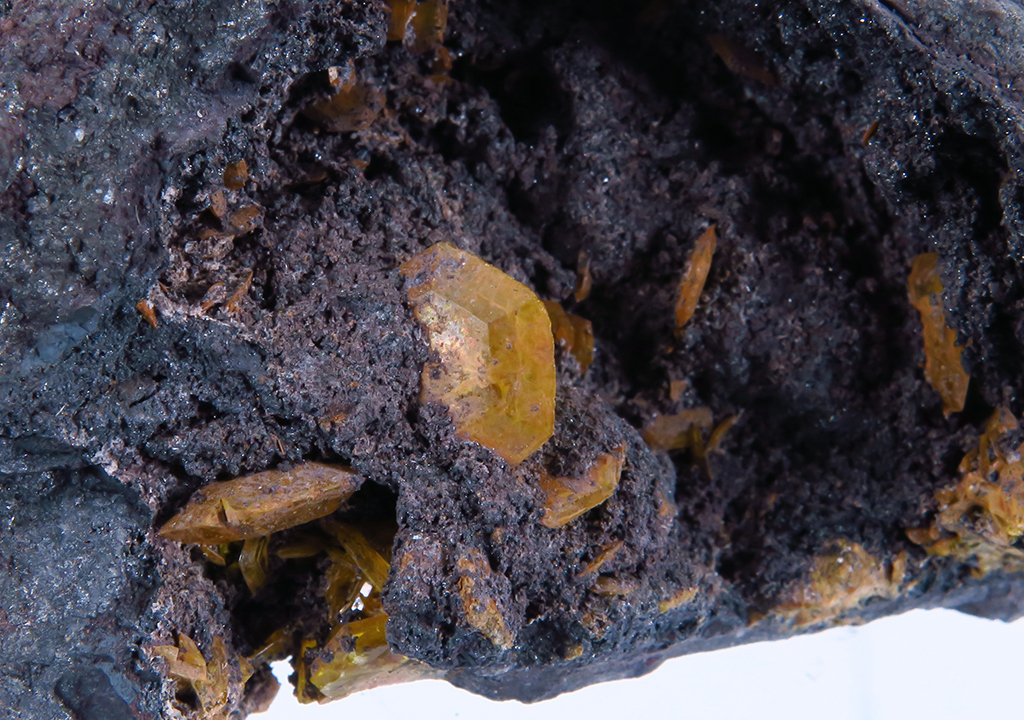
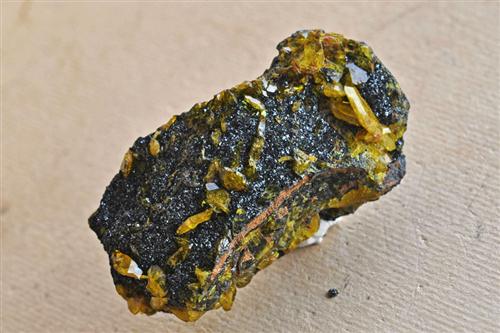
Crystals are typically hexagonal prisms or pyramids and display a vivid bright yellow to amber colour arising from the iron content. The mineral's softness (Mohs ~2.5) and fragility reflect its loosely bonded, water-rich structure. Because it is part of the ettringite family, sturmanite is susceptible to dehydration: in dry or warm air it can lose structural water, causing transparency to fade and surfaces to cloud over.
Sturmanite was first described in 1983 from specimens found at the Black Rock Mine in the Kalahari manganese field of the Northern Cape Province, South Africa — one of the world's most remarkable concentrations of manganese ore. The same vast deposit hosts the famous N'Chwaning, Wessel's, and Perth mines, all of which have since yielded fine sturmanite specimens alongside an extraordinary suite of associated minerals including hausmannite, braunite, and calcite.
The Kalahari manganese field remains the primary and most prolific source of sturmanite worldwide. The mineral occurs as a secondary phase in oxidised manganese ore bodies, forming in cavities and fractures where calcium-rich hydrothermal fluids circulate through iron- and boron-bearing rock. Additional occurrences have been documented in Russia, near Lakargi Mountain in the North Caucasus, though South African material dominates museum collections and the collector market.
Few minerals achieve the pure, warm yellow that sturmanite displays. The colour is intrinsic to the crystal structure — iron (Fe³⁺) substituting for aluminium within the ettringite framework creates an intense golden to amber transparency that becomes richer in well-formed prismatic specimens. Under good lighting, even small crystals glow as though lit from within.
With approximately 26 water molecules per formula unit and a borate group locked inside a calcium-iron framework, sturmanite's crystal structure is unusually complex for a mineral of such modest hardness. This high water content is what gives the ettringite group its characteristic column-like crystal habit — and also what makes these minerals among the most sensitive to environmental changes of any collectible species.
Virtually all gem-quality sturmanite on the collector market comes from a single geological province: the Kalahari manganese field of South Africa's Northern Cape. This concentrated origin — and the spectacular companion minerals found alongside it in cavities at N'Chwaning, Wessel's, and Black Rock — makes sturmanite as much a document of a specific place on Earth as it is a mineral species in its own right.
As a member of the ettringite group, sturmanite is structurally dependent on its high water content. In dry or heated air it gradually loses water molecules from the crystal lattice, causing the surfaces to turn opaque or cloudy and the once-vivid yellow clarity to dull irreversibly. Store sturmanite away from heat sources, air-conditioning vents, and direct sunlight. A sealed display case or a closed cabinet maintained at stable moderate humidity (45–60% RH) is ideal. Do not clean with dry cloths or compressed air.
"To be relaxed and let go in the moment of recognizing — that is the most important thing."— Tulku Urgyen Rinpoche
There is a kind of pain that lives below words. Not the sharp kind, not the kind you can name over coffee — but the older kind, the one settled into the walls of the chest, the one that came from something that happened a long time ago and never quite finished happening. Sturmanite is for that pain. Its energy is soft, warm, and unhurried. It does not force an opening. It simply rests at the solar plexus — the great holding centre, where the body stores what the mind could not process — and begins, gently, to warm what has been held cold.
Softening the Held HeartThe work this stone does is the work of long duration. It is not a quick release; it is the kind of shift that happens the way winter gives way to spring — imperceptibly at first, then suddenly obvious. A person sitting with sturmanite over weeks may notice that a grief they thought permanent has grown lighter, not because it was argued away, but because the stone kept returning warmth to the place where the heaviness lived. The solar plexus, when burdened, makes a person smaller — contracting the will, dimming the appetite for life. Sturmanite works on that contraction the way sunlight works on a closed fist: not forcing it open, just making it less necessary to stay shut. You begin to feel, again, that life has room in it — that the body is a place worth inhabiting.
Finding Words for the WordlessThere is a second gift, quieter but equally real. Some things we carry are not only painful — they are complex. The feeling you could never explain to anyone, not because it was too large but because no single sentence could hold its shape. Sturmanite assists in finding the thread of articulation that runs through even the most tangled inner experience. Sitting with it, something loosens in the way a thought forms — the gap between feeling and expression narrows. You find yourself able to say, at last, something closer to what you actually mean.
"Love is essentially self-communicative: those who do not have it catch it from those who have it."— Meher Baba
What passes between people when this stone is present is something like that. The old armour that pain builds — the guardedness, the habit of holding the real thing back — relaxes just enough that what is true can move from one person to another. Sturmanite does not manufacture sentiment; it simply removes a little of what was in the way. And in the space that opens, something genuine finds its path outward — as naturally as warmth moves from a held stone into a waiting hand.