
Fe³⁺PO₄·2H₂O
Sharp mind, silent heart — and infinite horizontal space
Strengite is named after Johann August Streng (1830–1897), a German mineralogist and professor at the University of Giessen. Streng was a specialist in chemical mineralogy and made important contributions to the understanding of phosphate mineral chemistry in the 19th century. The mineral was named in his honor in 1877 by the Austrian mineralogist Gustav Adolf Kenngott. Strengite is part of the variscite group — a family of hydrated metal orthophosphates sharing the same orthorhombic structure — and is by far the most energetically powerful member of that group.
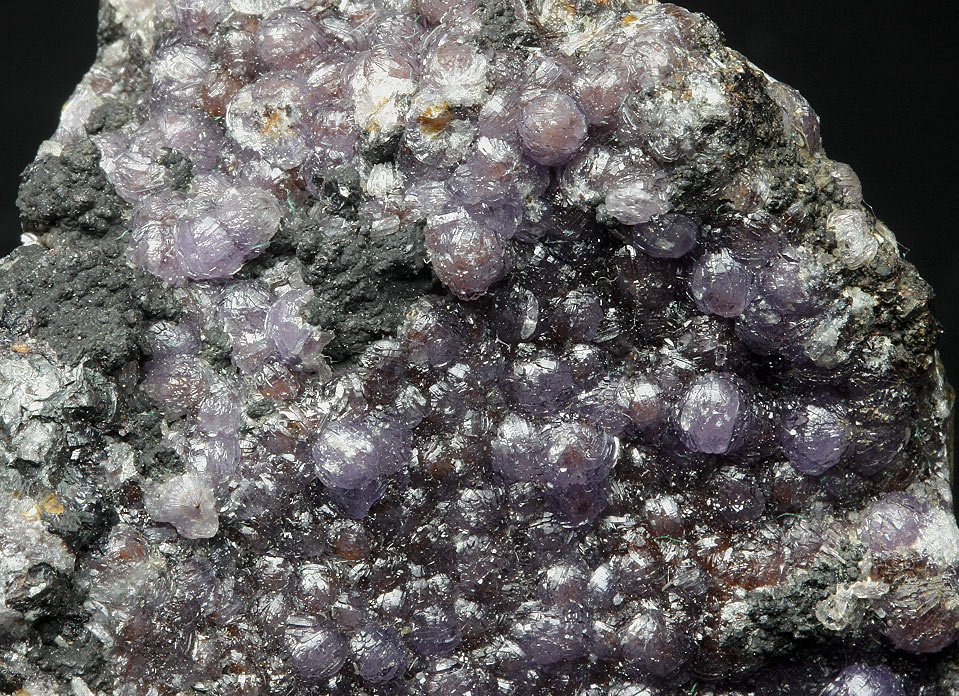
Strengite is the ferric iron (Fe³⁺) member of the variscite group, which also includes variscite (Al) and scorodite (As). In strengite, trivalent iron is coordinated octahedrally by oxygen atoms from the phosphate groups and the two water molecules of crystallization. The PO₄ tetrahedra and FeO₄(H₂O)₂ octahedra are linked by corner-sharing into a three-dimensional orthorhombic framework. The color ranges from colorless through pale pink to violet-pink and deep red-violet, with color intensity depending on the degree of Fe³⁺ content and any Mn substitution. Fine specimens show a delicate lilac to pinkish-violet color with vitreous luster and good transparency.
Crystals are typically small — often less than a millimeter across — and occur as tabular, dipyramidal, or pseudo-octahedral forms on matrix. They are commonly found as crusts or druses on limonite-rich matrix from altered phosphate pegmatites.
Strengite was first described in 1877 from phosphate-bearing iron ore deposits. The finest and most energetically powerful specimens come from the Leveaniemi iron mine in Svappavaara, northern Sweden — a LKAB magnetite ore deposit where phosphate-rich secondary minerals have crystallized in extraordinary quality. The Leveaniemi material produces brilliant violet-pink crystals on limonite matrix, often with an almost gemmy clarity.
Other significant localities include the Boa Vista Pegmatite in Minas Gerais, Brazil, which produces pale pink to rose-colored crystals in phosphate pegmatites, and Kreuzberg in Bavaria, Germany, where pale colorless to faintly tinted crystals occur in iron-rich metamorphic rocks. Additional occurrences are known from Portugal, the Czech Republic, and France.
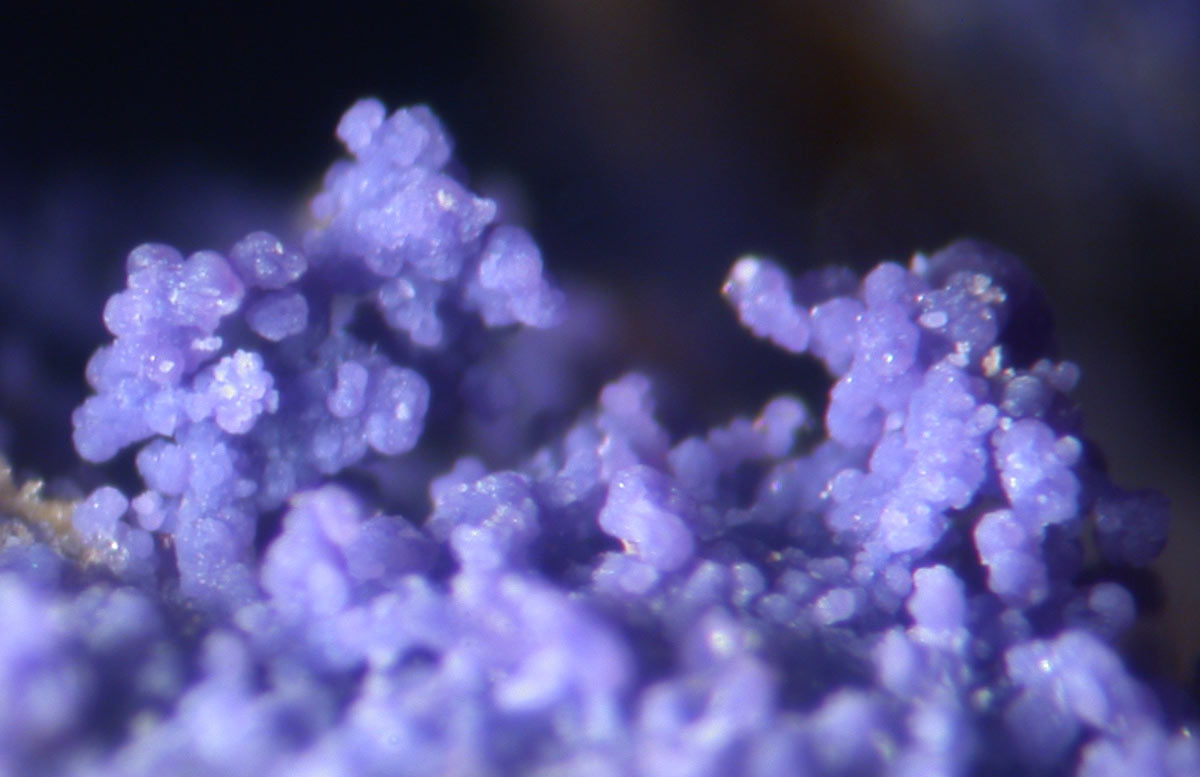


Strengite crystallizes in the dipyramidal class (2/m 2/m 2/m) of the orthorhombic system — a centrosymmetric point group. The characteristic crystal forms are dipyramids, prisms, and pseudo-octahedra. The orthorhombic symmetry produces three mutually perpendicular, non-equal axes, giving strengite a distinctive pseudo-cubic habit in some specimens while remaining unmistakably orthorhombic in crystallographic analysis.
Strengite is optically biaxial negative with refractive indices α = 1.690, β = 1.714, γ = 1.732 and a birefringence of 0.042. Under the polarizing microscope it shows moderate interference colors and strong dispersion of the optic axes. The strong pleochroism (colorless to pale violet to deeper violet across the three optical axes) makes it identifiable in thin section even when crystals are very small.
The presence of Fe³⁺ (d⁵, high-spin in octahedral coordination) makes strengite weakly paramagnetic. All five d-electrons are unpaired in the high-spin configuration, producing the maximum paramagnetic moment for a first-row transition metal. This iron center is also responsible for strengite's delicate pink-violet coloration through ligand field transitions, and gives the mineral a measurable response to a strong permanent magnet.
"Silence is truth. Silence is bliss. Silence is peace. And hence Silence is the Self."— Ramana Maharshi
Man, do I love this crystal. It simply makes you happy with a sharp, clear mind. It blows away the mental garbage and makes room for the empty mind to connect to a silent heart — and it has a way of stretching the heart's space horizontally, out to infinity.
The Most Powerful Vishuddha OpenerIt is the most powerful opener of the Throat, the Vishuddha. Where most throat stones work at the level of communication and expression, strengite reaches deeper — to the boundary between the mind and the silence beneath it. This is where the ego builds its wall, the blockage that keeps the heart from rising into the mind; strengite dissolves it. The mental clarity it gives is not the clarity of more or better thoughts but of fewer thoughts altogether, until the silent heart becomes audible and the Joy of that empty, unclouded experiencing remains.
"A quiet mind is all you need. All else will happen rightly, once your mind is quiet."— Nisargadatta Maharaj
The way it stretches the heart-space horizontally toward the infinite is a quality rarely met in crystals. Most work vertically, up and down the chakra column; strengite radiates laterally in the Expanding way, widening the container of the heart outward in every direction at once. Some people I have given it to do not feel its power as strongly as my wife and I do — so judge for yourself.
Location QualityThe most powerful strengite comes from the Leveäniemi mine in Sweden. The Boa Vista pegmatite in Brazil gives good, effective crystals, and the Kreuzberg material from Germany is gentler but still beautiful. As with most crystals, the finer the specimen, the more pronounced the response.