

Ca4(Al8Si28O72)·28H2O
a soft white light that helps the body say yes to what has already changed
Stellerite takes its name from Georg Wilhelm Steller (1709–1746), the German-Baltic naturalist who sailed with Vitus Bering's Great Northern Expedition and became the first European scientist to document the fauna of Alaska and the Kamchatka Peninsula. Though Steller never studied minerals himself, the zeolite was named in his honour by the Canadian chemist Henry How in 1873, who first described specimens collected at Wolfville, Nova Scotia — the mineral's type locality. The name was a tribute to Steller's legacy of natural discovery in remote regions of the world.
Stellerite belongs to the zeolite family — a class of framework silicates whose tetrahedral AlO4 and SiO4 units are linked into open three-dimensional channels that host both calcium cations and water molecules. This porous architecture is the key to the mineral's behaviour: the channels can exchange water freely with the surrounding atmosphere, which gives zeolites their remarkable adsorption properties but also their vulnerability to moisture change.
The orthorhombic symmetry places stellerite in the stilbite subgroup alongside its close relatives stilbite and barrerite; it is essentially the calcium-dominant end-member of that series. Crystals are typically tabular to platy, often gathered into characteristic bow-tie or sheaf-like fan aggregates. The colour runs from colourless to white and pale peach or cream; the lustre is pearly on cleavage faces, vitreous on prism faces. Specific gravity is approximately 2.18 and birefringence is low (δ ≈ 0.013).
The type locality is Wolfville, Nova Scotia, Canada, where Henry How first identified and described the mineral in 1873. Since then stellerite has been found across a broad belt of volcanic and hydrothermal terrain. Notable occurrences include the basalt-hosted zeolite deposits of the Deccan Traps in Maharashtra and Gujarat, India — among the most prolific sources of large, well-formed specimens — as well as the Faeroe Islands, Iceland, and the classic Norwegian localities near Arendal and in the Oslo Rift, which yield superb transparent crystals on matrix. Additional localities are documented in Morocco, Japan, and parts of the western United States.
Stellerite forms in the cavities and vesicles of basic volcanic rocks — basalts and andesites in particular — as hydrothermal and low-temperature secondary minerals precipitating from circulating alkaline groundwaters rich in calcium and silica. It frequently occurs alongside other zeolites such as stilbite, heulandite, apophyllite, and calcite, sharing the same geochemical niche in cooling lava flows.
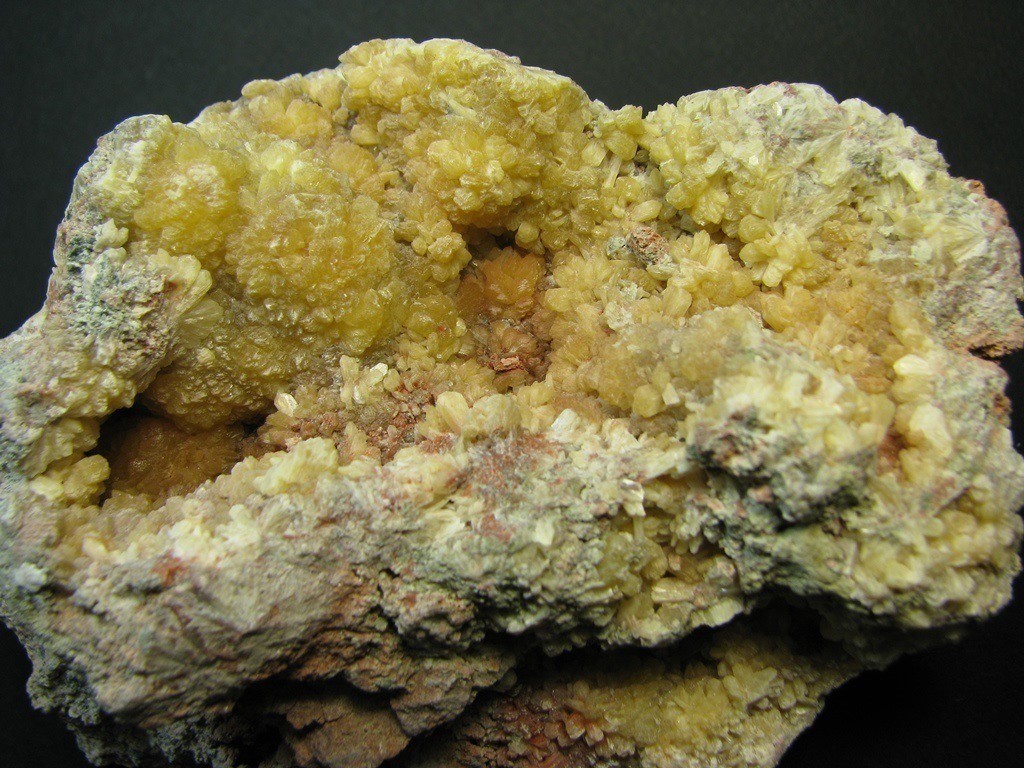
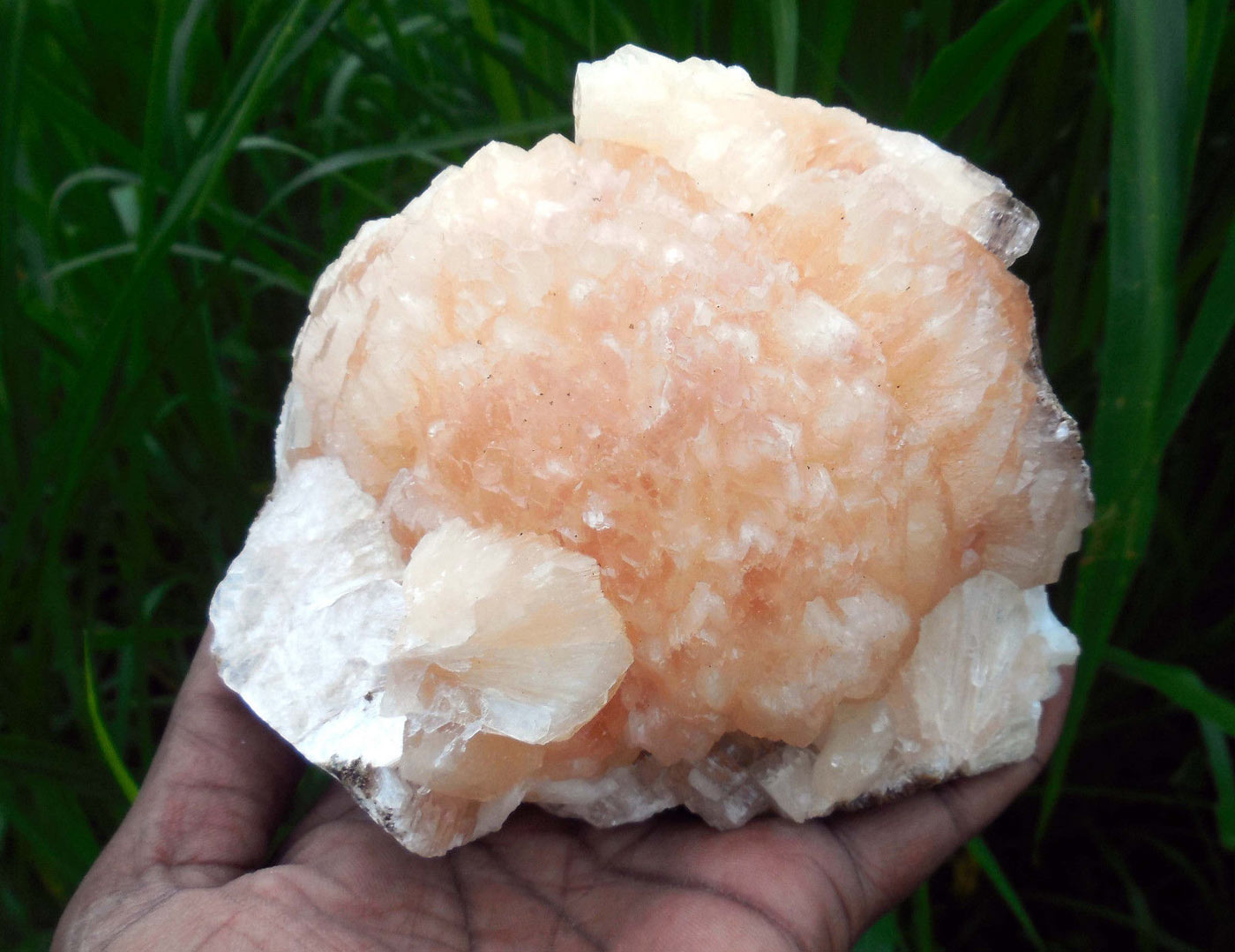


Stellerite almost never presents a single blade in isolation; individual tabular crystals instinctively arrange themselves into splaying fan or sheaf-like aggregates that radiate from a common centre — a growth pattern that makes every specimen look like a frozen moment of opening. The bow-tie twin form is considered the hallmark of the stilbite subgroup, and stellerite expresses it with particular elegance.
Unlike most minerals whose internal space is closed, stellerite's framework silicate channels remain open to the outside world. Water molecules within those channels are in slow but continuous dialogue with ambient humidity: the mineral breathes. This property gives the zeolite group their technological value as molecular sieves and ion exchangers, and it is exactly what makes stellerite so responsive — and so sensitive — to its environment.
Stellerite, stilbite, and barrerite form an isomorphous trio that differ only in which cation occupies the channel sites: calcium (stellerite), sodium-calcium (stilbite), and sodium (barrerite). The three can be visually indistinguishable and require X-ray diffraction or chemical analysis for confident identification. Many museum specimens labelled "stilbite" from older collections are, on modern analysis, stellerite.
As a zeolite, stellerite holds water molecules inside its open framework channels. In very dry or hot conditions — heated display cases, air-conditioning vents, direct sunlight — that water is drawn out faster than it can be replenished, causing the crystal lattice to contract unevenly and the surface to craze or develop a network of fine cracks. Keep stellerite away from direct heat sources, sunny windowsills, and desiccating airflows. A stable indoor environment at moderate humidity (40–55% RH) is ideal. The mineral is not water-soluble and can be briefly rinsed if dusty, but prolonged soaking is unnecessary.
"Realise the true meaning of 'I' and 'Thou'. To the Gnani who has attained the state of non-duality, the distinction vanishes."— Gnananda
There is a moment — and most people know it well — when something in life has already ended, and the mind has not yet agreed to let it go. The relationship is over, the season has turned, the door has swung shut. But the body still holds its old shape, still braces for a world that no longer exists. This is the exact territory stellerite works in. It does not speed the grief or rush the dissolving. It simply sits with you in that gap between what was and what now is, and very quietly, over hours and days, it begins to soften the bracing.
The quality it brings is not a new energy but a gradual loosening — the way a held breath finally releases, not in a rush but in slow stages. The solar plexus, where we store our need to hold things in place, where will clenches against unwanted truth — that centre softens first. Something in the gut unclenches by a degree, then another, without fanfare. The mind, still arguing, notices that the body has quietly moved on ahead of it.
What stellerite addresses most precisely is the end of a relationship. Not the anger or the grief, which other stones speak to more forcefully — but the peculiar resistance that comes after grief, the place where the self still cannot quite believe that what it loved has genuinely gone. The stone works like water seeping into stone: not dramatic, not fast, but continuous across the medium duration of days, reaching into the layers where the belief is held that things should have been different.
"Forget the past. The vanished lives of all men are dark with many shames. Human conduct is ever unreliable until man is anchored in the Divine. Everything in future will improve if you are making a spiritual effort now."— Shri Yukteswar
The stone teaches — not in words — that change is not the enemy of the self, it is the medium through which the self continues. The fan-shaped clusters that stellerite grows in, those splaying arrays of blades opening from a centre, are themselves a quiet image of what the stone does: the centre holds while everything around it opens outward, past the old boundary, into the new space that is already there waiting. Being softer in change does not mean being weak in it. It means the body stops fighting the wave and begins, instead, to move with it.
For anyone sitting with the specific ache of a broken bond — the love that did not last, the friendship that ended, the family shape that dissolved — stellerite offers something gentle and genuinely useful. Carry it. Let it sit near you while you sleep. Do not expect revelation. Expect, instead, that one morning the bracing will simply be a little less, and then a little less again, until the day when you notice, without effort, that you have already crossed over into acceptance.