
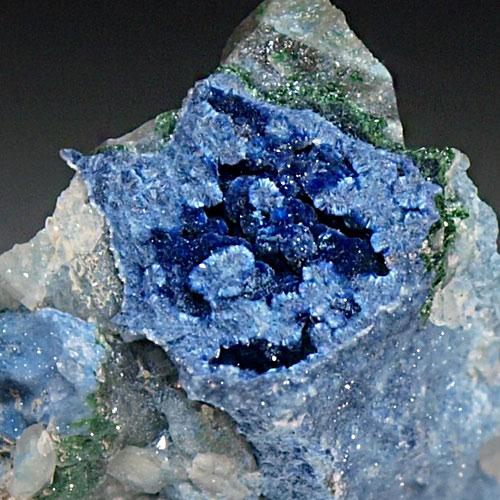
Cu5(SiO3)4(OH)2
a deep blue stone that opens a clear, true line between the inner and the outer voice
Shattuckite takes its name from the Shattuck Mine in Bisbee, Cochise County, Arizona — the locality where the mineral was first collected and described. The mine itself was named after the Shattuck family, prominent early developers of the Bisbee copper-mining district. The mineral was formally described as a distinct species in 1915, making it a relatively modern addition to mineralogy despite Bisbee being one of the most celebrated mineral-producing districts in North America.
Shattuckite is a copper silicate hydroxide classified as an inosilicate — a chain silicate in which linked SiO₄ tetrahedra form continuous single chains running through the structure. Five copper atoms are bound together with four silicate chains and two hydroxyl groups per formula unit. Its orthorhombic symmetry produces crystals with three mutually perpendicular axes of unequal length, typically expressing as fibrous, acicular (needle-like) masses or spherulitic (radiating) aggregates. The intense deep blue to turquoise colour is characteristic of secondary copper minerals formed through the oxidation and alteration of primary copper ore deposits.
Shattuckite was first described in 1915 from specimens collected at the Shattuck Mine in Bisbee, Cochise County, Arizona — one of the most celebrated copper-mining districts in North American mineralogical history. Bisbee's oxidation zone has produced an extraordinary variety of secondary copper minerals, and shattuckite formed there as a late-stage alteration product in the oxidised upper portions of copper ore deposits.
The mineral forms wherever copper-bearing solutions interact with silica under oxidising conditions. Notable occurrences beyond Arizona include the Kaokoveld copper district in Namibia, as well as various copper mines in the Democratic Republic of Congo, Norway, and Greece. Shattuckite is frequently found in close association with other secondary copper minerals such as malachite, azurite, chrysocolla, and plancheite, and is particularly renowned for its habit of forming vivid pseudomorphs after malachite — preserving the characteristic botryoidal and prismatic shapes of malachite crystals while replacing the original mineral with deep blue shattuckite.
Shattuckite is a secondary copper mineral. Copper compounds can be harmful if ingested or if fine dust is inhaled. Do not place in drinking water or use in gem elixirs prepared by direct contact. When handling raw or powdery specimens, wash hands thoroughly afterwards and avoid generating dust. Admire and work with it respectfully — external use and meditation proximity carry no risk, but direct ingestion or dust inhalation must be avoided.
Shattuckite's colour is among the most saturated deep blues in the secondary copper mineral world — a rich, almost electric hue produced by copper's interaction with silicate chains in the orthorhombic structure. In fibrous aggregates the mineral shows a silky, almost velvet lustre, with individual acicular crystals scattering light across their surfaces to create depth and movement that flat photographs rarely capture.
One of shattuckite's most celebrated physical signatures is its habit of forming complete pseudomorphs after malachite. As copper-bearing solutions percolate through weathered ore zones, shattuckite silicate ions gradually replace malachite carbonate ions atom by atom — preserving every curve and striation of the original malachite crystal while swapping its green for blue. These "ghost malachites in blue" are prized specimens that record a chapter of geological transformation visible at the hand-specimen scale.
Shattuckite frequently crystallises in spherulitic (radially fibrous, globe-like) aggregates, with thousands of hair-thin needles radiating outward from a common centre. This growth form, driven by the rapid crystallisation typical of secondary oxidation zones, produces rounded, velvety blue balls that look almost botanical — more like deep-sea anemones than mineral specimens.
"If you keep a light before a thousand people, it reaches all without making any distinction."— Bhagawan Nityananda
There is a place in the body where the inner life and the outer world meet — a narrow passage between knowing and speaking, between what moves in the depths and what finally arrives in the air as word or sound. For most people, something stands guard there. Not cruelty, not even deliberate silence — only the old habit of protection, the long-ago learned reflex of holding back before the mouth can be wrong or judged or silenced by someone else. The wall was built for good reason. But it outlasted its reasons, and now it stands between the heart and everything the heart longs to say.
Shattuckite, deep blue and quietly fibrous, works at exactly that passage. Its colour is not the blue of distance or cold sky but the blue of water in motion, of ocean just before it speaks against stone. Held in stillness, it has the quality of a chamber that has been cleared — not empty, but open. The pressure behind unspoken things begins, gently and without drama, to ease. Not because the stone is performing anything; more the way a quiet room after noise makes you realise how much you were clenching.
The Clear ChannelPsychic communication — true inner knowing — does not arrive loudly. It comes as the quietest of all signals, a thread of clarity so fine that the thinking mind can shout it down before it is even heard. The trouble is not that the signal is absent; it is that the wall between inner and outer amplifies every outer noise and mutes everything that rises from within. Shattuckite does not force the wall down. It dissolves the static. Sitting with it, you may begin to notice the difference between a thought that was planted by fear or the opinions of others, and a knowing that is genuinely yours — an inner voice that does not argue, does not defend, does not need permission. That distinction, once felt clearly even once, changes how you listen to yourself forever.
"Silence is the highest form of prayer. In the stillness of the mind, the voice of the Infinite is heard."— Trailanga Swami
This is a stone for people who distrust their own perceptions — who have heard, too many times, that what they sense is wrong, exaggerated, imagined. It does not offer certainty or bombast. It offers something steadier: a fine-tuning. The stone's quality of working over several hours, moving neither upward nor outward in any dramatic arc but simply staying — quietly dissolving whatever obscures the signal — gives it a particular usefulness during periods when the inner and outer voices have become confused with each other. What is mine, and what was given to me? What do I actually know, and what am I only repeating? You do not need to answer these questions analytically. You only need to be still long enough for the answer to show itself. The blue stone keeps you company in that stillness. All is well, even in the not-yet-knowing. Turn within. The voice you are looking for has never left.