
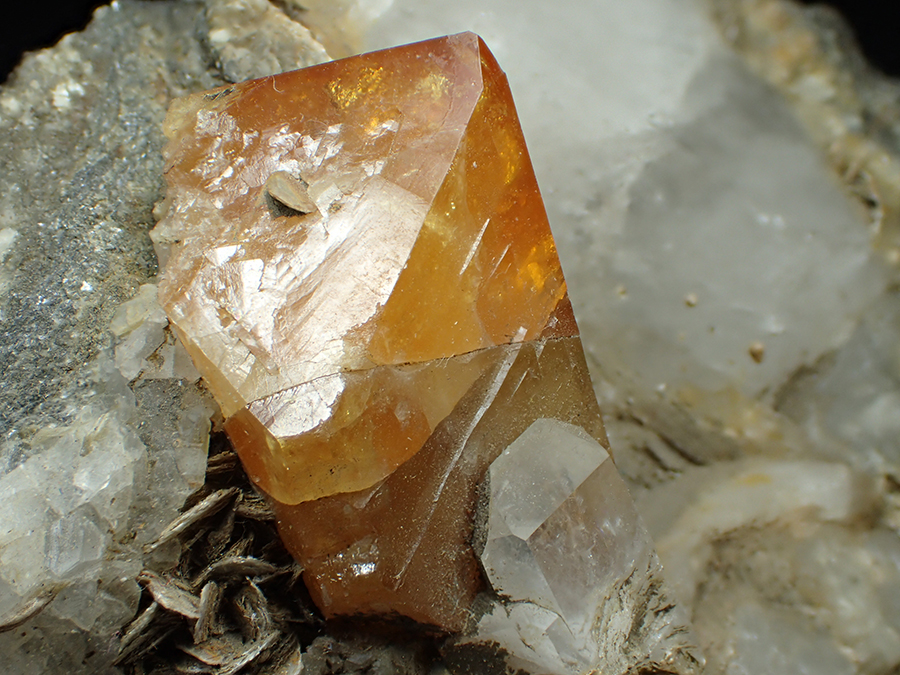
CaWO4 — Calcium Tungstate
a warm amber weight that keeps both feet on the ground while the eyes stay on the dream
Scheelite is named in honour of Carl Wilhelm Scheele (1742–1786), the Swedish-German pharmacist and chemist who first identified tungsten as a distinct element. In 1781 Scheele demonstrated that a white oxide could be extracted from the heavy mineral then called "tungsten" by Swedish miners — a name meaning "heavy stone" in Swedish (tung, heavy; sten, stone). The mineral was formally named scheelite in 1821 by the German mineralogist Karl Caesar von Leonhard, commemorating Scheele's foundational role in tungsten chemistry. The element tungsten itself later took its symbol W from Wolfram, a related tungstate mineral, but the discovery credit and the crystal's name remain Scheele's.
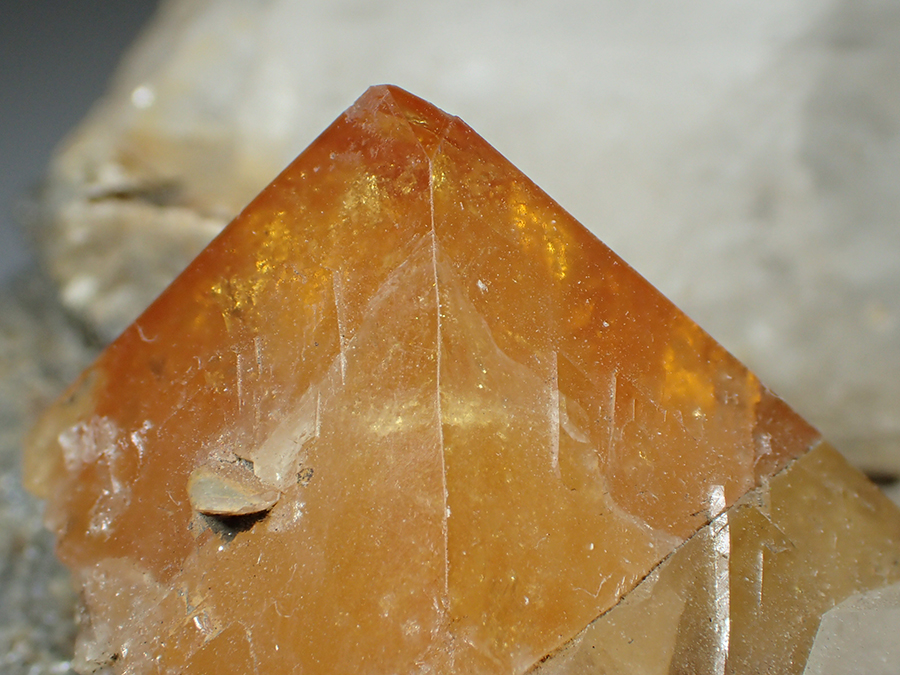
Scheelite crystallises in the tetragonal system with a characteristic pseudo-octahedral dipyramidal habit — its stubby, eight-faced crystals are often mistaken at a glance for octahedra. The structure consists of calcium cations coordinated by eight oxygen atoms, alternating with isolated tungstate (WO4) tetrahedra in a compact, dense lattice. This architecture gives scheelite an unusually high specific gravity of 5.9–6.1 g/cm³, noticeably heavier than most silicate minerals of similar size. The tight WO4 packing also produces a high refractive index (1.918–1.938) and moderate dispersion, lending transparent crystals an adamantine — near-diamond — lustre and visible "fire" in gem-quality material. Colour ranges from colourless and white to pale yellow, orange, and brown, depending on trace impurities; rare gem-grade crystals have been faceted for collectors.
Scheelite was first described in 1751 from the type locality at Mount Bispbergs klack near Säter, Dalarna, Sweden. Swedish miners already knew the mineral and called it "tungsten" for its exceptional weight. Carl Wilhelm Scheele's 1781 chemical investigation of this same ore enabled him to isolate tungstic acid and demonstrate that a new metal oxide — what we now call tungsten — was present within it. The formal mineral name followed forty years later when von Leonhard systematised the nomenclature.
Significant scheelite deposits occur across a broad belt of contact-metamorphic and skarn environments. Notable occurrences include Cínovec (Czech Republic), the Swiss Alps, South Korea, Japan, Australia, Brazil's Currais Novos mine, and the southwestern United States (Arizona, Connecticut). Today China — particularly the Luoyang district — dominates global tungsten mining, with scheelite alongside wolframite as the two principal ore minerals.

Few minerals announce themselves as unmistakably as scheelite. Under a short-wave UV lamp its crystals burst into bright sky-blue light, a response so reliable and vivid that miners and geologists have used it as a primary field identification test for generations. The source is the tungstate group itself — the WO42− ion absorbs ultraviolet energy and re-emits it as visible blue-white luminescence. This is not a surface coating or a trace impurity effect; it is intrinsic to the mineral's chemistry, making every scheelite specimen carry its own built-in identification light.
Scheelite packs a remarkable contradiction into a pale, modest-looking crystal: the weight of a tungsten ore in a stone that can appear almost white. Its specific gravity of nearly 6 is roughly twice that of common silicates, and the dense WO4 lattice that creates this density also produces a high refractive index and adamantine — diamond-like — lustre in quality material. Gem-grade transparent crystals show genuine "fire" (spectral dispersion visible as flashes of colour), though scheelite's softness at Mohs 4.5–5 limits its use as a faceted gem.
Alongside wolframite, scheelite is one of the two primary ores from which the world extracts tungsten — the metal with the highest melting point of any element. This industrial importance has given scheelite an outsized role in modern history, from WWII strategic competition to the cutting edges of every high-speed drill and tungsten-carbide tool in use today. The same tungsten atoms that glow blue under UV at a mineral show are also the atoms that survive the heat of a rocket nozzle or the tip of a drill boring through steel.
"Constant remembrance of the Guru will automatically stop you from thinking, speaking, or acting upon evil and baser thoughts. There is no room for pretension in constant remembrance."— Gnananda
There is a kind of person who can stand in the middle of a wide open field, feel the ground solid and real beneath their feet, and still hold a clear picture of where they want to go — not anxious about the distance, not untethered by the vision, just steady in both directions at once. Scheelite is a stone for that quality.
It works in the solar plexus — the body's fire centre, the place where will and vitality are stored like fuel in a deep tank. When that centre is well and clear, the ordinary pressures of the day don't drain it. There is enough left over to stay relaxed about the future, enough to hold an aspiration without gripping it. Scheelite touches that place gently, reinforcing it the way a slow meal reinforces the body: not dramatically, but durably, so that a few hours later you notice you are still going.
The stone's blurb is simple: it helps you stay grounded while reaching for dreams and focuses on balance and optimism. In practice this means it tends to dissolve the small, creeping kind of discouragement — the sort that arrives not as a crisis but as a gradual tightening, a forgetting that what you are working toward is worth the patience. When scheelite is nearby, that tightening loosens. The horizon comes back into view, not as pressure but as direction.
Grounded DreamingThe felt experience is neither excitement nor mere calm — it is something closer to a quiet confidence that both things are possible simultaneously: full presence in the moment and a coherent picture of what comes next. The solar plexus does not need to choose between the two. Its job, when open and fed, is exactly this integration — keeping the body alive and strong while the mind holds something further out. Scheelite supports that integration without forcing it, the way good light in a room supports whatever work is already underway.
"Don't worry, be happy."— Meher Baba
This is ultimately a stone about trust — trust that the ground holds, and that the dream does not require you to leave it. The energy it carries is outward-radiating: not pulling inward into self-examination, not rising toward transcendence, but spreading gently into the field around the body, making the ordinary a little more spacious, a little warmer. Scheelite does not promise the extraordinary. What it offers is something quieter and, for most of a human life, more useful: the settled feeling that things can work out, that it is fine to keep going, that staying grounded and reaching forward are not opposites but the same motion, taken one patient step at a time.