
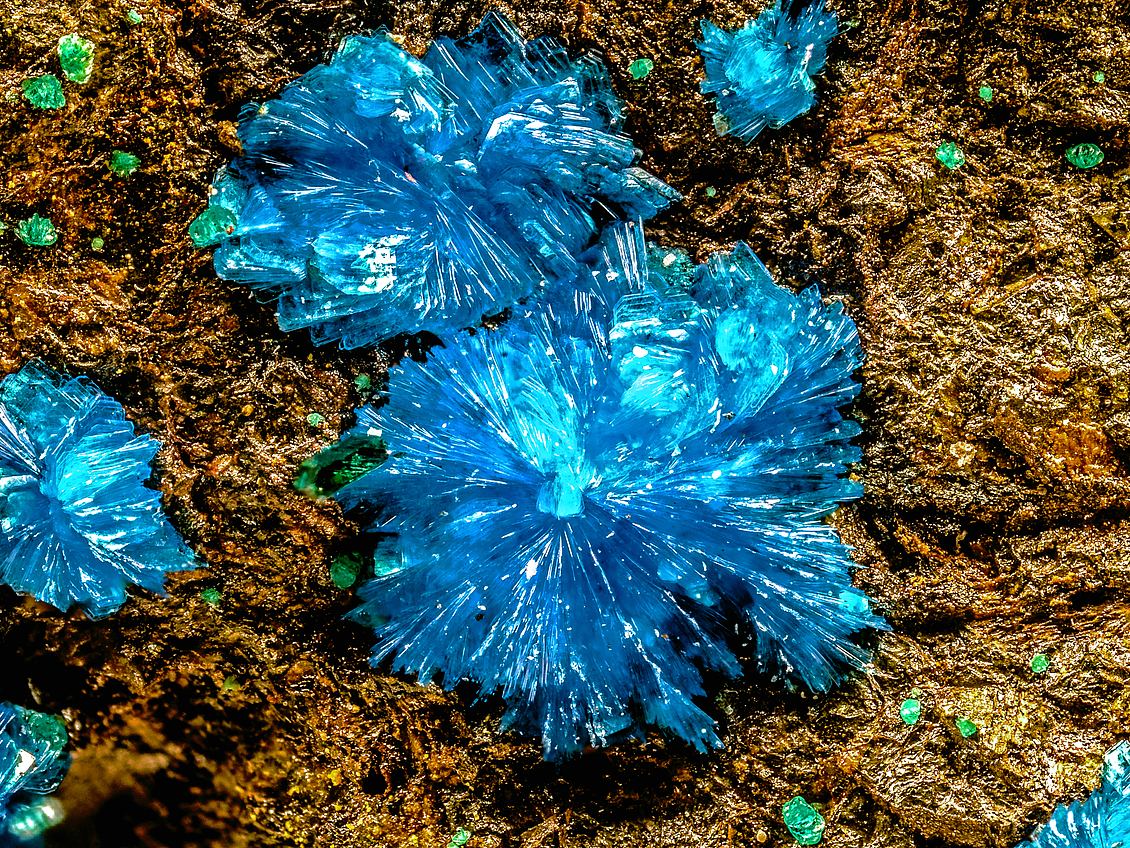
NaCaCu5(PO4)4Cl·5H2O
The ground opens, and you are already home
Named in honor of Herbert Alexander Sample (1887–1952), an American mineralogist at the United States Geological Survey who devoted much of his career to studying secondary minerals in oxidized copper ore deposits — precisely the geological environment in which the mineral bearing his name was later found and described. The species was formally characterized in 1941 by the mineralogists Joseph Murdoch and Robert Coleman Clapp from specimens collected at Chuquicamata in northern Chile, following the established mineralogical tradition of naming new species for scientists whose work contributed directly to understanding the geological context of their discovery.
Sampleite's formula — NaCaCu₅(PO₄)₄Cl·5H₂O — is structurally unusual in two respects. First, it incorporates chloride (Cl⁻) as a structural component of the crystal lattice alongside phosphate (PO₄³⁻) groups; this kind of mixed-anion architecture, where a halide is woven into a phosphate framework rather than occurring as a separate phase, is relatively uncommon and places Sampleite among a small group of "chlorophosphates" rather than simple phosphates. Second, the formula includes five water molecules that are not merely adsorbed on the crystal surface but are incorporated as structural water into the framework itself, occupying specific crystallographic sites that help stabilize the copper-bearing lattice.
Five copper atoms per formula unit (Cu₅) account for the vivid sky-blue color — Cu²⁺ is one of the most efficient chromophores in mineralogy — and contribute to a specific gravity notably above average for a phosphate. The orthorhombic symmetry produces crystals that are typically prismatic to tabular, often forming compact aggregates with a glassy, vitreous luster that gives even small specimens an immediately striking appearance.
First described in 1941 by Joseph Murdoch and Robert Coleman Clapp from specimens at Chuquicamata, a copper mining district in the Atacama Region of northern Chile. Chuquicamata is one of the world's largest open-pit copper mines and one of the most mineralogically prolific copper localities ever documented — the hyperarid conditions of the Atacama Desert, among the driest environments on Earth, preserve delicate secondary minerals that would dissolve within years in more humid climates. Many of the finest examples of rare secondary copper minerals in museum collections worldwide come from this and neighboring Atacama districts for exactly this reason.
Beyond Chile, Sampleite has been confirmed at copper mines in Queensland, Australia, as well as at several other secondary copper deposits in arid regions globally. In every case it forms in the oxidized zone above primary copper sulfide ore bodies, where the original sulfide minerals have been chemically transformed by surface-derived groundwater enriched in oxygen, phosphate, chloride, sodium, and calcium — the precise combination of elements the Sampleite structure requires.
Sampleite contains copper — five copper atoms per formula unit — making it a potentially toxic mineral if handled carelessly. Copper compounds can be harmful if ingested or if dust is inhaled. Risk from careful handling of intact, undamaged specimens is low, but standard precautions apply.
Wash hands thoroughly after handling. Do not grind, sand, or polish Sampleite without respiratory protection. Do not make crystal water or elixirs. Keep away from children and pets. Store carefully to prevent damage to the soft (3–4 Mohs) crystals, which can shed fine particles if abraded.
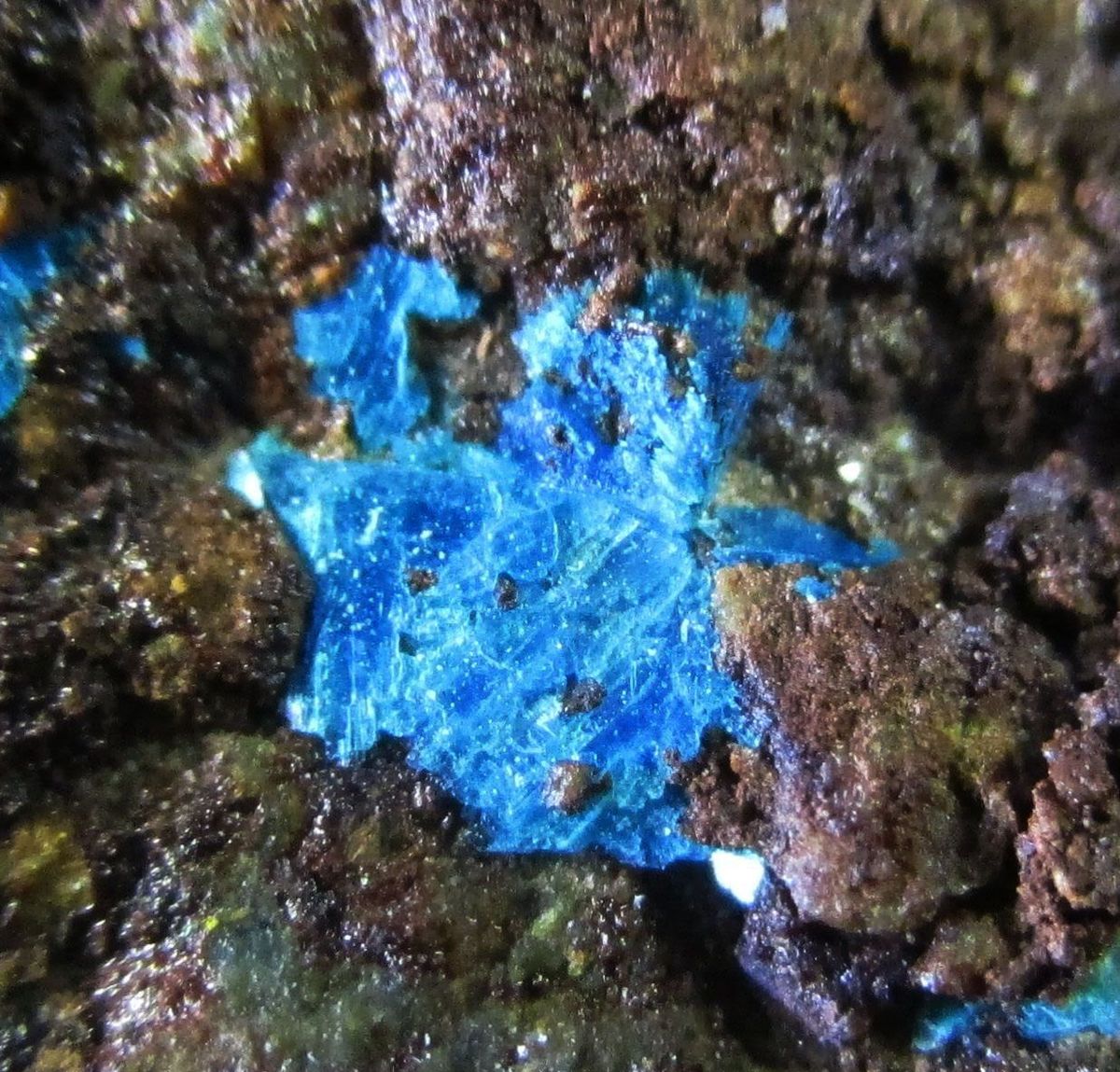
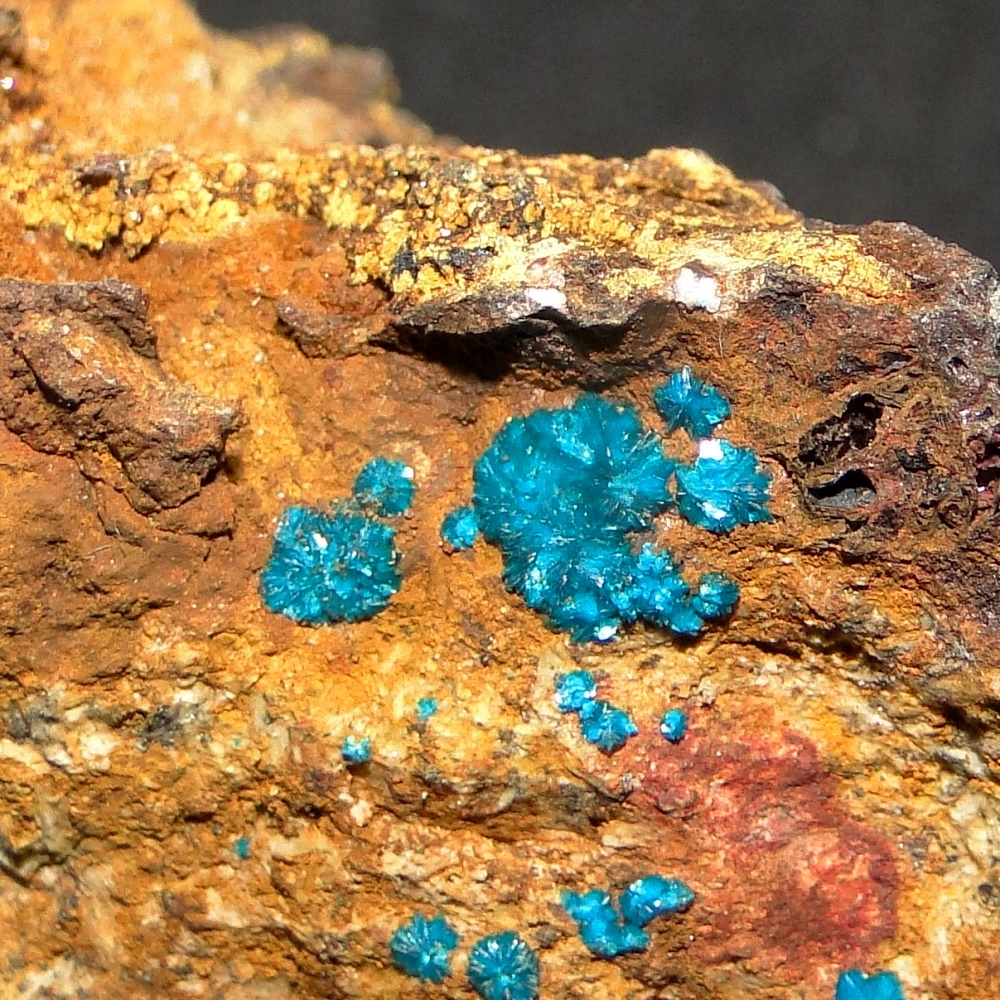
Most phosphate minerals contain only phosphate anions (PO₄³⁻) balanced by metal cations. Sampleite's structure incorporates a chloride ion (Cl⁻) as a required structural member — a genuinely mixed-anion framework. This architectural distinction is not merely chemical but geological: it means Sampleite can only form where chloride-bearing groundwater and phosphate-rich solution meet simultaneously in an oxidized copper environment, a geochemical overlap so specific that the resulting mineral is genuinely rare wherever it occurs.
Sampleite's type locality, Chuquicamata in the Atacama Desert, is among the most mineralogically extraordinary copper localities on Earth — a place where extreme aridity and one of the world's largest sulfide ore bodies have combined for millions of years to produce an oxidized zone of exceptional depth and mineral diversity. Specimens from Chuquicamata carry a geological pedigree that few localities can match: they formed slowly, in conditions of chemical precision, in a place where time moves differently because water almost never arrives to disturb what crystallizes.
The combination of P=7 (high power) with F=5 (medium frequency) is unusual among Throat-chakra crystals. Most Throat crystals work through refinement — high frequency dissolving subtle patterns slowly. Sampleite works through impact: it hits at depth rather than dissolving at height. The Grounding energy type makes this even more specific: the power moves downward, anchoring the Throat's expression in the earth of the body rather than the ideal of the mind. The result is a crystal that changes awareness quickly and grounded-ly — two qualities rarely found together.
Sampleite carries Life, Joy, and Grounding at the Throat chakra — a combination that is rarer and more interesting than it might initially appear. Grounding at the Throat does not mean earthiness in opposition to expression; it means expression rooted in the earth of being rather than the performance of identity. And that distinction — between the voice that rises from below and the voice that strains toward approval — is exactly what Sampleite makes immediately felt. The P=7 power drives the shift quickly: there is no gradual warming up, no slow accumulation of subtle energy over days of practice. The ground opens, and awareness drops into it all at once.
Life and Joy at the Throat — The High-Power OpeningWhat most crystal workers notice first is the speed. Sampleite transports the mind into the spiritual domain almost before the expectation of transport has formed — the shift comes from the high power at work rather than from elevated frequency. This is not a crystal that works by dissolving blockages finely over time (that would require higher F); it is a crystal that breaks through them with impact. The Life energy at the Throat adds immediacy to this: aliveness at the point of speech, the sudden sense that something real is speaking rather than something rehearsed. Joy follows naturally — not as euphoria but as the felt ease of the Throat when its habituated tension has been briefly released.
Neem Karoli Baba — "Maharajji" to those who found him — was famous for exactly this quality of instant landing. People who encountered him reported not a gradual opening but an arrival: one moment they were in their ordinary mind, the next they were somewhere completely present, completely at home, without knowing how they got there. He fed people, he poked them, he laughed, he wept — his entire teaching was Life lived at the ground level of love rather than the ceiling level of concept. "Love everyone. Serve everyone. Remember God." Three instructions, all three pointing downward into the physical world rather than upward away from it.
"Love everyone. Serve everyone. Remember God."— Neem Karoli Baba (Maharajji)
The Grounding energy in Sampleite is the feature that distinguishes it most clearly from the other Throat crystals in this collection. Cumengeite expands outward; Childrenite opens the fearless voice forward; Sampleite drops down. The spiritual domain it transports one to is not above the ordinary world but below and within it — the ground of being that was always there, accessible the moment the upward-straining of ordinary mental effort pauses. This is an ancient understanding: the divine is not reached by climbing but by arriving at what was already present.
Nityananda, the avadhoota of Ganeshpuri whose very physical presence was reported by thousands to drop visitors into instantaneous stillness, pointed in this direction consistently. He did not teach ascent. His instruction — "The heart is the hub of all sacred places. Go there and roam" — sends awareness inward and downward, to what is central and stable in the body rather than to what is elevated and rarefied above it. For Sampleite, translate "heart" as "Throat": the Throat, when grounded, becomes the hub of authentic expression, and from that hub, the whole body knows itself as a spiritual instrument rather than a vehicle that happens to occasionally have spiritual experiences.
With D=5, Sampleite is a concentrated-session crystal rather than a long companion — it opens powerfully and then steps back, leaving the insight it delivered in the practitioner's hands. Used in ceremony, in meditation, or in any moment when the shift needs to happen quickly, it accomplishes in minutes what more gentle crystals might take weeks to approach. What it opens, the practitioner then carries.
"The heart is the hub of all sacred places. Go there and roam."— Nityananda of Ganeshpuri