
Na(Li,Al)3Al6(BO3)3Si6O18(OH)4
Red fire that heals the aching heart
The name rubellite comes from the Latin rubellus, meaning reddish, and is applied to the red, pink and rose-red varieties of elbaite, the lithium-rich species of the tourmaline group. The word tourmaline itself derives from the Sinhalese turmali, a term Dutch traders used for the mixed gem gravels of Sri Lanka.
Rubellite is a varietal name rather than a separate species: a red-to-pink elbaite. To qualify as true rubellite the colour should hold richly under both daylight and incandescent light, distinguishing it from the more common pale pinks.
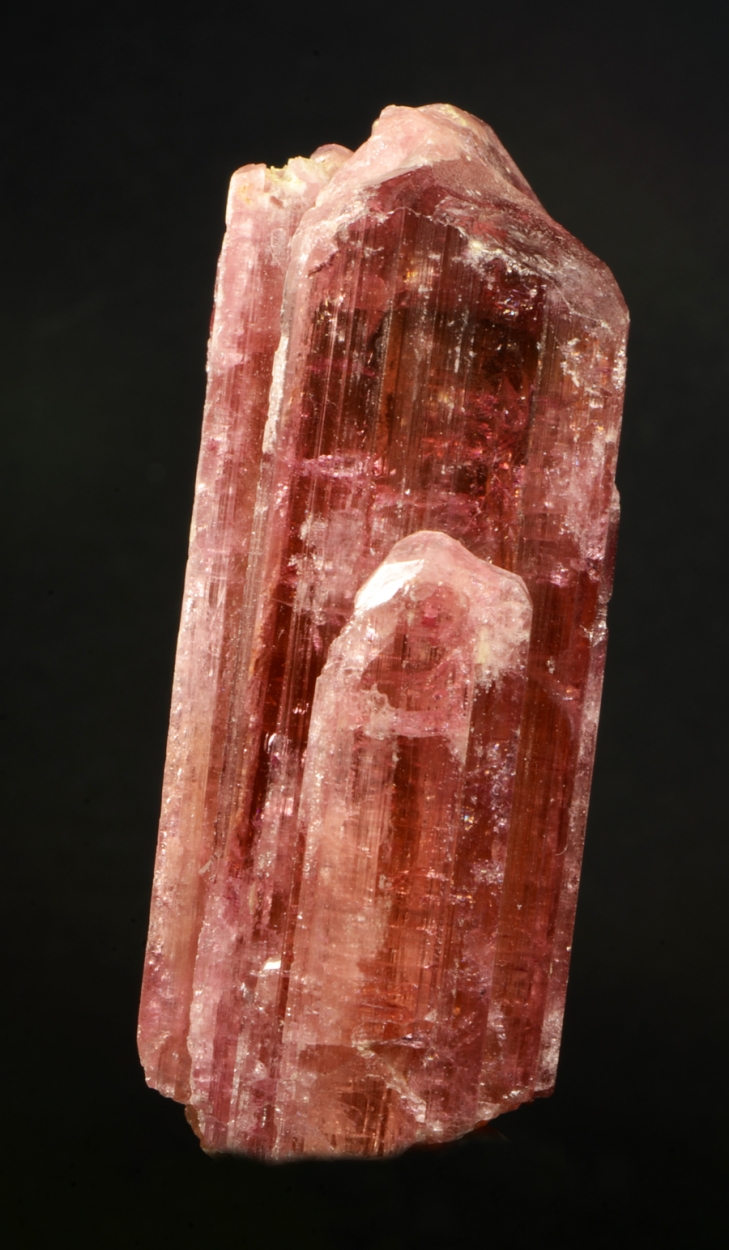
Rubellite is the red-pink variety of elbaite, a complex boron cyclosilicate of the tourmaline group, with the simplified formula Na(Li,Al)3Al6(BO3)3Si6O18(OH)4. Its defining feature is rings of six silica tetrahedra — the mark of a cyclosilicate — stacked along the trigonal axis with boron, lithium and aluminium, producing the long, striated prismatic crystals tourmaline is known for. It is hard and durable at Mohs 7–7.5. The red-pink colour is generally attributed to traces of manganese.
Tourmaline is famously piezoelectric and pyroelectric: squeeze or heat a crystal and it develops an electric charge across its ends, an effect of its polar, non-centrosymmetric structure. Rubellite forms chiefly in lithium-rich granitic pegmatites, often alongside lepidolite, quartz and other tourmalines.
Tourmaline has been treasured for centuries, and the red varieties have long been confused with rubies in royal collections — several famous "rubies" in historic crown jewels are in fact red tourmalines. Elbaite takes its name from the island of Elba, Italy, an early classic locality.
Today the finest rubellite comes from the lithium pegmatites of Brazil — especially Minas Gerais, with the Cruzeiro mine a celebrated source — as well as from Madagascar, Nigeria, Mozambique, Afghanistan, Pakistan and the United States (notably Maine and California). Rubellite is often found growing within or upon lepidolite, the lilac lithium mica, in scenes of striking colour.
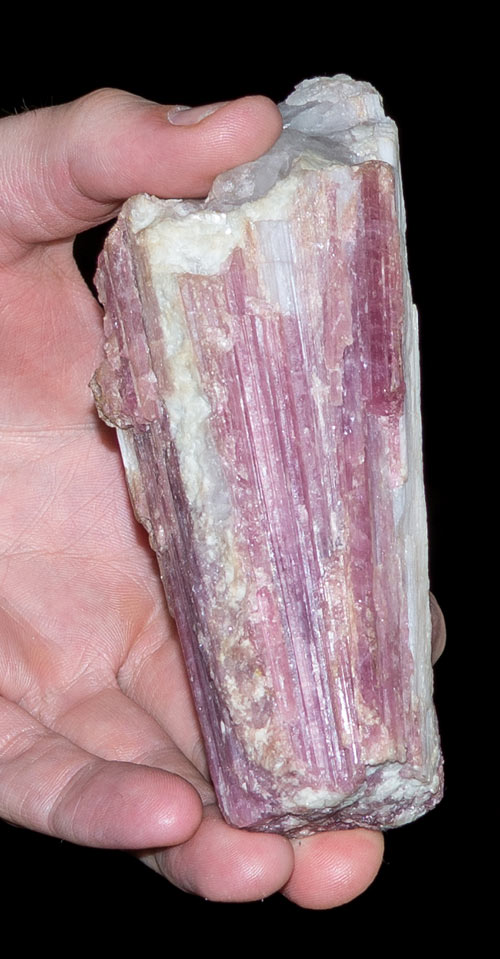

Like all tourmaline, rubellite generates an electric charge when squeezed or heated — a genuine physical polarity built into its non-symmetric crystal structure, the kind of quiet energetic activity that sets tourmaline apart among gems.
Rubellite is the red-to-rose variety of lithium-rich elbaite, its colour drawn from traces of manganese. True rubellite holds its red richly in both daylight and lamplight, distinguishing it from the paler pinks.
Forming in lithium-rich granitic pegmatites, rubellite often grows alongside or within lilac lepidolite, sharing the lithium that links the kundalini-bearing minerals of these rare, slow-cooled veins.
"Recognize, release, relax."— Tulku Urgyen Rinpoche
Rubellite is a red stone for love-aches. Its frequency settles at the solar plexus — the fire-centre of will and vitality, where the body stores its energy — but its Love attribute draws that fire up into the heart, so the warmth radiates from the chest as much as from the belly. It is named for balance and harmony with the earth, a stone that steadies a person while it works on the tender places, and the old descriptions name it plainly as a healer for the aches of love.
Its current is Kundalini, and here rubellite does something specific: it centres the rising fire around the heart. The kundalini burns away blockage as it climbs, and rubellite gathers that fire at the chest, where the great knot of stored emotion — old grief, old love, the residue of every closed door — is brought up to the surface for healing rather than left buried. With a Duration of seven it stays at the task, a long companion that keeps surfacing and dissolving emotion layer by layer.
So its gift is the bringing-up itself: feelings raised gently into the light to be felt through and released, the heart's fire harmonised with the steady ground of the earth.
"All living beings desire to be happy always, without any misery. In everyone there is observed supreme love."— Ramana Maharshi