

Cu2(NO3)(OH)3
Love made steady, the heart with its feet on the earth
Rouaite takes its name from its type locality, the Roua copper mines in the Daluis–Guillaumes district of the Alpes-Maritimes in south-eastern France, where the mineral was found and characterised. Place-naming of this kind is common among rare secondary copper minerals, which are often known from only one or two small occurrences.
It is the monoclinic dimorph of gerhardtite: the two minerals share an identical chemistry, Cu2(NO3)(OH)3, but arrange the same atoms in different symmetries.
Rouaite is a basic copper nitrate, Cu2(NO3)(OH)3, crystallising in the monoclinic system — one of the very few nitrate minerals, a small and unusual mineral class. Copper sits in oxygen-and-hydroxyl octahedra, with nitrate groups completing the structure; the abundant copper gives the mineral its deep emerald-to-blue-green colour. It is soft, around Mohs 2–3, and forms small tabular crystals and crusts.
Nitrate minerals are rare in nature because the nitrate ion is highly soluble and easily washed away; rouaite survives only in particular, sheltered oxidised copper settings. It is a secondary mineral, formed where copper ores weather in the presence of nitrate, and as a dimorph of gerhardtite it represents one of two ways the same chemistry can crystallise.
Rouaite was described from the Roua mines in the Alpes-Maritimes of France, a small historic copper district in the southern French Alps. It occurs as a rare oxidation product alongside other secondary copper minerals.
Because true nitrate minerals form and persist only under narrow conditions — an arid or sheltered microclimate that keeps the soluble nitrate from dissolving away — rouaite remains known from only a handful of localities. It is a collector's rarity rather than a stone of commerce, valued precisely for how seldom the right chemistry and the right shelter coincide.
Nitrate minerals are among the scarcest in nature, since the nitrate ion is so soluble it usually washes away before it can crystallise. Rouaite is one of the few that endure, surviving only where sheltered conditions protect it.
Rouaite shares its exact chemistry with gerhardtite but crystallises in a different symmetry — a clear example of how the same atoms can settle into more than one ordered form depending on the conditions of growth.
Its rich green-to-blue colour is pure copper at work. As a rare and seldom-seen species, it carries the quiet abundance that the hard-to-find stones bring to those drawn to them.
"Silence is the highest form of prayer. In the stillness of the mind, the voice of the Infinite is heard."— Trailanga Swami
Rouaite is a heart stone carried on a green, copper current, and it brings three things together that rarely meet so easily — Love, Life and Joy — and then does something unusual with them: it grounds them. Its frequency centres in the heart, the middle chamber that joins the upper and lower worlds, and because love is among its attributes the heart becomes the place from which it all radiates: softness, gratitude, authentic connection that bypasses the filtering mind.
The grounding is what sets it apart. Where many heart stones lift and expand, rouaite's energy flows downward and inward, settling the open heart so its love arrives as weight and presence rather than drifting off into sentiment. It works a little like a healing stone too, lending stability and strength, so that the joy it brings — that thoughtless gladness that comes when blockages dissolve and only pure experiencing remains — has somewhere solid to land.
And because Life rides with it, the heart is fed as it is grounded: vitality poured into the centre, the foggy, drained heaviness cleared, the channel kept open. It is love made steady — the heart with its feet on the earth.
"Love is essentially self-communicative: those who do not have it catch it from those who have it."— Meher Baba
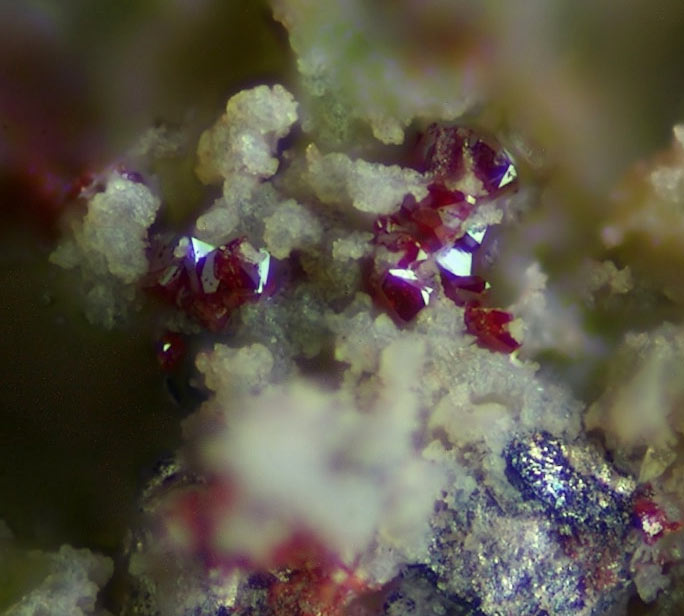
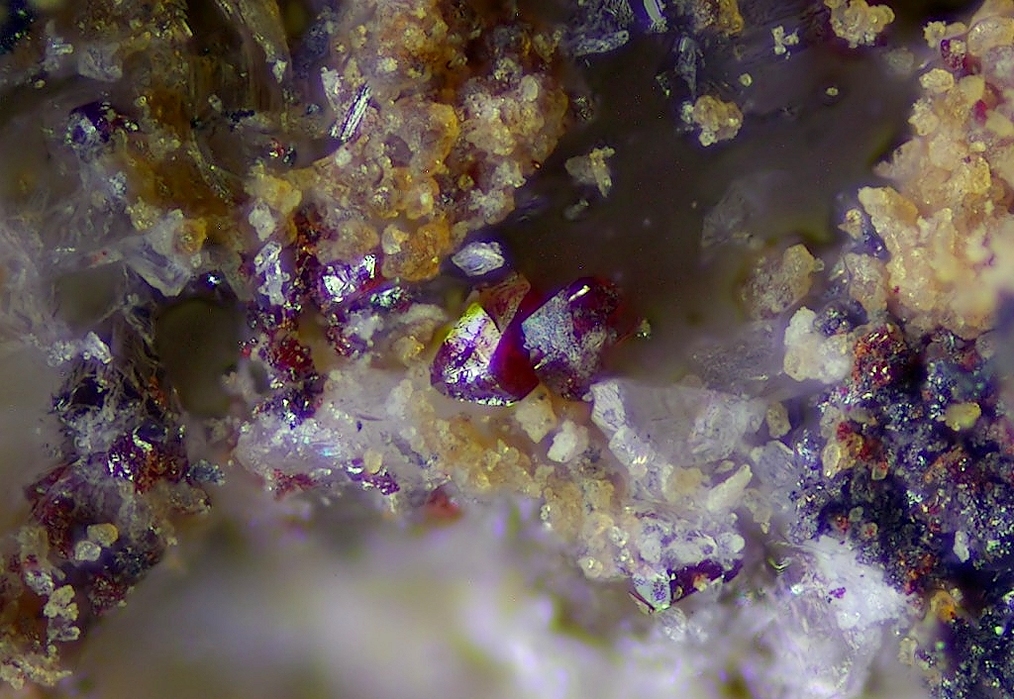
Tillmannsite is a silver–mercury vanadate — (Ag3Hg)(V,As)O4 — that crystallises in the tetragonal system as tiny, lustrous, pseudo-octahedral crystals of a deep red to brownish-red. The largest reach only about fifty micrometres, so it can be studied only under magnification; what looks like a whole stone in the photographs above is a cluster smaller than a grain of salt.
It was described as a new mineral species in 2003, from the oxidised zone of the old copper mines of Roua — the same historic French workings that gave rouaite its name. To this day the Roua mines remain its type locality and essentially its only home: a mineral known to science from a single mountainside.
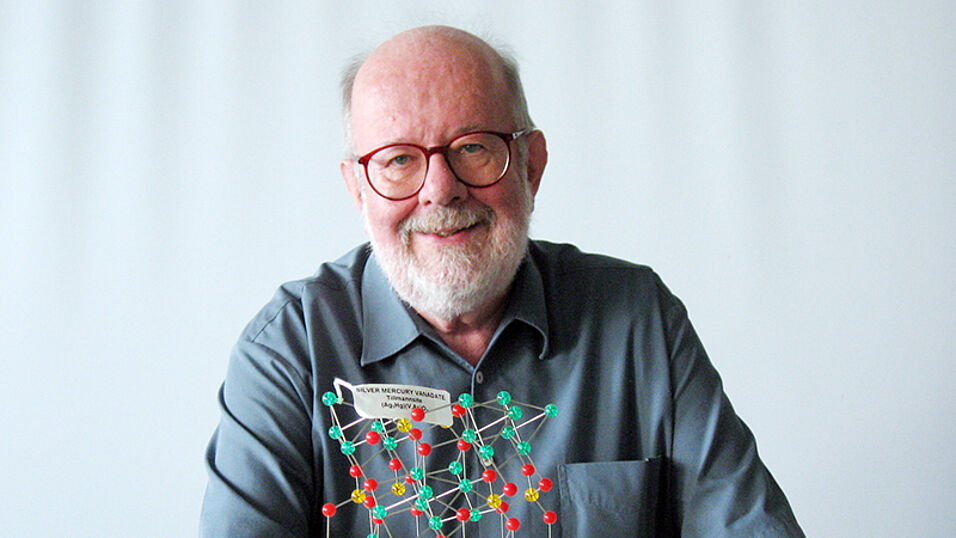
Etymology — Named for a CrystallographerThe species honours Professor Ekkehart Tillmanns (1941–2020), the eminent German-Austrian crystallographer who for decades led the Institute of Mineralogy and Crystallography at the University of Vienna. To have a mineral named after you is the discipline's highest tribute — reserved for those who shaped the science itself.


Since the crystal can never be owned, I went to meet it where it lives. The Roua mines sit in wild country above the red-rock Gorges de Daluis, near Puget-Théniers in the Alpes-Maritimes — reached on foot over the Col de Roua at 1 284 metres. To stand on that ground, directly above the only place on Earth this mineral has ever formed, is its own kind of communion: you cannot put tillmannsite in your pocket, but you can stand in its field and feel what it carries.
Almost every crystal centres on a single chakra. Tillmannsite is the rare exception: it works at three frequencies at once — the Root, the Sacral and the Solar Plexus, the entire lower trinity that governs survival, sexuality and personal power. Its frequency reading is therefore low (1 · 2 · 3) — but everything else is off the scale.
Its Power is beyond 10 — the scale only runs to ten, yet tillmannsite pushes past it — and its Duration is a full 10, a stone that never stops working, peeling back layer after layer to the very core. On those measures it would sit around position 5 in the Top 200, and arguably higher; only its low frequency holds it back from the very summit. Yet it can never appear on the list at all, because there is nothing to buy, hold or carry — its ranking is purely theoretical, a power no one can place on a shelf.
And it breaks another rule. Most stones do one thing; tillmannsite is at once Expanding (radiating its energy outward), a Kundalini stone (driving the primal fire up the spine), and Grounding (pouring energy down into the earth) — a combination no other crystal on this site carries. Woven through it are a frank sexual energy and a steady current of love. It is, in every sense, one of a kind.
"Life begins where fear ends."— Osho
If rouaite is love made steady, tillmannsite is the furnace beneath it. Where almost every stone settles into a single centre, this one takes hold of the whole lower trinity at once — Root, Sacral and Solar Plexus, the ground of survival, sexuality and will. It is neither subtle nor gentle: its power runs past the top of the scale, and once it begins it does not let go, working without pause down to the deepest, oldest structures of the self.
The Fire That Rises and the Root That HoldsWhat makes it singular is that it does three opposite things at the same time. It grounds — sending energy down through the root into the earth, so there is something solid to stand on. It wakes the kundalini — the primal force coiled at the base of the spine, lit at the Root, fed by the sexual current of the Sacral, and driven up the sushumna to burn away karma as it climbs. And it expands — radiating outward through the bodies even as it rises and roots. Grounding, rising and expanding all at once: a stone that anchors you and sets you alight in the same breath.
"The ultimate purpose of human birth is not to seek worldly pleasure, but to realize the 'Aham Brahmasmi' (I am the Absolute) state through the control of the life force (Prana)."— Siva Prabakara
That is precisely tillmannsite's work: it takes the raw life force — the sexual, creative heat of the lower centres — and, rather than spending it outward, turns it upward as fuel for awakening. The sexual energy in it is not denied but transmuted; the love woven through it keeps that fire warm rather than merely fierce. This is the alchemy the lower chakras were always meant for: desire become devotion, survival become ground, power become offering.
No one will ever hold this crystal in their hand — but its lesson needs no specimen, only the willingness to let the fear at the root dissolve, so that, as Osho says, life can begin.