

CaMn3Mn[Si5O15]
First aid for the heart — it holds the wound until forgiveness can breathe
The name comes from the Greek rhodon (ῥόδον), meaning "rose," chosen for the mineral's characteristic rose-red to pink colour. It was coined by the German mineralogist Christoph Friedrich Jasche in 1819, and joins a small family of rose-named manganese minerals whose shared root has been a source of confusion ever since.
Rhodonite is a pyroxenoid: like the true pyroxenes it is built from single chains of silica tetrahedra, but the chain takes a kink and repeats only after every fifth tetrahedron rather than every second. That irregular, lower-symmetry chain is what places it in the triclinic system, and the manganese threaded through the structure — partly substituted by iron, magnesium, and calcium — is what gives the mineral its rose colour.
Rhodonite was first described in 1819 from the Harz Mountains of Germany, where it occurs in metamorphosed manganese ore. It forms where manganese-rich rocks are reworked by metamorphism or hydrothermal activity, typically alongside other manganese minerals.
Today the most celebrated crystallized specimens — including the rare transparent, gem-quality material — come from Broken Hill in New South Wales, Australia. Other important sources include Franklin in New Jersey, USA, as well as Brazil, Peru, and the classic Swedish manganese deposit at Långban.
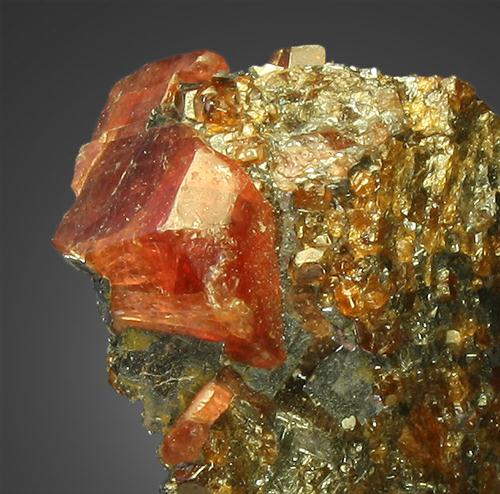
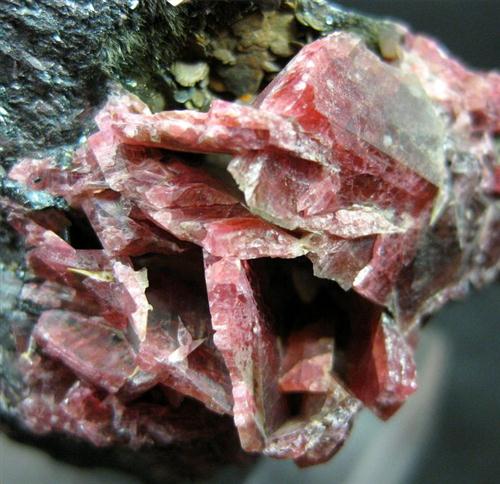
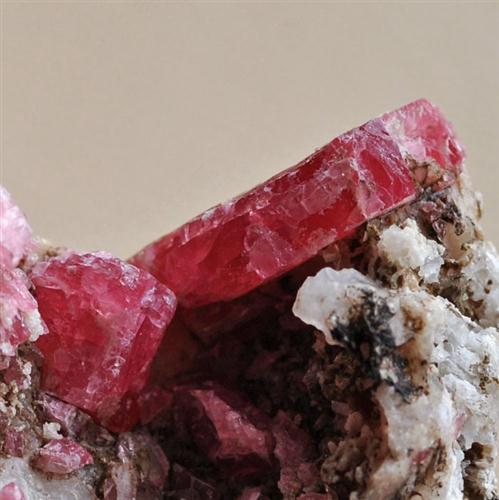

The rose-pink to deep red colour comes from divalent manganese in the structure. What makes massive rhodonite instantly recognizable, though, is the contrast laid over that pink: networks of black dendritic veins and patches of manganese oxide, formed as the surface manganese weathers and oxidizes. The interplay of rose and black is the mineral's visual signature and a reliable field clue.
In the rare transparent, gem-quality crystals, rhodonite is pleochroic — it shows different shades, from yellowish-red to pinkish-red, depending on the crystallographic direction through which the light passes. This directional colour shift is visible only in the clear material and is one of the qualities that makes faceted rhodonite so prized among collectors.
"Love should be like breathing. It should be just a quality in you—wherever you are, with whomsoever you are. Even if you are alone, love goes on overflowing from you. It is not a question of being in love with someone; it is a question of being love."— Osho
Rhodonite works low and close, at the sacral centre — the watery, emotional seat where desire, hurt, and the raw charge of feeling are held. It is not a stone that reaches for the subtle root of a problem; it meets the acute, outer layer first, the immediate flood of an emotion while it is still hot. That is exactly why it earns its old reputation as emotional first aid: when panic or a fresh scar overwhelms the system, rhodonite settles into the sacral waters and presses on the raw feeling with real force until its grip loosens.
First Aid at the SacralBecause love runs through its nature, the energy does not stay only in the lower belly — it also gathers into the heart and radiates warmth and kindness from there, so the sacral's panic is met not with more pressure but with compassion. This is what turns the work toward forgiveness: the wound is held long enough, and gently enough, that the body can stop bracing against it. Alongside this, rhodonite feeds life back into a system that shock has left drained and foggy, restoring vitality where there was only numbness; and as the charge finally dissolves, what remains is joy — the clear, thoughtless openness underneath the feeling, the ease of simply experiencing again.
"The heart is the hub of all sacred places. Go there and roam."— Bhagawan Nityananda
This is not a one-hour remedy. Rhodonite is a long-working companion that keeps returning to the wound through sleep and through the day, layer after layer, until an old emotional pattern has genuinely loosened and forgiveness can set. Its strength is considerable, but the thread of love woven through it keeps that strength bearable rather than harsh. And as the sacral clears, the way opens for the kundalini to move: the primal energy rises more freely up the sushumna, burning away the emotional karma knotted at these lower centres as it climbs. Common and easy to come by, rhodonite makes an accessible, everyday ally for exactly the moments when the heart is too raw to hold itself.
Rhodonite sits at the head of a small family of manganese silicates that share its emotional, heart-and-sacral nature. Two of its closest relatives are bustamite and johannsenite — both calcium-manganese silicates of the same composition, CaMn2+Si2O6, essentially rhodonite with calcium folded into the structure. Curiously, the two are built differently: bustamite is a pyroxenoid like rhodonite (and looks the part — pink), while johannsenite arranges the very same atoms as a true pyroxene (and comes out green to grey-brown). Neither made the Top 200, but both carry a recognisably rhodonite-like energy with a twist of their own.
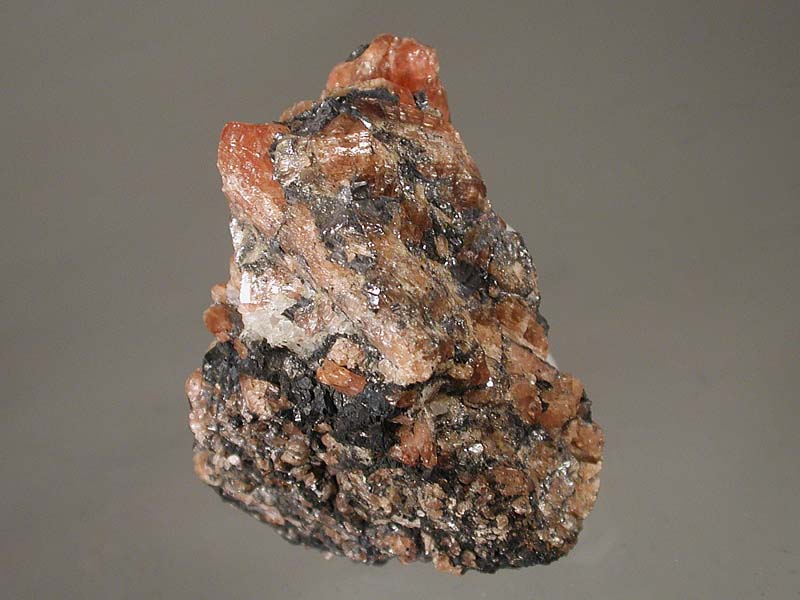
Bustamite is rhodonite's calcium-rich twin: the same pink pyroxenoid of the wollastonite family, but with calcium taking up much of the manganese's place (its colour even fades in sunlight, much as rhodonite's can). It was named after the Mexican mineralogist José María Bustamante.
Energetically it is practically the same as rhodonite — the same loving, healing first-aid for the heart and the sacral — but a little more joyful, and it adds something rhodonite only hints at: a frank sexual aliveness. The calcium seems to lighten and warm the work, so the emotional healing arrives wrapped in gladness and a freer, more embodied sensuality.

Johannsenite has exactly the same recipe as bustamite — CaMn2+Si2O6 — but builds it as a true pyroxene rather than a pyroxenoid, which is why it looks so different: greenish to grey-brown rather than pink. Named in 1932 after the petrologist Albert Johannsen, it is known for one telling habit — over time it weathers and alters into rhodonite itself.
That slow transformation is its spiritual signature too. Working gently at the solar plexus, it is a quiet, patient, long-lasting stone — soft in power but steady for a long while — that strengthens the will and settles personal power in the background, like a precursor quietly ripening toward rhodonite's fuller heart-work.
One more stone belongs here for a quite different reason. Raslakite is no relative at all — it shares neither rhodonite's chemistry nor its structure — yet it is such a convincing visual double that it earns a place here: proof that in the mineral world a strong family resemblance can be pure coincidence.

At a glance Raslakite is a dead ringer for rhodonite — the same rosy raspberry-red, the same bladed, glassy habit. But the resemblance is skin-deep: it is a rare eudialyte-group mineral, a complex sodium-calcium-iron-zirconium ring-silicate from the alkaline rocks of the Lovozero massif on Russia's Kola Peninsula — chemically and structurally a world away from rhodonite's simple manganese chain-silicate. Even the shared colour is coincidence: rhodonite's pink comes from manganese, while the eudialyte group runs red through quite different chemistry.
Energetically it stands on its own rather than echoing rhodonite. At frequency 2, power 5 and duration 4 it is a moderate, steady stone — gentler and shorter-working than rhodonite's powerful, long-lasting heart-aid — a reminder that two stones can look like twins and yet carry entirely different energy.