

Cs(AlSi2)O6·nH2O
Clearing the body's toxins, clearing the mind's confusion
Pollucite is named after Pollux — the Greek hero Polydeuces — one of the Dioscuri twins, the other being Castor. The naming was proposed by Breithaupt in 1846 because pollucite is almost always found together with petalite, which was once called castorite. The mythological twins Castor and Pollux occur inseparably together in the constellation Gemini, mirroring how the two minerals appear together in lepidolite pegmatites: companions in the earth, as in the sky.
Pollucite is a cesium alumino-silicate zeolite — one of the principal natural sources of cesium, the rarest of the stable alkali metals. Its isometric (cubic) crystal system produces the highest possible symmetry in a crystal — the same as diamond — and specimens often occur as glassy, colorless to white masses without obvious crystal faces. The cesium ions occupy the large channel sites in the aluminosilicate framework, the same structural position occupied by sodium in analcime (to which pollucite is structurally related). The variable water content (nH₂O) is characteristic of the zeolite group.
The type locality for pollucite is the island of Elba, Italy — where it was first formally described and named by Breithaupt in 1846 in association with petalite (castorite). Pollucite occurs in complex granitic pegmatites — the deep, slowly-cooled intrusions that concentrate rare elements not accommodated in common rock-forming minerals. Major cesium-rich pollucite deposits are known from Bernic Lake (Manitoba, Canada), the Bikita tin field (Zimbabwe), and several localities in Australia. These deposits are important industrial sources of cesium for atomic clock research and specialty chemicals.
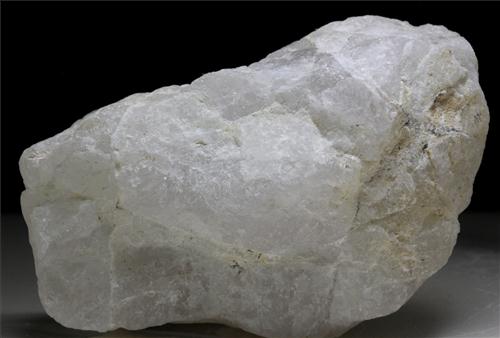
Pollucite is one of very few minerals to contain cesium as an essential component. Cesium is the most electropositive stable element — the most willing to give up its outer electron — making it chemically unique among the alkali metals. This extreme electron-donating character of cesium in the crystal lattice may underlie pollucite's detoxifying energetic quality.
Pollucite's cubic crystal system represents the highest possible symmetry in nature. The same symmetry class as diamond, fluorite, and galena — equal in all three dimensions, no preferred axis. This internal perfection of form is reflected in the crystal's energetic quality: balanced, equal, non-directional, present in all directions simultaneously.
"Wisdom is the greatest cleanser."— Shri Yukteswar
Pollucite is very similar to petalite, in energy as in chemistry, and the two are often found together in the earth — with the added gift that pollucite clears toxins from the body.
The Twin of PetalitePollucite and petalite grow together, share a chemistry, and carry the names of the mythological twins, Pollux and Castor. Energetically they share the same register — light, clean, heart-centred, with a gentle opening that never forces. Pollucite's distinguishing mark is its detoxifying quality. The cesium in its structure — the most electropositive of the stable elements, the most willing to give itself away — creates a field the body recognises as cleansing: something in pollucite's presence helps the physical system release what does not belong in it.
"I have come not to teach but to awaken."— Meher Baba
It works at a calm mid-register — not the most intense or the highest in frequency, but reliably present and sustained. As a Healing energy it stays at the Heart, the Anahata, resting there like a quiet magnifier and dissolving what it finds in place; and its gentle power makes it a long-term companion rather than a high-intensity opener. The clearing it gives is gradual and cumulative, a steady detoxification that works with the heart's own intelligence to recognise and release what has been accumulated — cleansing the physical and the emotional bodies alike.