
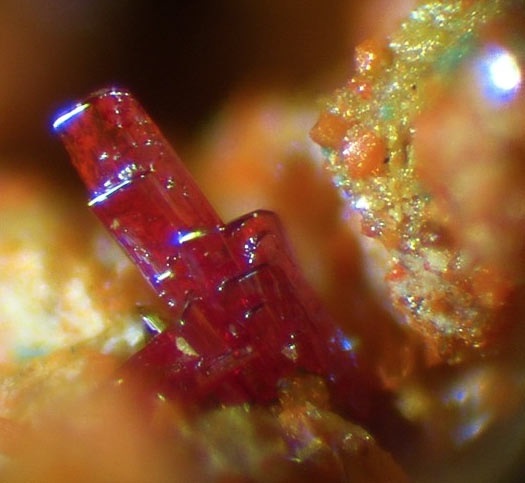
Pb2O(CrO4)
Sacred fire fills every chakra to burn the oldest karma clean
The name derives from two ancient Greek words: φοῖνιξ (phoinix), meaning crimson or scarlet, and χρῶμα (chroma), meaning colour or complexion. Together they describe the mineral's most arresting property — its intense, blood-red to orange-red hue, which is caused by the chromate (CrO₄²⁻) anion and the interaction of lead and chromium in the crystal lattice. The mineral was formally described by Nils Gabriel Nordenskiöld in 1832, who chose the name to capture the fiery, phoenix-like quality of its colour.
Phoenicochroite belongs to the chromate mineral group and has an unusually simple formula — two lead atoms bridged by a single oxide oxygen, combined with the chromate tetrahedron. This compact arrangement produces the monoclinic prismatic symmetry and the characteristic tabular or platy crystal habit. The lead-oxygen-lead bridging unit creates relatively short Pb–O bonds that contribute to the high density of the mineral despite its low hardness, and the intense red-orange colour arises from ligand-to-metal charge transfer within the chromate group.
Phoenicochroite was first described in 1832 from the Berezovskoe (Berezovsk) gold deposit in the Ural Mountains, Russia — one of the oldest continuously mined gold localities in the world. The type specimens were collected from the oxidised zones of this hydrothermal deposit where lead and chromium-bearing phases were altered by surface weathering, creating the rare secondary chromate assemblages in which phoenicochroite occurs.
A second significant occurrence — and one that is especially important spiritually — is Dundas, Tasmania, Australia, where phoenicochroite is found in close association with penfieldite. These two minerals forming together in the same locality gives rise to one of the most powerful crystal combinations known for kundalini activation. Outside of Russia and Tasmania, the mineral remains exceedingly rare globally.
Phoenicochroite contains both lead (Pb) and hexavalent chromium (Cr⁶⁺ as chromate), making it acutely toxic. Lead is a cumulative neurotoxin and chromate is a known carcinogen.
Do not handle without protective gloves. Never wet the specimen or allow it to contact the mouth. Do not grind or produce dust. Keep away from children and pets. These specimens are for display and energy work only — do not wear as jewellery, do not make elixirs, and do not keep in prolonged direct skin contact. Always wash hands thoroughly after handling.
Among all crystal combinations for kundalini activation, the phoenicochroite–penfieldite pairing stands apart. The low frequency of phoenicochroite combined with the particular quality of penfieldite creates an explosive energetic contrast — described as cold water on a heated frying pan. The two minerals naturally co-occur at the same locality, as if geology itself prepared this combination. Very few crystal duos in the world are known to produce this intensity of kundalini effect.
Most sacral-chakra crystals work locally in the lower energy field. Phoenicochroite is unusual in that it floods all chakras simultaneously with fire, targeting karmic structures that are too dense and embedded for softer, higher-frequency stones to dissolve. Its low frequency (F=2) is not a weakness — it is precisely the reason it reaches into the densest layers of energetic debris where high-frequency stones cannot penetrate. The combination of moderate power and sustained duration (P=4, D=4) means the fire burns steadily rather than explosively.
.jpg)
"All the buddhas of all the ages have been telling you a very simple fact: Be — don't try to become."— Osho
Phoenicochroite is a fire stone. On its own it carries a very low frequency (F=2) seated in the sacral centre, but its real role is as one half of a pair: combined with penfieldite — which, by a gift of geology, is found in the same mine — it becomes one of the most powerful kundalini-activating combinations known. The contrast is the mechanism: the low, dense frequency of phoenicochroite meeting the high frequency of penfieldite works like cold water hitting a heated frying pan, and the meeting itself is the firework.
What that fire does is burn. Phoenicochroite floods all the chakras with heat aimed at the densest, oldest karmic structures — the residues too embedded for softer, higher-frequency stones to reach. Its low frequency is not a weakness here but the whole point: it is what lets it descend into the heaviest layers, while its moderate, steady power and duration (P=4, D=4) keep the burn even rather than explosive. This is not a stone for the gentle beginning of a path; it is for those who have already done the inner work and are ready for the burning of what remains.
"We reap what we sow. Do your duty without worrying about the results; everything else will be handled by the cosmos."— Swami Samarth of Akkalkot