
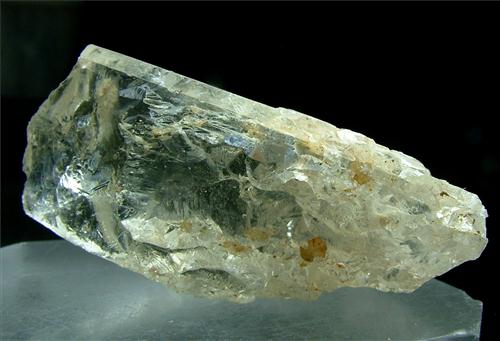
LiAlSi4O10
A clear angelic light steps down and empties the soul of what it still carries.
The name Petalite comes from the Greek petalon, meaning "leaf." It was given for the mineral's perfect cleavage: petalite splits along a single plane into thin, flat, leaf-like sheets, and that papery, foliated parting is its most immediate physical signature.
It was discovered in 1800 by the Brazilian naturalist and statesman José Bonifácio de Andrada e Silva, who first described the species from Swedish material. The leaf in its name is a small piece of poetry hiding in plain mineralogy — a stone that comes apart like the pages of a book.
Petalite is a lithium aluminium silicate with a framework structure — sheets of folded SiO4 and AlO4 tetrahedra linked into a continuous three-dimensional network, with lithium tucked into the cavities. The folded-layer geometry sits on the boundary between framework and sheet silicates, which is why older references sometimes filed petalite among the phyllosilicates before its tectosilicate framework was understood; structurally it is a framework silicate that fractures with a strongly foliated, almost layered cleavage.
That perfect cleavage and a hardness of 6 to 6.5 make clean gem material delicate to cut. Most petalite is colourless or white, glassy and transparent, though traces of manganese tint it pink and other impurities lend it a pale blue or grey. Heated strongly, petalite breaks down into spodumene and quartz — a transformation that records the same lithium chemistry rearranging itself under temperature.
The type locality is the island of Utö, in the Stockholm archipelago of Sweden, where petalite occurs in lithium-rich granitic pegmatites. Utö's pegmatites hold a place in scientific history far larger than the small island itself: in 1817 the Swedish chemist Johan August Arfwedson, analysing petalite from this very deposit, detected a previously unknown element. It was named lithium, from the Greek lithos, "stone," because — unlike the other alkali metals known from plant ashes — it had first been found locked inside a rock.
Today petalite is mined as a lithium ore and treasured by collectors from pegmatite fields around the world: Brazil's Minas Gerais, the Karibib district of Namibia, the giant Bikita deposit in Zimbabwe, and localities across Australia. The clear and pink crystals from Brazil and the cleavable masses from Africa are the specimens most often seen.


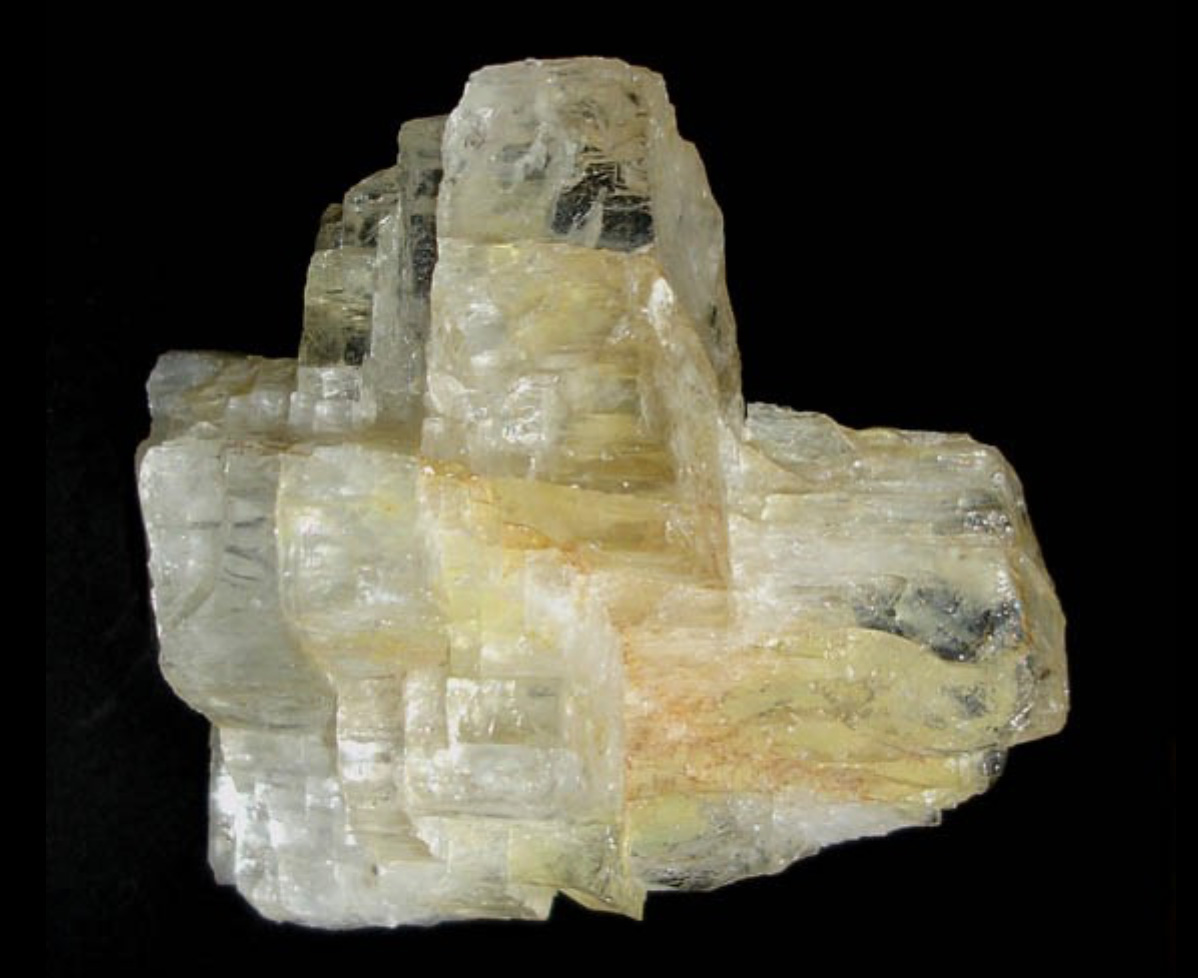
Most often water-clear to milky white with a glassy transparency, petalite also appears in soft pink from manganese and pale blue-grey from other traces — gentle, washed-out tints that suit its reputation as a calm, high-light stone.
Its one perfect cleavage parts the crystal into thin, flat, foliated sheets — the very property that named it. The split surfaces carry a pearly sheen where the leaf-like layers catch the light.
Under ultraviolet light much petalite answers with a soft orange-to-pink fluorescence, a hidden luminescence absent in daylight that betrays the lithium chemistry woven through its framework.
"I have come not to teach but to awaken."— Meher Baba
Petalite vibrates at a height well above the body's own chakras — a fine, clear band that opens like a window set above the crown. It does not work on the surface troubles of the day. From that high place it reaches back into the oldest layers of stored memory, the sorrows and shocks that seem to belong to a time before this life began, the impressions that lie even deeper than the root of a person, and it lets a soft, clear light fall over them so that they thin and lift. This is why it has long been called the Angel Stone: holding it feels less like effort and more like being met from above, a high tenderness that asks nothing and simply illumines.
Its power is gentle rather than forceful, but it is patient — it settles in and keeps working quietly through the hours, finding the root of a thing rather than only its surface ache. The light it brings is refining; it raises the whole tone of a person a little higher, a little finer, the way a single clear note lifts a room. I have come not to teach but to awaken — petalite teaches nothing; it only wakes what was always there beneath the long-carried weight.
"God is the supreme Light that pervades all beings. All humans are one family, united by the light of grace."— Vallalar
Petalite has a rare quality among crystals: it never needs cleansing. Most stones drink in the heaviness of the rooms and the hands that hold them and must be cleared again and again; petalite keeps its own clear note untouched, never clouding, never absorbing the density around it. It stays bright the way grace stays bright — drawing nothing dark into itself, only shedding light outward. For this reason it makes a steady, protective companion: a high lamp that does not go out, holding its connection open while everything heavier is gently dissolved beneath it.