

(Mg,Fe)2SiO4
Green fire of the sun, abundance returning to the centre
Peridot is the gem name for iron-bearing forsterite, the magnesium-rich end of the olivine series. The origin of the word is uncertain — it is usually traced either to the Old French peritot or to the Arabic faridat, simply meaning “gem.” The mineral species forsterite itself was named in 1824 by Armand Lévy after the English naturalist and mineral collector Adolarius Jacob Forster.
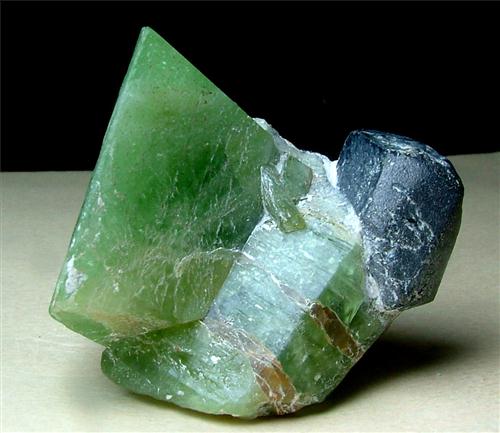
Peridot is gem-quality olivine, (Mg,Fe)2SiO4 — an orthorhombic nesosilicate built from isolated SiO4 tetrahedra bound together by magnesium and iron. Its olive-to-lime green is idiochromatic: the colour comes from iron that is an essential part of the crystal itself, not from any impurity, which is why peridot occurs in essentially a single hue, ranging only from yellow-green to deep olive.
It is a moderately hard, vitreous stone (about 6.5–7 on the Mohs scale) and the magnesium end-member of the most abundant mineral family of the Earth's upper mantle. Volcanic eruptions, and even meteorites, carry it up to where it can be cut and worn.
Peridot has been mined for at least three and a half thousand years from Zabargad (St John's) Island in the Egyptian Red Sea — the ancient Topazios — where it was treasured by the Egyptians as the “gem of the sun.” For centuries the island's location was kept secret.
Major modern sources include the San Carlos Apache lands of Arizona, the high mountains of Pakistan, and Myanmar. Because olivine is the dominant mineral of the upper mantle, peridot is, in a sense, a fragment of the deep Earth brought briefly to the surface.
Peridot is the lime-to-olive gem of forsterite-olivine, idiochromatic and mantle-born — coloured by the iron woven into its own structure.
Olivine is the most abundant mineral of the Earth's upper mantle; volcanoes lift it to the surface, so a cut peridot is a sliver of the deep Earth.
Found in pallasite meteorites, peridot is one of the only gems with both a terrestrial and an extraterrestrial source — a stone of both sun and stars.

"There is no other way to reach enlightenment than by recognizing buddha nature and attaining stability in it."— Tulku Urgyen Rinpoche
Peridot settles at the solar plexus — the fire-centre of will, agency and personal power, and the body's main place of digestion and of storing energy like a battery. Its frequency is modest and works the nearer layers rather than the deep root; its transmission carries good strength, and it stays for a fair while. This is a warm, daily stone for the centre, not a high-altitude one.
As a stone of Life it feeds that centre with vitality — the river of energy that lifts foggy-minded lethargy and the drained feeling of being run down, restoring the steady warmth from which will and good health arise. Because it also carries Love, that energy does not stay in the belly alone: love draws the frequency up into the heart as well, so the rekindled fire is softened, filled with kindness, gratitude and compassion rather than mere drive. This is the root of its old reputation as a stone of compassion and abundance, and of releasing jealousy — for jealousy is what contracts when the heart is closed and the will feels poor, and it loosens as soon as a person feels both fed and connected.
It is also Expanding: the warmed energy radiates outward from the centre rather than knotting, so one feels larger and more at one with their surroundings, more able to wish others well. Abundance, in this stone, is less a getting than a raising of the sail — an openness that lets what is already blowing actually reach you.
"The winds of grace are always blowing, but you have to raise the sail."— Ramakrishna
And underneath the fed and softened centre waits Joy — the thoughtless, unfiltered gladness that is simply there once the belly unclenches and envy lets go, the same plain happiness that rises while watching a green hillside or the sun going down.