

(Ca,K,Na,Ba)5[Al10Si35O84]·34H2O
The sweet widening where wanting softens into joy
Paulingite is named in honour of Linus Carl Pauling (1901–1994), the American chemist and twice Nobel laureate, whose work on the chemical bond and the architecture of crystals reshaped twentieth-century science. The mineral was described and named in 1960 by Werner H. Kamb and W. S. Oke, who chose Pauling's name as a tribute to his profound influence on the understanding of crystal structures.
Today "paulingite" is treated as a small mineral series, its members told apart by their dominant cation — paulingite-Ca, paulingite-K and paulingite-Na — but all of them carry the chemist's name.
Paulingite is a rare zeolite — a hydrated aluminosilicate built from a framework of linked silicon– and aluminium–oxygen tetrahedra. It crystallises in the cubic system as tiny, glassy rhombic dodecahedra, colourless to pale yellow, orange or red. Within the open framework lie wide cages holding water molecules and loosely bound cations — calcium, potassium, sodium and barium — that can exchange with their surroundings.
Its most striking structural feature is the sheer size of its repeating unit: paulingite has one of the largest unit cells of any mineral, with a cubic edge of about 35 ångströms, a scale otherwise seen mainly in crystallised proteins. The framework is so open and water-rich that the mineral is unusually light, with a density near 2.1.
Paulingite was first described in 1960 from gas cavities in a Tertiary basalt at Rock Island Dam, Douglas County, Washington, USA, where clear crystals were found in basalt boulders dredged from the Columbia River.
It has since turned up in basalts and volcanic rocks around the world — among them Riggins in Idaho, Ritter in Oregon, Chase Creek in British Columbia, the Giant's Causeway in Northern Ireland, and quarries in Germany and the Czech Republic — though everywhere it remains a scarce and prized find for collectors of zeolites.
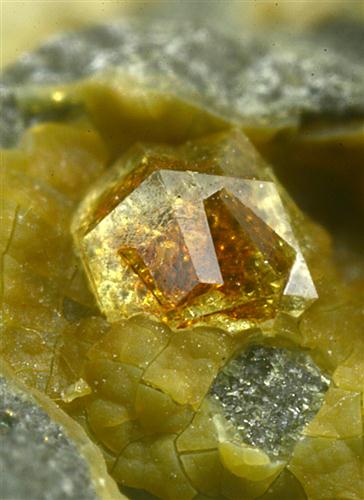
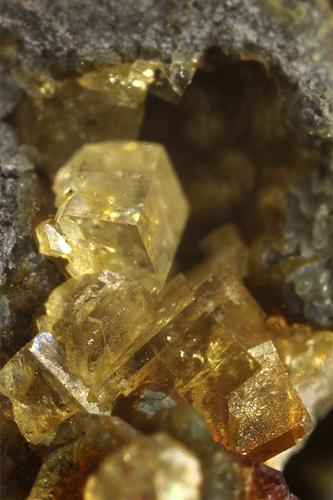
Among all minerals, paulingite has one of the largest unit cells — about 35 ångströms on edge — a structural scale normally reserved for proteins rather than rock-forming minerals.
Its open, cage-filled framework holds water and exchangeable cations; warmth releases the water and it returns again, the lattice acting as a reversible molecular sponge.
Paulingite grows as tiny, vitreous-to-almost-adamantine rhombic dodecahedra, colourless to pale yellow, orange or red, and is notably light for its size.
"All the buddhas of all the ages have been telling you a very simple fact: Be — don't try to become."— Osho
Paulingite settles into the sacral centre — the seat of desire, sensuality and emotional flow, the fluid, watery, magnetic water of the body. Its frequency is soft and low, so it works the nearer, more acute layers of feeling rather than reaching for the deepest root; yet its transmission is strong, and what it touches it moves with real force, even if it works only a short while on one or two things at a time.
As a stone of Life it pours vitality straight into that centre, flushing out the drained, foggy heaviness and the lethargy that pools in the belly, so the sacral waters begin to move again like a river remembering its bed. And because it also carries Love, its frequency does not stay only in the sacral but centres as well in the heart — so the loosening of desire is met with warmth and gratitude rather than grasping.
Paulingite is, above all, an Expanding stone. The energy radiates outward from the centre through the layered bodies, and a person feels larger, softer at the edges, more at one with everything around them — the small, walled-off self quietly widening into its surroundings.
"The consciousness in you and the consciousness in me, apparently two, really one, seek unity and that is love."— Nisargadatta Maharaj
What is left, as the wanting eases, is Joy — not a manufactured cheer but the thoughtless, unfiltered gladness that is simply there once a knot dissolves. The sacral, fully open, is innocence: nothing to chase, nothing to become, only this — being, just as it is.