

NaCa2(Mg4Al)(Si6Al2)O22(OH)2
The heart stops accusing itself, and warmth pours down to feed the body.
Pargasite carries the name of the place it was first found: Pargas (in Finnish, Parainen), a small town in the south-western archipelago of Finland whose pale metamorphosed limestones have yielded minerals to collectors for two centuries. The mineral was described from this locality in 1814 and named simply for the town — a straightforward geographical naming in the manner of so many nineteenth-century species.
It is a member of the amphibole supergroup, and like its relatives it wears a name rooted in observation rather than legend — no myth, no person, only the quiet Finnish quarry that gave it to science.
Pargasite is a calcium amphibole — an inosilicate built on the amphibole supergroup's signature double chains of silica tetrahedra running the length of the crystal. Sodium occupies the large A-site, calcium fills the paired M4 sites, and aluminium substitutes both into the octahedral ribbon (with magnesium) and into the tetrahedral chains themselves, replacing silicon. That double aluminium substitution is what distinguishes pargasite from common hornblende and tremolite, and it is written into the formula as the (Mg4Al) and (Si6Al2) groups.
The monoclinic structure (space group C2/m) gives the amphibole's diagnostic two cleavage directions meeting at roughly 56° and 124°, and a Mohs hardness of 5 to 6. The bound hydroxyl groups (OH) are essential: it is this structural water that makes pargasite, in the deep earth, one of the principal water-bearing minerals of the uppermost mantle.
Pargasite was first recognised in 1814 in the dolomitic marbles and skarns of its Finnish type locality, where it grows in metamorphosed limestone altered by the heat of nearby igneous rock. These contact-metamorphic and skarn settings — limestones cooked and recrystallised along the margins of intrusions — remain its classic habitat the world over.
Today the most prized specimens are the gem-clear green and honey-yellow crystals from the Hunza Valley in Pakistan and the Luc Yen district of Vietnam, where pargasite occurs in marble alongside ruby and spinel. It also turns up in andesitic volcanic rocks and altered ultramafic bodies, and, deep beneath our feet, as a stable hydrous phase in the mantle itself — a quiet reservoir of the planet's water.
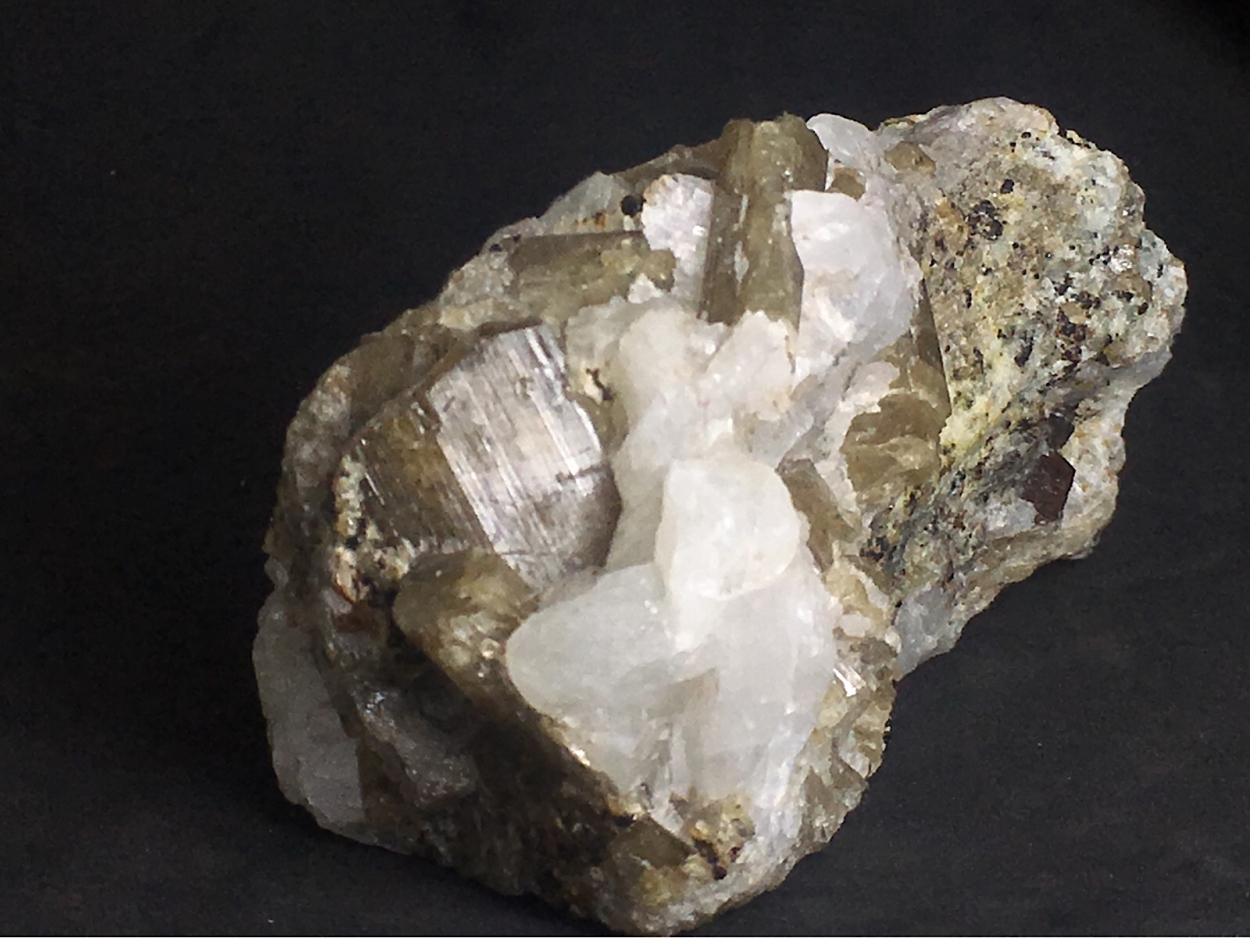
Gem pargasite ranges from grass-green through olive to warm honey-gold, and the best crystals are pleochroic — the body colour shifts subtly as the stone is turned, the light splitting into two slightly different hues along the crystal's axes.
Where most amphiboles are opaque and stubby, pargasite from Pakistan and Vietnam can be glass-clear and transparent, with a bright vitreous lustre — the clarity that lets it be cut at all, and that makes its inner green glow.
It splits along two perfect cleavage planes that meet at the amphibole's tell-tale angle of about 56° and 124° — the diagonal grain that distinguishes the whole amphibole family from the near-90° cleavage of the pyroxenes.
"The nature of your own mind is the Dharmakaya. Do not look for the Buddha elsewhere; look directly into the radiance of your own awareness."— Lama Achuk Rinpoche
Pargasite settles into the centre of the chest — the meeting place where everything above and everything below is joined, and where the old hurts are kept folded and unspoken. This is not a soft, vague comfort. There is real strength in it: it presses on what is held there, the way a steady hand presses on an ache, and what has been knotted for years begins, under that pressure, to give. It does not drift over the heart; it stays, resting its warmth on the sore place and remaining there until the soreness loosens and dissolves.
What it dissolves first is the inner voice that accuses. So much of what closes the heart is the quiet, constant self-judgement — the running verdict that one is not enough. Pargasite fills that space instead with kindness, an unforced tenderness toward oneself that spreads out as gentleness toward everyone else. As the accusing voice quiets, you may begin to wonder who exactly was being judged, and by whom — and in that wondering the whole case simply falls away. All is well; nothing was ever as wrong as the mind insisted.
"The heart is the hub of all sacred places. Go there and roam."— Bhagawan Nityananda
Pargasite has a second, quieter gift that sets it apart from other heart stones: it does not let the warmth stay aloft. The opened, softened feeling is drawn gently downward, past the chest and into the belly — the storehouse of vitality behind the navel — and there it becomes plain physical life. The body is fed; digestion eases; the foggy, drained heaviness lifts and a steady current of energy returns. It is the safe, downward-flowing kind of grace, the opposite of force: it calms a system in overload and asks nothing, only pours warmth from the heart into the flesh until the whole body feels held.