

Pb2Cu2(Se4+O3)(SO4)(OH)4
a rare blue voice that radiates love outward from the throat
Munakataite takes its name directly from its type locality: the Kato mine in Munakata City, Fukuoka Prefecture, on the northern coast of Kyushu, Japan. The suffix -ite follows standard mineralogical convention for locality-named species. The mineral was approved by the IMA (International Mineralogical Association) in 2007 and described in the Journal of Mineralogical and Petrological Sciences (vol. 103, p. 327). Munakata itself is a historically important city — home to the Munakata Grand Shrines, a UNESCO World Heritage site — though the mineral's name honours its Kato mine origin rather than any cultural connection.
Munakataite is a rare lead-copper selenite-sulfate hydroxide. Its structure combines three distinct anionic groups — selenite (SeO3²⁻), sulfate (SO4²⁻), and hydroxyl (OH⁻) — coordinated around a framework of lead and copper cations, making it chemically unusual even among secondary oxidation-zone minerals. The monoclinic space group P 21/m gives the crystals their characteristic fibrous prismatic habit.
The mineral is extraordinarily soft at 1.5 on the Mohs scale, barely harder than talc, and has a notably high specific gravity of 5.53 g/cm³ — a direct consequence of its lead content. Crystals are light blue in colour, transparent to translucent, with a vitreous to pearly lustre, a bluish-white streak, and perfect cleavage along {h0l}. The high refractive index (β ≈ 1.891) gives individual crystals an intense, gem-like inner light despite their modest size.
Munakataite was first identified at the Kato mine, Munakata City, Fukuoka Prefecture, Kyushu, Japan — its sole known type locality at the time of IMA approval in 2007. The Kato mine is a base-metal deposit in which supergene oxidation of primary sulfide ores produced a suite of rare secondary minerals, munakataite among them.
As with most secondary lead-copper minerals, munakataite forms in the oxidised zone of polymetallic deposits where lead, copper, selenium, and sulfur are all present together. Beyond Japan, occurrences of closely related selenite-sulfate minerals are documented in arid oxidised zones of Chile and other copper-belt regions, though munakataite specimens of display quality are exceptionally scarce on the collector market and rarely leave specialised mineralogical collections.
Munakataite contains significant lead (Pb) and copper (Cu), both of which are toxic to humans. Do not handle with bare hands for extended periods; always wash hands thoroughly after touching specimens. Never ingest, lick, or inhale any dust — fine particles are particularly hazardous. Do not use in gem water or elixirs. Store in a sealed display case, away from children and pets. Treat as a display mineral only.

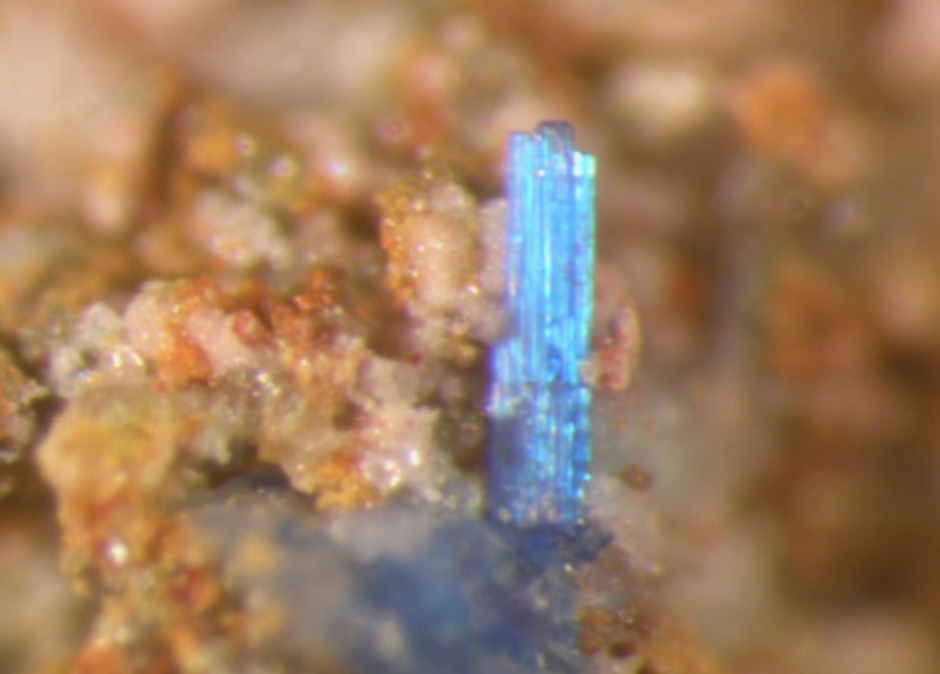
The pale to medium blue colour of munakataite arises from the copper content in its lattice. Combined with a refractive index of β ≈ 1.891 and a vitreous-to-pearly lustre, even tiny fibrous crystals catch light with unusual intensity, giving the mineral a luminous, almost electric quality that belies its extreme softness.
Munakataite is simultaneously among the softest display minerals (Mohs 1.5) and one of the densest secondary copper minerals (SG 5.53). A small specimen feels startlingly heavy in the hand while looking fragile and delicate — a physical paradox that is immediately noticeable to anyone who picks one up.
Very few minerals incorporate three distinct anionic groups of this type — selenite, sulfate, and hydroxyl — within a single structure alongside two different heavy metals (lead and copper). This chemical complexity makes munakataite a mineralogical curiosity and places it at a rare intersection of oxidation-zone geochemistry that requires very specific ore compositions to form.
"Love everyone, serve everyone, remember God, and tell the truth."— Neem Karoli Baba
There is a stillness that comes before a true word is spoken — not silence from fear, not quiet from suppression, but the held breath of someone who knows exactly what needs to be said and is about to say it. Munakataite lives in that moment. It is a rare thing: a stone whose entire character points outward, whose energy does not ask you to go inward and descend but to open the throat and let what is real move through it into the world.
The ego builds its wall precisely here, between the heart and the mouth. Every unsaid thing, every truth softened for safety, every voice that shrank when it should have been clear — that accumulation is what this stone quietly and persistently dissolves. Not quickly, not with great heat, but with a steady medium-duration current that works through the hours, loosening what is held tight. You may notice, after sitting with it, that a conversation goes differently than expected — more honest, less defended, warmer.
Love radiating outwardBecause munakataite carries the Love quality alongside its Throat frequency, the opening it creates is not cold clarity but warm clarity. The voice that finds its way through is not the voice of the critic or the strategist but something closer to the heart — the kind of expression that is simultaneously completely true and completely kind. Love here is not sentiment; it is a whole-body de-stressor that fills the throat with an authentic warmth before the words form. This is what the stone radiates outward: not just signal, but care.
Its rarity matters. The Rare quality in a crystal quietly amplifies the sense of what is possible — the reaching toward something difficult to find, the willingness to go where most do not go. A person drawn to this stone is usually someone who already senses there is something important they have not yet said, or not yet said fully. The crystal honours that readiness.
"Man is a miniature sun. Within the human body lies the same energy that fuels the stars; the goal of Yoga is to ignite that inner light until the body itself becomes luminous."— Vishuddhananda
All is well. Nothing has gone permanently wrong with the throat that has stayed closed. The silence was protective, and the protection made sense at the time. But the wall that was built to keep judgment out has also kept love in — and there is a point where keeping love in becomes the real harm. This stone simply rests at that boundary and waits. It does not force. It does not hurry. It just keeps the question alive: what is true, and is there someone who needs to hear it? When the answer finally surfaces, and it does, the voice that carries it tends to be quieter than expected — and clearer.