
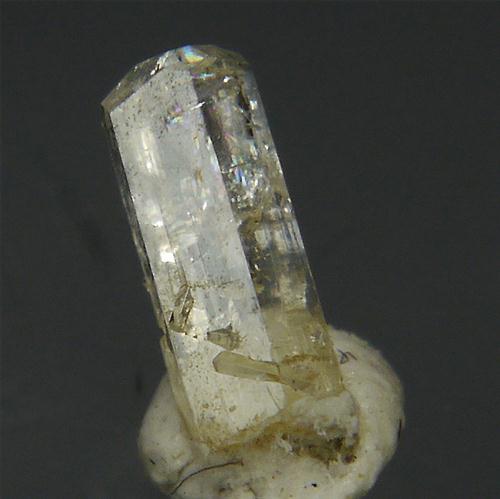
K2Ca4Al2Be4Si24O60·H2O
a high crown-light that thins the illusion and never clouds
The name milarite derives from Val Milar, the valley in the Swiss canton of Graubünden that was recorded on the specimen label when the mineral was first described. The irony embedded in the name is that "Val Milar" was itself a clerical error: the actual collecting locality was Val Giuf, a neighbouring valley. By the time the mistake was discovered the name had already entered the mineralogical literature and, under the rules of nomenclature, it stood. The mineral was formally described by the Swiss mineralogist Gustav Adolf Kenngott in 1870.
Milarite belongs to the osumilite supergroup, forming elongated hexagonal prisms with a characteristically hollow-tube ring-silicate framework. The structure is built around double rings of six-membered silicate tetrahedra, with beryllium filling smaller four-coordinated sites and aluminium occupying larger octahedral positions — a combination that gives the mineral its distinctive pale green to yellowish-green colour. Potassium and calcium occupy the large channel sites running parallel to the c-axis, locking the framework into its stable hexagonal geometry.
Specimens typically occur as short to long prismatic crystals in alpine fissure veins, often seated on calcite, fluorite, or bastnäsite. The transparency can be excellent in well-formed crystals, and the vitreous to slightly resinous lustre is one of the first things a collector notices when holding a good piece.
Milarite was first described in 1870 by Gustav Adolf Kenngott from material collected in Val Giuf, Graubünden, Switzerland — though the label on the type specimen read "Val Milar," and that erroneous valley name became immortalised in the mineral's official designation. Switzerland remains the classic source, with alpine fissure veins in Graubünden producing the finest gem-quality crystals.
Beyond Switzerland the mineral occurs in Brazil (Minas Gerais), Mexico, Namibia, China, and the United States. Gem-grade transparent crystals are uncommon enough to be prized by collectors; most museum specimens come from the Swiss Alps or from Brazilian pegmatites. Milarite also appears in marble xenoliths and in hydrothermal veins where beryllium-bearing fluids have percolated through calc-silicate host rocks.


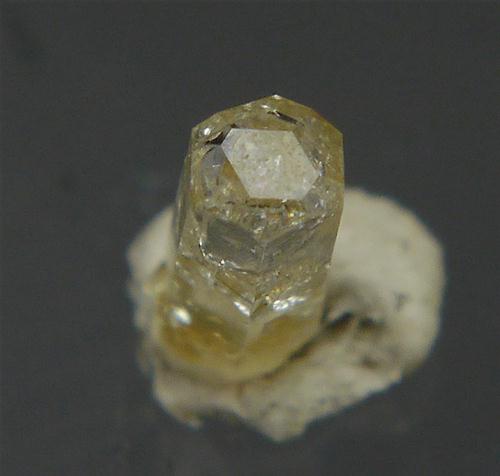
Milarite produces a pale, clear green that leans toward yellow — a colour caused by trace iron within the beryllium-aluminium silicate framework rather than by a primary chromophore. Well-formed alpine specimens can achieve near-gemstone clarity, transmitting light cleanly through elongated prisms that appear almost luminous against white matrix.
The double six-membered silicate rings create genuine hollow channels running the full length of every crystal. This unusually open framework — uncommon among silicates — is visible in the crystal's low density relative to its hard, durable surface, and accounts for the slightly resinous feel of a fresh cleavage face alongside the otherwise glassy exterior.
Beryllium is rare in the Earth's crust, and beryllium silicates that also incorporate potassium, calcium, and aluminium in a single stable phase are rarer still. Milarite's multi-element formula places it in a small and structurally distinctive mineral family — the milarite group — that it nominates by name, a distinction reserved only for the mineral that first defined the group's architecture.
"This beggar has done nothing. It is all due to Father's Grace and your faith, alone."— Yogiram
There is a moment in sitting — not dramatic, not announced — when what you have been calling reality simply becomes thinner. The wall of story and self-opinion loses some of its opacity. You are still here; the room is still here; but the grip of identification loosens just enough that a kind of seeing becomes possible that was not possible before. Milarite works precisely at that threshold. Its high crown-level vibration does not push or burn; it thins. Layer by layer — and the duration is sufficient to go several layers deep — the identifications that hold the ego in place are shown, quietly, to be made of a substance less solid than they claimed.
The crown is the seat of a thousand identifications. Every "I am this" and "I am that" lives there — not in the intellect, but as a felt certainty, the kind that answers when you ask "who are you?" The crystal's expanding quality means its action does not stay contained at the top of the head; it radiates outward through the field, making the whole energetic body more permeable to what the crown is already beginning to allow. And because the frequency carries the full refinement of a crown-level dissolution, what it loosens tends not to return. The roots are touched, not merely the leaves.
What does that actually feel like? Often it is the experience of watching a thought arise and simply not quite believing it the way you did. A grievance that was iron becomes clay. A self-image that seemed load-bearing turns out to be freestanding — nothing is actually holding it up. This is not collapse; it is clarification. Milarite does not hollow you out. It allows the Grace-Light that is already present behind every layer of illusion to become just slightly more visible — the way a thin cloud passing between you and the sun suddenly shows you that the sun was there all along, shining with complete indifference to the cloud.
"It is always the false that makes you suffer, the false desires and fears, the false values and ideas. Abandon the false and you are free of pain."— Nisargadatta Maharaj
The "Cleaning" quality in milarite means the stone itself never becomes saturated with what it dissolves. You can work with it continuously without needing to clear or reset it — its own crystalline clarity is structurally maintained, much as those open channels in its hexagonal framework allow energy to move through rather than accumulate. This is a rare and practical gift: a stone that works several hours to days on a single session, that never carries the residue of what it has helped to release, and that can be returned to again and again without diminishing returns.
Spiritual vision — the capacity to see through the story the mind constructs over experience — is not something milarite delivers from the outside. It is something the mind already has when the layers of false identification thin enough to permit it. This stone assists that thinning, patiently and at the level of cause. What you find when the illusion thins is not emptiness. It is the recognition that Father's Grace — call it the Vast Grace-Light, call it pure awareness, call it the simple fact of being — was never actually obscured. Only the belief in the obstruction was real. And beliefs, unlike stones, dissolve.