
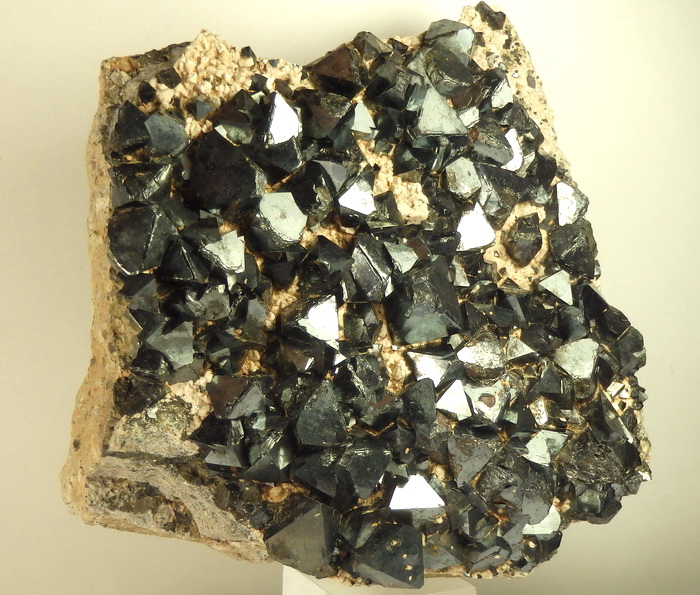
Fe2+Fe23+O4
Life and joy expand outward from the root, grounding bliss into the earth itself
The name magnetite derives from the ancient Greek Magnesia — a region of Thessaly (northern Greece) where magnetic iron ore was encountered in antiquity. Ancient Greek writers described iron being attracted to certain black stones found in this district. One popular legend holds that the name comes from a shepherd called Magnes, whose iron-tipped staff and iron-nailed sandals were pulled toward a black rock on a hillside on Mount Ida. Whether legend or observation, the name has been in use for over two millennia, making magnetite one of the oldest-named minerals known to humanity.
Magnetite has an inverse spinel structure — iron occupies both tetrahedral and octahedral sites within a cubic close-packed oxygen lattice, but with a characteristic inversion: the tetrahedral sites are occupied by Fe³⁺ while the octahedral sites hold both Fe²⁺ and Fe³⁺. This specific site distribution is what gives magnetite its exceptional ferromagnetism — electrons can hop rapidly between the two iron oxidation states, creating a spontaneous magnetic moment throughout the crystal.
Magnetite has been known since at least the 6th century BC — it is referenced in ancient Greek, Chinese, and Indian writings as a naturally magnetic stone (lodestone). No single discoverer can be named; it is one of humanity's oldest-observed minerals. It is found on every continent and in an enormous range of geological settings: igneous rocks, metamorphic sequences, hydrothermal veins, and sedimentary iron formations. Major deposits include Kiruna, Sweden (one of the world's largest magnetite mines); the Kola Peninsula, Russia; the Ural Mountains; the Bushveld Complex, South Africa; and scattered localities across the USA and Australia. The finest collector-grade octahedral crystals come from the Kovdor massif, Kola Peninsula, Russia.


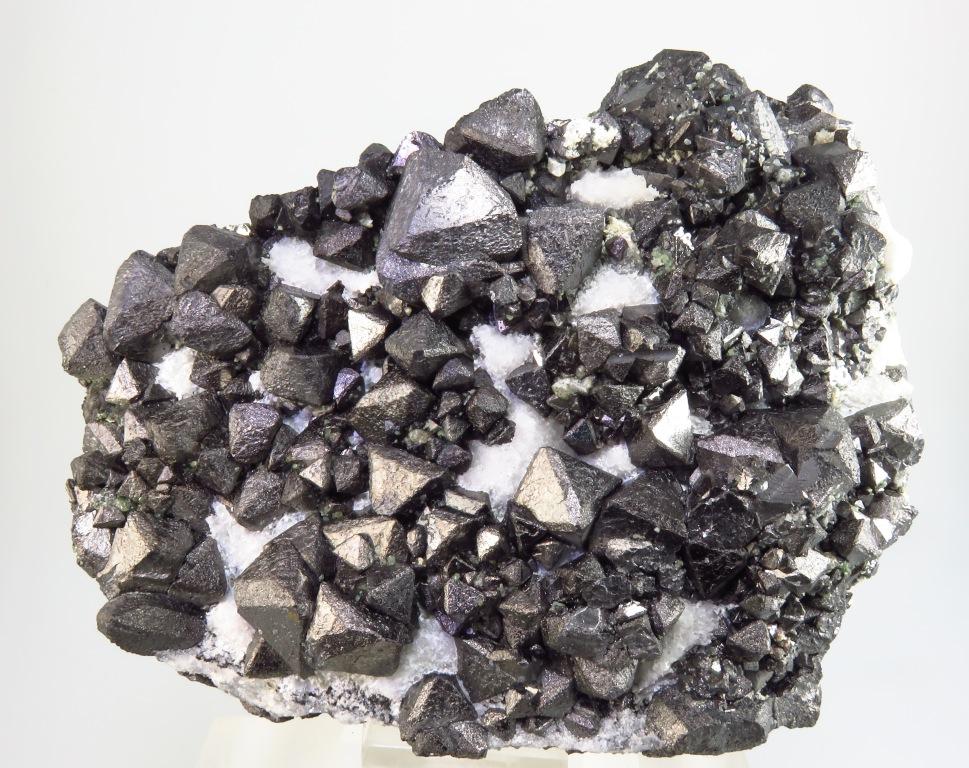
Magnetite is the only common mineral on Earth that is naturally and strongly ferromagnetic at room temperature. The lodestone variety — naturally magnetised magnetite — is the first magnetic material ever used by humans, and retains its magnetism indefinitely without any external field. No other natural mineral displays this combination of accessible, strong, spontaneous magnetism. The electron-exchange mechanism between Fe²⁺ and Fe³⁺ that drives this property is unique to the inverse spinel structure.
Unlike normal spinel (MgAl₂O₄), where the divalent cation occupies tetrahedral sites, magnetite has an inverse arrangement: Fe³⁺ takes the tetrahedral sites while both Fe²⁺ and Fe³⁺ share the octahedral sites. This specific electronic configuration allows rapid electron hopping between iron sites — the microscopic mechanism behind both magnetite's ferromagnetism and its unusually high electrical conductivity for an oxide mineral.
"The kind of happiness you get in meditation does not exist on this earth anywhere else."— Shivabalayogi
One of my favourite crystals. Magnetite brings me back to earth and lets me enjoy life. It is a great balancer, drawing duality back into balance.
The BalancerMagnetite works at the Root, the Muladhara — the seat of raw presence and the will to exist, and the ground where the kundalini lies coiled before it ever rises. Its energy is expanding: it radiates outward from that base, making the field of vitality feel larger, more solid, more rooted in the body and in life itself. Working at the most fundamental level of all, it touches not subtle impressions but basic physical aliveness and the simple sense of being at home in one's body and on this Earth. This is the stone that returns a scattered, over-expanded practitioner to the ground, dissolving the faint dissociation that too much upper-chakra work can bring.
"Wisdom is knowing I am nothing, Love is knowing I am everything, and between the two my life moves."— Nisargadatta Maharaj
Its power is substantial — it transmits its root-vitality clearly and steadily — and its long duration makes it a daylong companion that keeps working through activity and through sleep, ideal to carry rather than reserve for formal sitting. The Joy it gives is characteristic: not the jubilant joy of an opening heart but the quiet, animal contentment of being fully alive and fully embodied, present without tension. Magnetite is not transcendence but integration — heaven and earth drawn together into the living body. True to its own magnetism, it draws the field into alignment, eases the body's aches and pains, and helps a scattered intention settle and manifest into solid ground.