

(Fe,Mn,Mg)3(PO4)2·4H2O
Green balm for the bruised heart
Ludlamite was named in 1877 by Frederick Field in honour of Henry Ludlam (1824–1880), the English mineralogist and collector whose fine cabinet was among the most celebrated of its day.
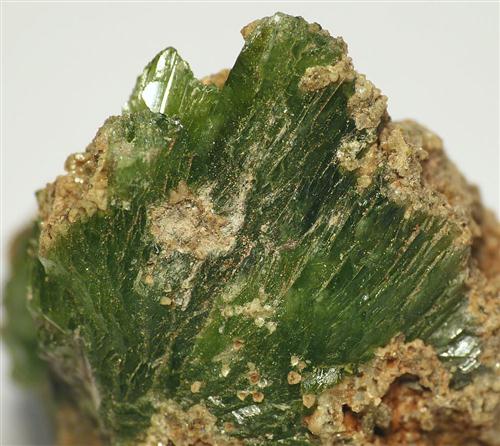
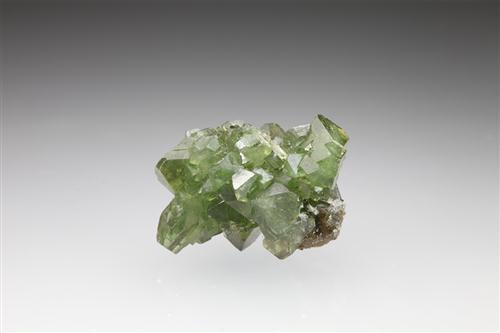
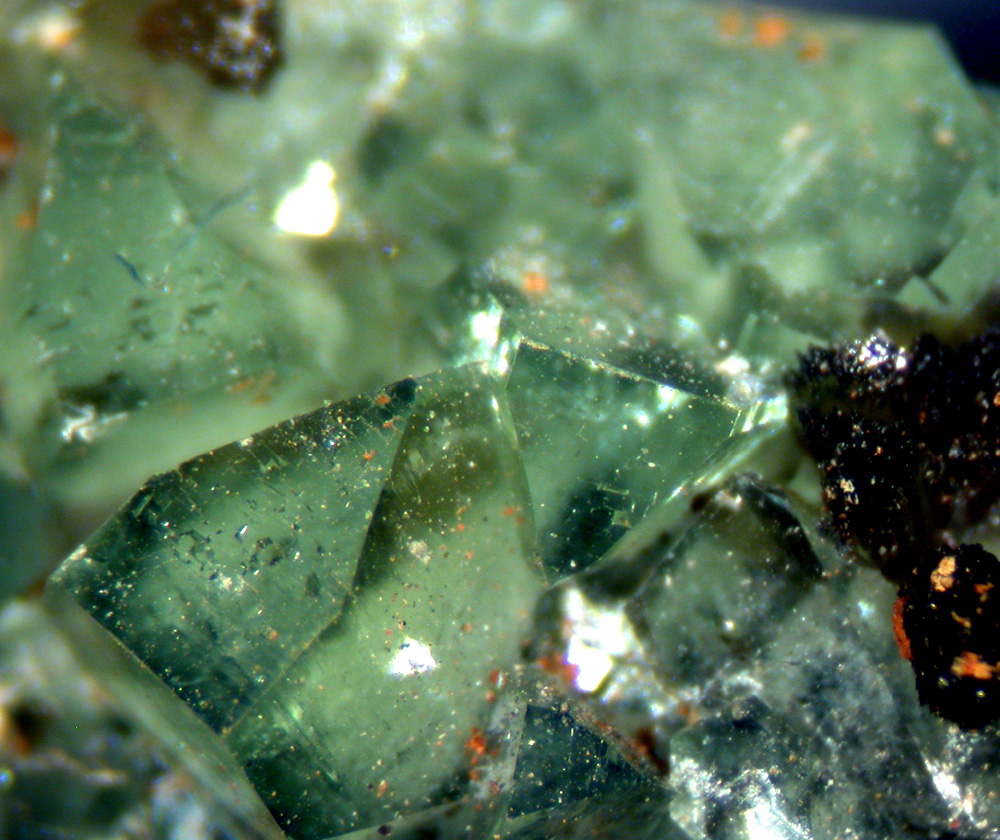
Ludlamite is a hydrated iron phosphate, (Fe,Mn,Mg)3(PO4)2·4H2O, crystallising in the monoclinic system. It is soft (about 3.5) and famous for its colour: a vivid apple-green to emerald, transparent and gemmy, in tabular or wedge-shaped crystals.
Its iron is in the reduced ferrous state, which is why it grows only in oxygen-poor settings — an alteration product of earlier phosphates such as vivianite and triphylite, in pegmatites and in reducing ore zones.
Ludlamite was first described in 1877 from the Wheal Jane mine near Truro in Cornwall, England, long one of the great mining districts of the world.
It is found at scattered phosphate localities worldwide, always prized by collectors for its rare, gemmy green crystals; the largest and finest have come from Bolivia and from old European and American mines.
A soft, gemmy iron phosphate of vivid apple-to-emerald green — one of the most coveted green crystals among collectors.
Its ferrous iron means it can only grow in oxygen-poor, reducing conditions — the green itself a record of how it formed.
It crystallises as older phosphates like vivianite and triphylite break down, a fresh green bloom rising from their decay.
"To truly surrender is not only to be beaten but to not care."— Swami Rudrananda
Ludlamite works at the heart — the centre of the chakra system and the body's main place for the healing of emotion, where past hurts are held as the knot the tradition calls the Vishnu Granthi. Its frequency sits in the middle range, working the nearer layers; its transmission is gentle and it stays a moderate while. This is exactly its blurb: a soft, kindly energy for emotional recovery and heart healing, fitting for the gentle green stone.
As a stone of Life it feeds the heart with vitality, lifting the drained, foggy heaviness that settles in after a wound; it does not force the healing but feeds it, the way the green crystal itself grows slowly out of older, broken-down minerals. The recovery it offers is not a wrenching catharsis but a quiet mending — the bruise fading rather than being torn open.
"There are very few things in the mind which eat up as much energy as worry."— Meher Baba
It is also Expanding: the renewed warmth does not stay knotted in the chest but radiates gently outward from the centre, so a person feels a little larger and more at ease, less braced around the old sore place. Slowly the heart unclenches, the worry that fed on its energy loosens its grip, and the green calm settles in where the ache had been.
Ludlamite is not the only green phosphate that carries the gift of Life. Anapaite — Ca2Fe2+(PO4)2·4H2O, a soft green phosphate of the triclinic system (pinacoidal class) — is a close cousin. It is a hydrated calcium phosphate in which iron takes one of the calcium positions (Ca2Fe in place of Ca3), and like ludlamite it is a glassy secondary phosphate that grows in the same company: among siderite and vivianite, in phosphate-rich iron beds and even inside fossil shells. It was first found at Anapa, on the Taman Peninsula of Russia's Black Sea coast — which is where its name comes from. It never made the Top 200, yet it shares ludlamite's life-giving nature, simply at a different centre.
A Word on ApatiteAnapaite is often pictured as “apatite with iron,” and energetically the two do share a great deal — the same vitalising, life-feeding current — though anapaite is the gentler, less powerful of the pair. Chemically, though, they are not the same family: true apatite is Ca5(PO4)3(F,Cl,OH), anhydrous and hexagonal, while anapaite is this hydrated, triclinic calcium-iron phosphate. The near-rhyme of the names is a coincidence of place — Anapa — not of chemistry; but the felt kinship with apatite is real.

Energetically, anapaite echoes apatite — the same life-feeding, vitalising current — only softer and less forceful. Where ludlamite pours life and joy through the open heart, anapaite works lower, at the sacral centre, as a quiet stone of Life: it feeds vitality back into a system gone foggy, lethargic and drained, lifting the heaviness and restoring the flow of life-force, with a gentle buffer against daily stress. Its power is soft and its work is medium-lasting — returning over hours and days rather than in a single rush.