
PbCu(SO4)(OH)2
The clear blue voice that turns truth into action
Linarite is named after its type locality, the lead-mining district of Linares in Jaén, Andalusia, Spain. It was named in 1839 by the German mineralogist Ernst Friedrich Glocker, after the town whose oxidised lead ores yielded the deep-blue mineral.
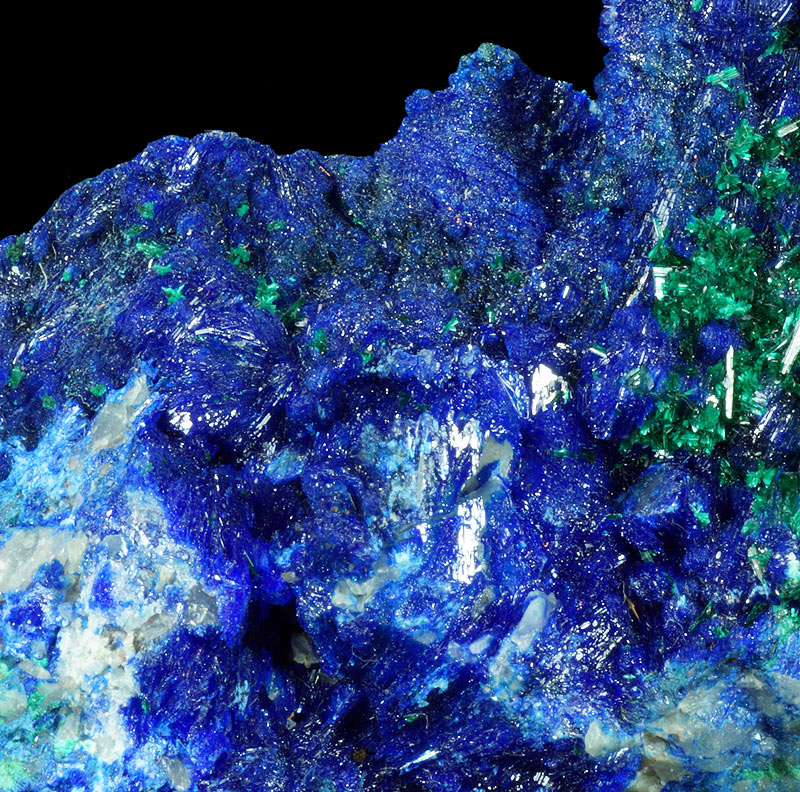
Linarite is a lead copper sulfate hydroxide, PbCu(SO4)(OH)2, crystallising in the monoclinic system as deep azure-blue, tabular to prismatic crystals of sub-adamantine lustre. It is heavy, owing to its lead, and very soft — only about 2.5 on the Mohs scale — with a pale blue streak.
It is a secondary mineral, forming where galena (lead sulfide) and copper minerals weather together in the oxidised zone of ore deposits, so it keeps company with brochantite, caledonite, cerussite and anglesite. Its intense blue makes it easy to mistake for azurite, but linarite is a sulfate, not a carbonate, and does not fizz in dilute acid — a quick way to tell them apart. As a lead- and copper-bearing mineral it should be handled cleanly and never made into crystal water.
First recognised at Linares in Spain and named in 1839, linarite has since been found wherever lead and copper ores weather side by side.
Notable specimens come from Leadhills and Wanlockhead in Scotland, the Caldbeck Fells of Cumbria in England, Tsumeb in Namibia, the mines of Arizona, and the rich blue crusts of the Atacama in Chile. It is always a secondary mineral of the oxidised zone, and never abundant in large crystals.
Contains lead and copper — do not ingest, lick, or make crystal water or elixirs from this mineral.
Wash hands after handling. Do not grind or polish it dry, and keep it away from children and pets.

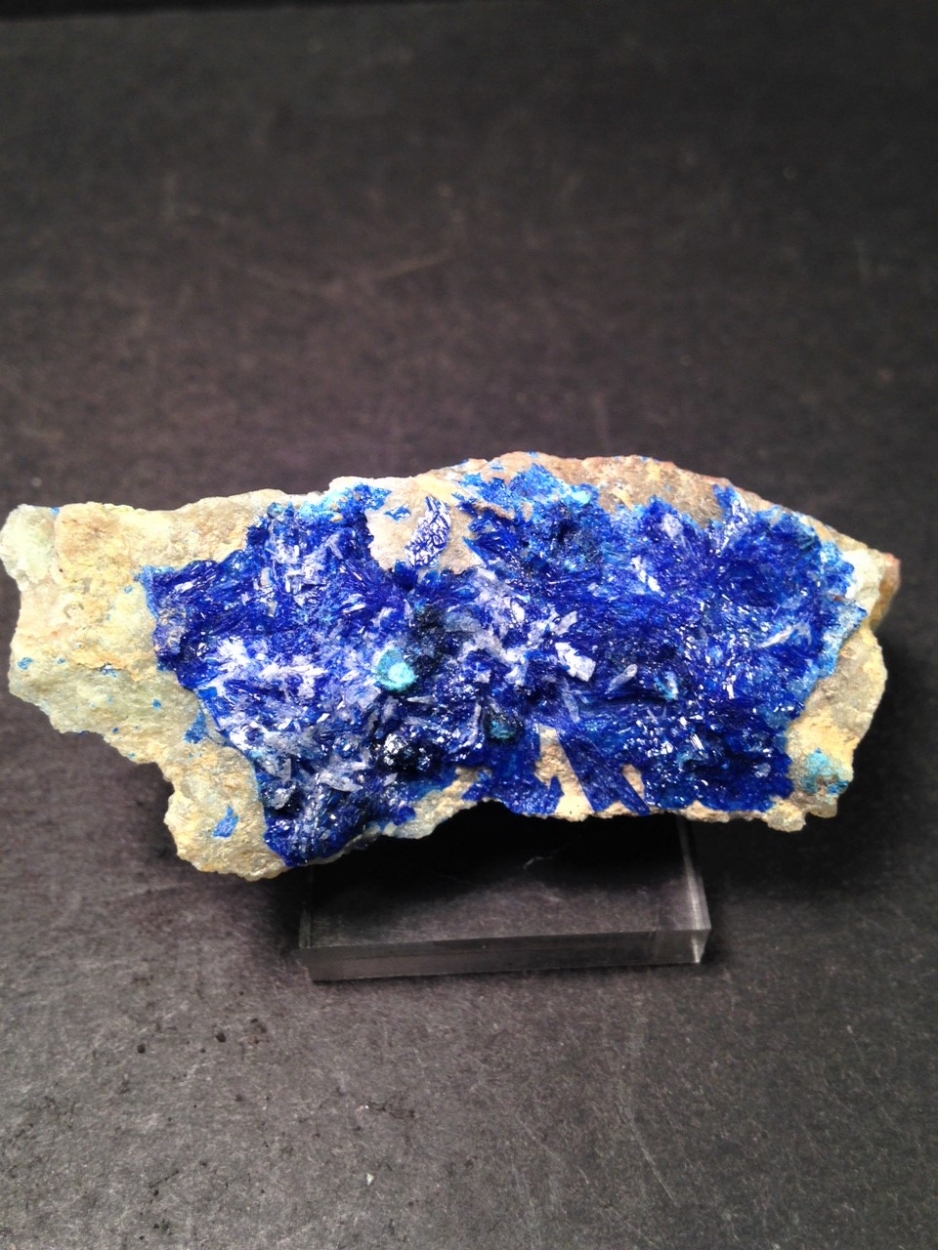
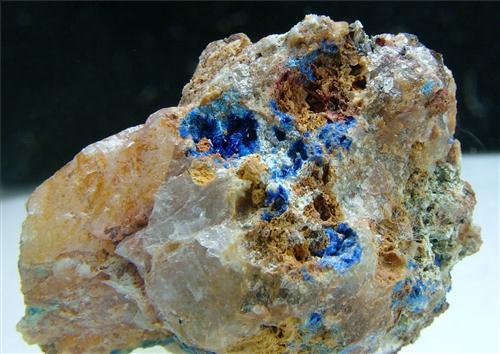
Linarite's deep, saturated blue and sub-adamantine lustre rival azurite's; the two are routinely mistaken, separated only by linarite's refusal to fizz in acid.
Lead gives linarite real heft, yet it is one of the softer minerals (about 2.5), brittle and far too delicate to wear.
A secondary mineral, it forms only where lead and copper ores oxidise together, growing among brochantite, caledonite and cerussite in the oxidised zone.
"Just as camphor is consumed by the flames of fire, so also, mind must be consumed by soul-fire."— Bhagawan Nityananda
Linarite works at the throat — the centre of expression, truth and resonance, where speech, song and will take form. The throat is also where the great wall stands between heart and mind: the ego builds it to protect itself, and while it stands a person cannot say what is truly theirs to say. Linarite's frequency is high enough to reach the subtler layers of that block, though its transmission is light and brief — sharp and direct rather than slow and deep.
Its work is sharper, more direct, and outward. This is a stone for putting one's will into action and seeing it through — for letting the truth that has been held back finally be spoken, and spoken with love rather than force. The old emotional wall the mind built for safety begins to give way, as if the very thing that ran the mind were quietly consumed, leaving room for honest speech.
"If your thoughts are rooted in love and integrity, only goodness will follow you."— Vallalar
As an Expanding stone its energy radiates outward from the throat, so expression no longer stays small and guarded but reaches out and meets the world, and a person feels larger, more at one with those they speak to. When the wall is down, speaking the truth costs nothing: one simply says what is so, quietly, and rests.

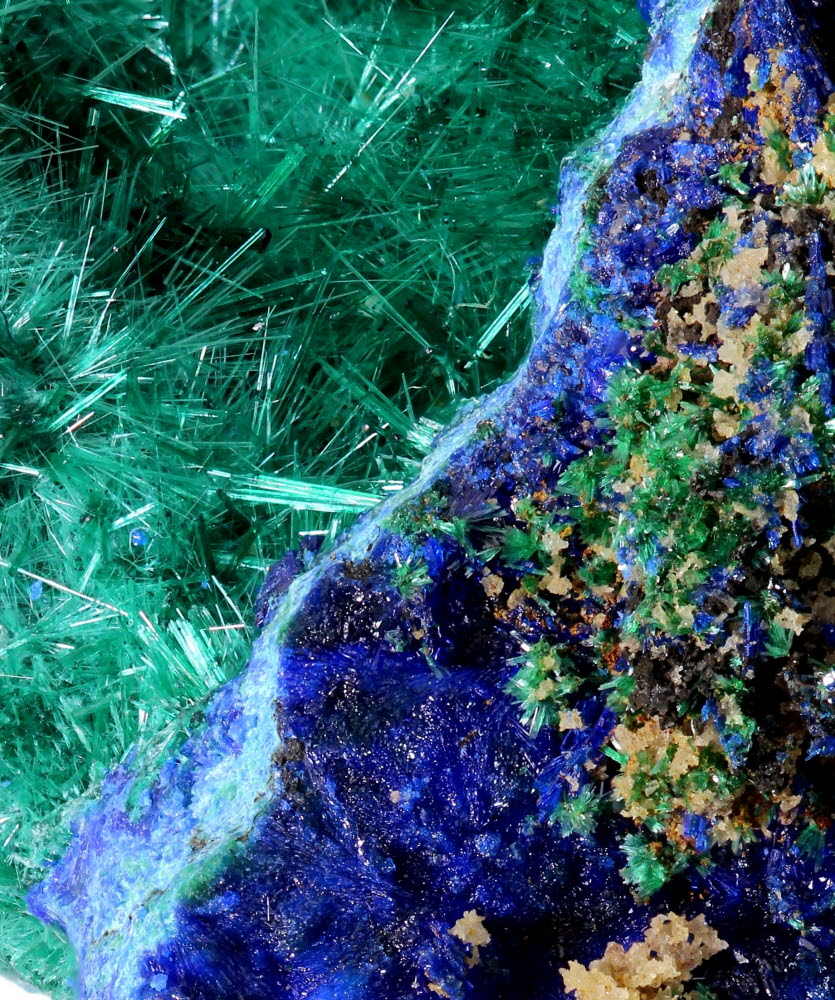
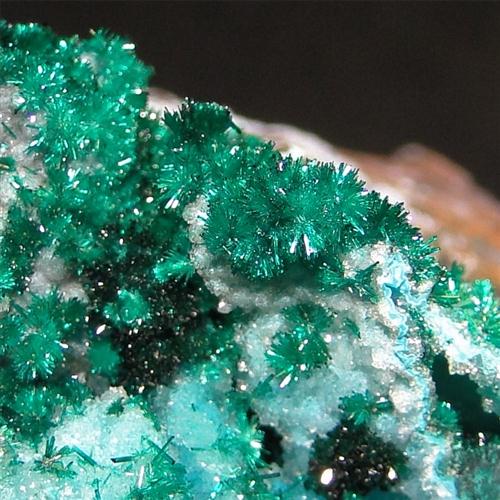
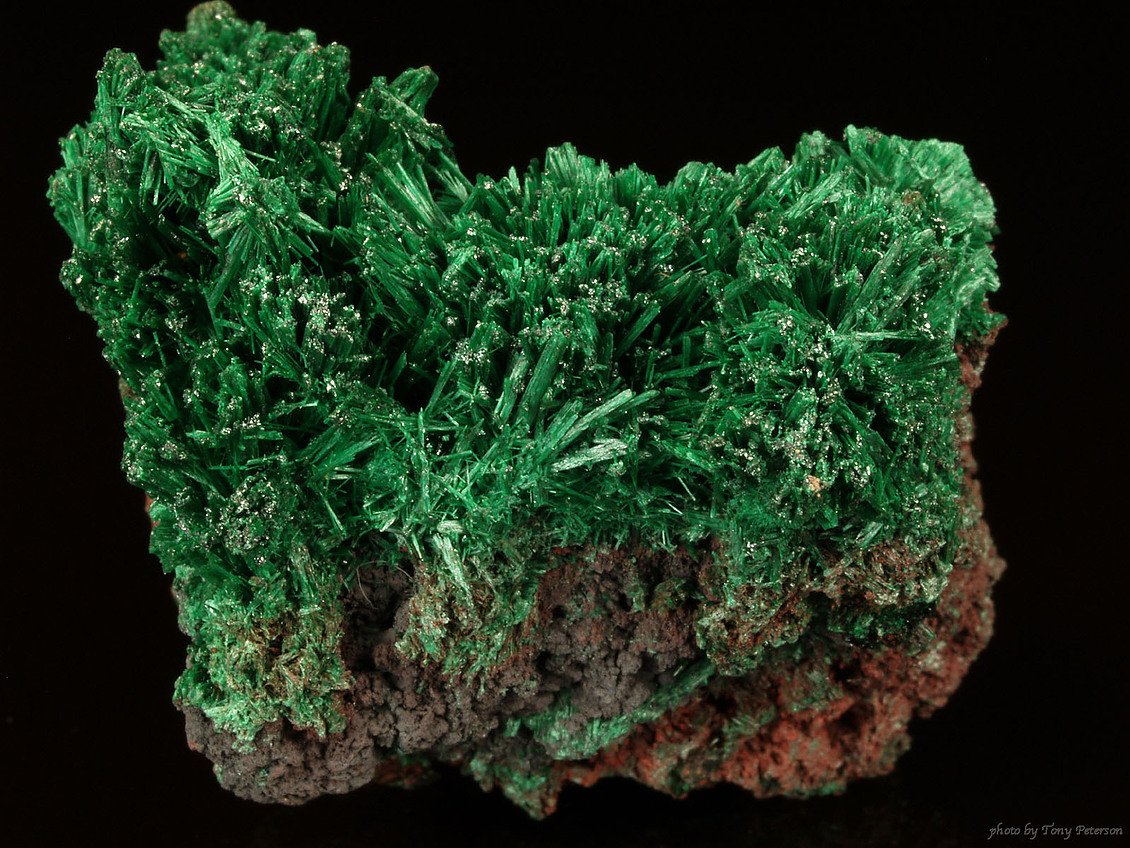
Linarite keeps company with several copper minerals, and two of them fool the eye. Its own vivid blue is so close to azurite's that the two are constantly confused — only a drop of acid (azurite fizzes, linarite does not) reliably tells them apart. And the green crystals most often found nestled against linarite are not malachite but brochantite — which is itself a notorious look-alike for malachite. None of these three appears in the Top 200, and that is worth a word.
Why Brochantite, Not MalachiteLinarite and malachite can certainly share a mine — both are secondary minerals of the oxidised zone of copper deposits — but they are not the tightest pairing, and the reason is chemistry. Linarite, PbCu(SO4)(OH)2, is a sulfate: it forms in acidic, sulfate-rich pockets where carbonate is suppressed, so its true neighbours are the lead–copper sulfates — brochantite, caledonite, leadhillite, anglesite, cerussite. Malachite, Cu2(CO3)(OH)2, needs the opposite: appreciable carbonate, usually near limestone or CO2-charged groundwater. Both can occur within one zoned oxidation envelope, but they tend to occupy different niches, and the matrix hugging good linarite is far more often brochantite or caledonite than massive malachite. Where the two do meet intimately, it is usually because metastable linarite has begun to alter toward malachite as conditions turn more carbonate-rich — malachite encrusting or replacing an earlier linarite rather than the two having grown together. At the classic localities — Leadhills–Wanlockhead, Linares (the type locality), Tsumeb, and the Arizona–New Mexico oxidation zones — linarite comes mostly alongside the other Pb–Cu sulfates, with malachite present in the broader assemblage but rarely the defining companion.
Why They're Not in the Top 200A crystal missing from the Top 200 is not a crystal without spiritual value. The ranking is built on F / P / D — Frequency, Power and Duration — so it naturally leans toward stones that vibrate high, transmit strongly, or keep working on a person over a long time. That is a real and useful measure, but it is not the whole of what a stone can give. Sometimes a soft, caring stone is exactly what is needed — and these three are a perfect example. They do not open, clear, expand, or pour in energy. They work in the opposite direction: toward calming and softening.
The green so often mistaken for malachite, and the species most truly at home beside linarite. As a stone it is gentle and quiet, working at the solar plexus: it settles a churning, anxious gut and steadies frayed nerves, easing the low hum of worry that sits in the belly so a calm, grounded sense of oneself can return. Soft and brief — soothing rather than forcing.
The green most people picture — though, as above, it sits in linarite's wider assemblage rather than right against it. A gentle, nurturing green that calms an overloaded system: the stone for burnout and nervous exhaustion, settling what runs too hot, drawing off the excess, and letting a frayed system rest and recover.
Linarite's deep-blue twin works on the heart: it softens and warms it, easing the guardedness around feeling so that tenderness can return. Where linarite reaches the throat and pushes outward, azurite simply makes the heart gentle again — quiet, warm and unhurried.