
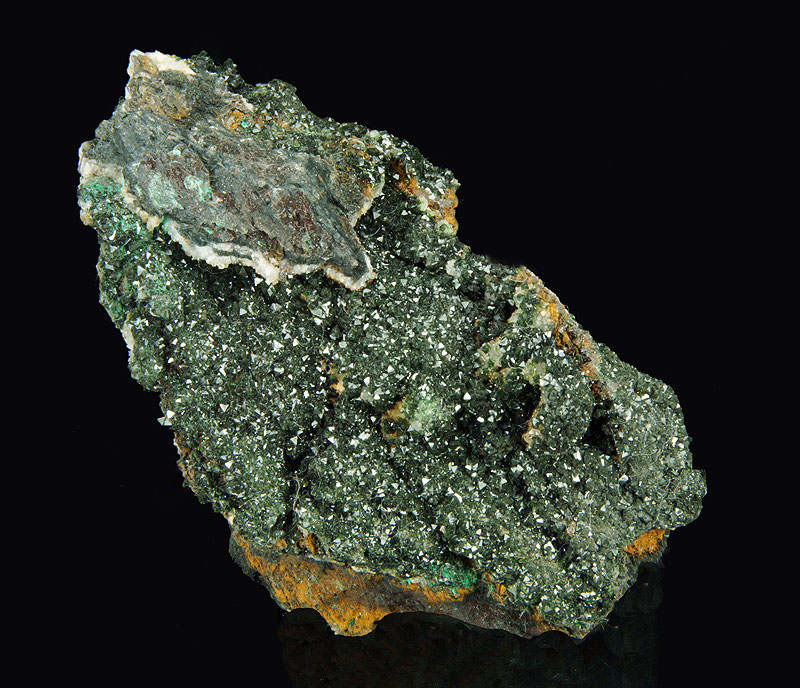
Cu2PO4(OH)
The ego dissolves and the heart shines with its own purpose
Libethenite takes its name from Ľubietová, a village in central Slovakia (historically known by its German name Libethen), where the mineral was first collected and described in the early nineteenth century. Ľubietová was a significant copper mining centre in the Habsburg era, and the secondary copper minerals that formed in its mine oxidation zones attracted the attention of early mineralogists. The anglicised form Libethenite follows the German place name, with the standard -ite suffix applied to denote a mineral species.
The mineral was formally described in 1823 by Sebastian C. Weis, a Prussian geologist and crystallographer, from specimens obtained at Ľubietová.
Libethenite belongs to the olivenite group — a family of copper and other metal arsenates and phosphates sharing the general formula Cu₂(XO₄)(OH). Its phosphate analogue within the group is itself, while the arsenic analogue is olivenite (Cu₂AsO₄(OH)). The rich dark olive-green to near-black colour is a direct expression of Cu²⁺ d-orbital transitions within the orthorhombic crystal lattice.
Crystals are typically short prismatic, dipyramidal, or drusy on matrix, showing characteristic striated faces parallel to the elongation axis. The orthorhombic dipyramidal symmetry gives libethenite crystals a recognisable double-ended habit when free to grow in open cavities. Its moderate hardness (4 Mohs) and well-developed cleavage make it a relatively accessible mineral for handling and display.
First discovered in Ľubietová (Libethen in German), Slovak Republic — where it was collected from the secondary oxidation zones of the historic copper ore deposits in the nineteenth century. In the modern era the finest specimen-quality libethenite comes predominantly from the Zambian Copper Belt in central Africa, particularly the Mindola and Nkana mines near Kitwe and the mines in the Copperbelt Province. The Zambian specimens, such as the hero image on this page, display bright olive-green prismatic crystals of exceptional clarity and size on limonite or malachite matrix.
Libethenite is a secondary mineral, forming in the oxidation zones of copper ore deposits wherever both copper and phosphate are available in the circulating groundwater. It occurs alongside malachite, azurite, olivenite, and other secondary copper minerals. Other significant localities include the Likasi area of the Democratic Republic of Congo, the Wheal Phoenix mine in Cornwall, England, and various copper mining districts in France, Germany, and the American Southwest.


This is the master crystal for dissolving limitations and helping you progress in life. Libethenite carries Healing and Life energy centred at the Heart chakra — a combination that works not by dramatic upheaval but by a persistent, gentle softening of whatever has hardened around the heart. The limitations it dissolves are not external circumstances but internal ones: the contracted beliefs, the defended identities, the ego structures that prevent the heart from opening to what it already knows.
The Healing energy type at the Heart chakra is stationary and dissolving — it does not push or drive. It rests in the centre of the chest and quietly works on whatever it finds there. At frequency 4, it operates primarily on the physical and emotional-astral layers, addressing accumulated grief, old relational patterns, and the energetic residue of experiences the heart has not yet fully processed. This is thoroughgoing work, not superficial — but because it is Healing (not Kundalini), it proceeds at the body's own pace rather than forcing.
The Life energy component adds something important: libethenite does not leave you depleted after its healing work. It vitalises the Heart centre simultaneously, so the process feels supportive rather than draining. People often report that working with libethenite leaves them feeling more capable of love and service — not because they have tried harder, but because something that was blocking the heart's natural generosity has been loosened.
Duration 9 makes libethenite a quiet daily companion. It works in the background, hour after hour, continuing its gentle dissolving action long after the meditation session has ended. Place it on the chest during meditation, carry it in a breast pocket, or keep it on the bedside table. Its moderate power (P=5) means it is accessible even for those new to crystal work — it will not overwhelm, but it will not let the work slip either.
"Love everyone, serve everyone, remember God, and tell the truth."
— Neem Karoli Baba