

NaCaBeSi2O6F
Kundalini rises through the heart into a boundless inner sun
The name leucophanite derives from the Greek λευκός (leukos), meaning "white," and φαίνεσθαι (phainesthai), meaning "to appear" — thus "white-appearing." The mineral was named in 1840 by Wilhelm Karl Ritter von Haidinger, the Austrian mineralogist, in reference to the pale or whitish colour of the early specimens described. Later specimens show a wide colour range from colourless and white to pale yellow and vivid green.
Leucophanite is a rare beryllium fluorosilicate — an unusual composition that carries both beryllium and fluorine alongside calcium and sodium in a single silicate. It crystallises in the triclinic–pedial class, the lowest symmetry possible in crystallography: no rotational axes and no mirror planes.
Leucophanite was first described from the Langesundsfjord area of Telemark (now Vestfold og Telemark), Norway — specifically from the famous Langesund and Låven island alkaline syenite complexes that have yielded numerous rare beryllium and rare-earth minerals. Norway remains the primary source, particularly the Låven island pegmatites where leucophanite occurs in association with albite, serandite, catapleiite, and other exotic alkaline minerals.
Additional occurrences have been reported in the Kola Peninsula, Russia, and in alkaline complexes in Greenland and Canada, though Norwegian material continues to be the finest available for collectors.
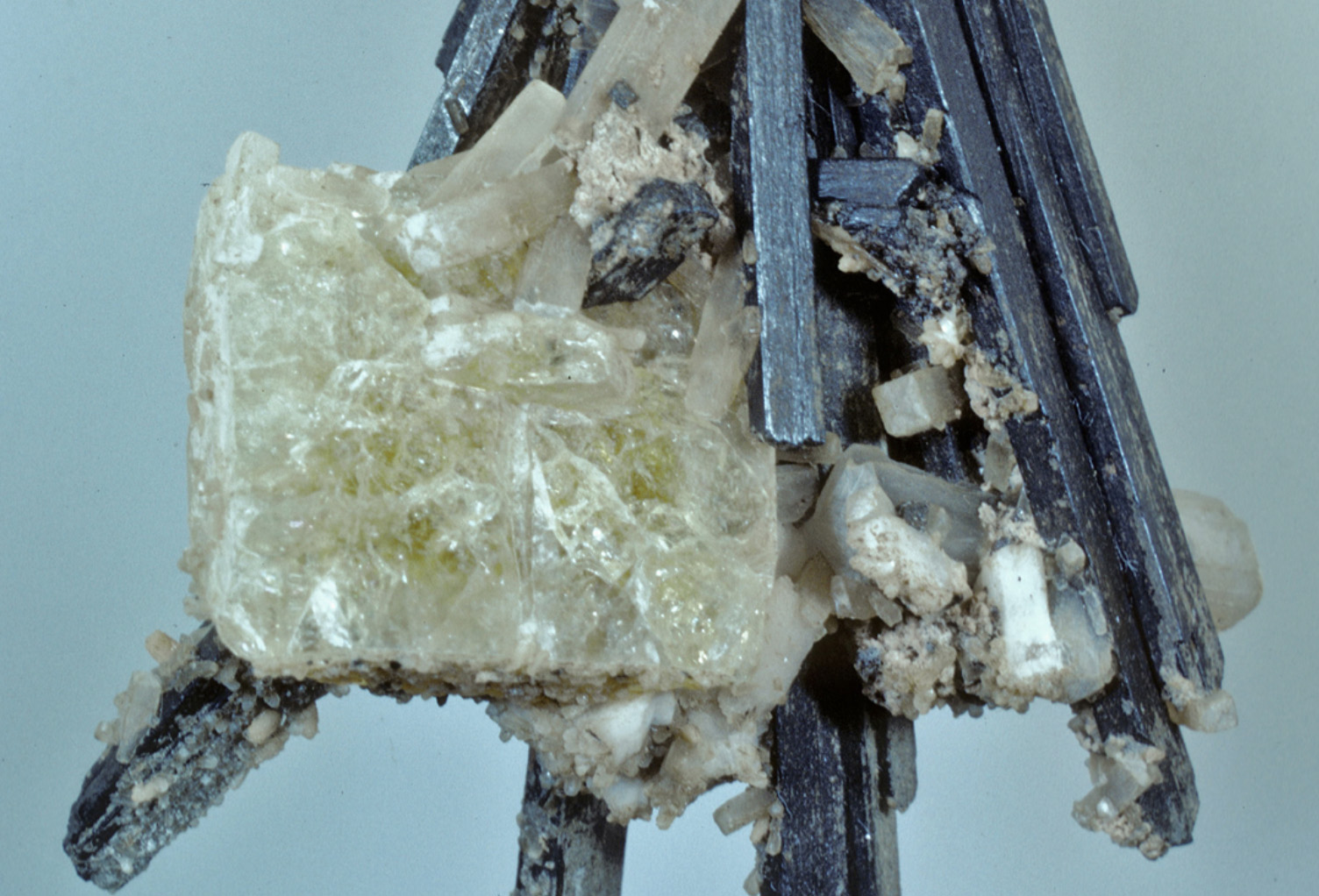

Leucophanite crystallises in the triclinic–pedial class — the lowest symmetry possible in crystallography, with no rotational axes and no mirror planes. Very few minerals are built this asymmetrically, which gives its tabular to platy crystals their characteristically skewed, one-of-a-kind faces.
It ranges from colourless and white through pale yellow to a vivid green, with a waxy to vitreous lustre. The green and yellow of the most prized specimens come entirely from trace-element substitution in the silicate framework rather than from any added colouring element.
"Happiness is your nature. It is not wrong to desire it. What is wrong is seeking it outside when it is inside."— Ramana Maharshi
Leucophanite is classed at the Third Eye, but its work begins lower and rises. It is a kundalini stone with a strong life-giving current, and what it does first is open the heart, then guide the rising energy up through that opened heart rather than past it. Held in quiet attention, the green stone tends to make people smile before anything else — a small, involuntary gladness, as if the body had remembered something simple it had mislaid. Ramana's plain instruction fits it exactly: the happiness is not arriving from the crystal, it is being uncovered where it already was.
Kundalini Through the HeartThe green variety — like the cluster above with albite and serandite — works through warmth. It opens the heart and lifts the kundalini quite strongly, then runs that current through the heart, burning off the karmic residue gathered there. This is the point: kundalini that rises through an open heart is not the same as kundalini that bypasses it. When the heart is open as the fire passes, the transmutation completes — the body's raw force becomes something finer, not as a concept but as a felt redirection. Its power is high enough that even a small specimen carries the impulse strongly, so a modest stone is plenty.
"The kind of happiness you get in meditation does not exist on this earth anywhere else."— Shivabalayogi
The yellow leucophanites are about size rather than warmth. They make the energetic body large and strong — like a sun, steady and ever-glowing, not easily shaken. The two colours are felt distinctly in practice: green opens and warms the heart; yellow expands and steadies the whole field. Either way the effect is not a brief flare — it runs for several hours, enough to carry a full day of practice without returning to the stone, settling into the body rather than spiking and fading.