
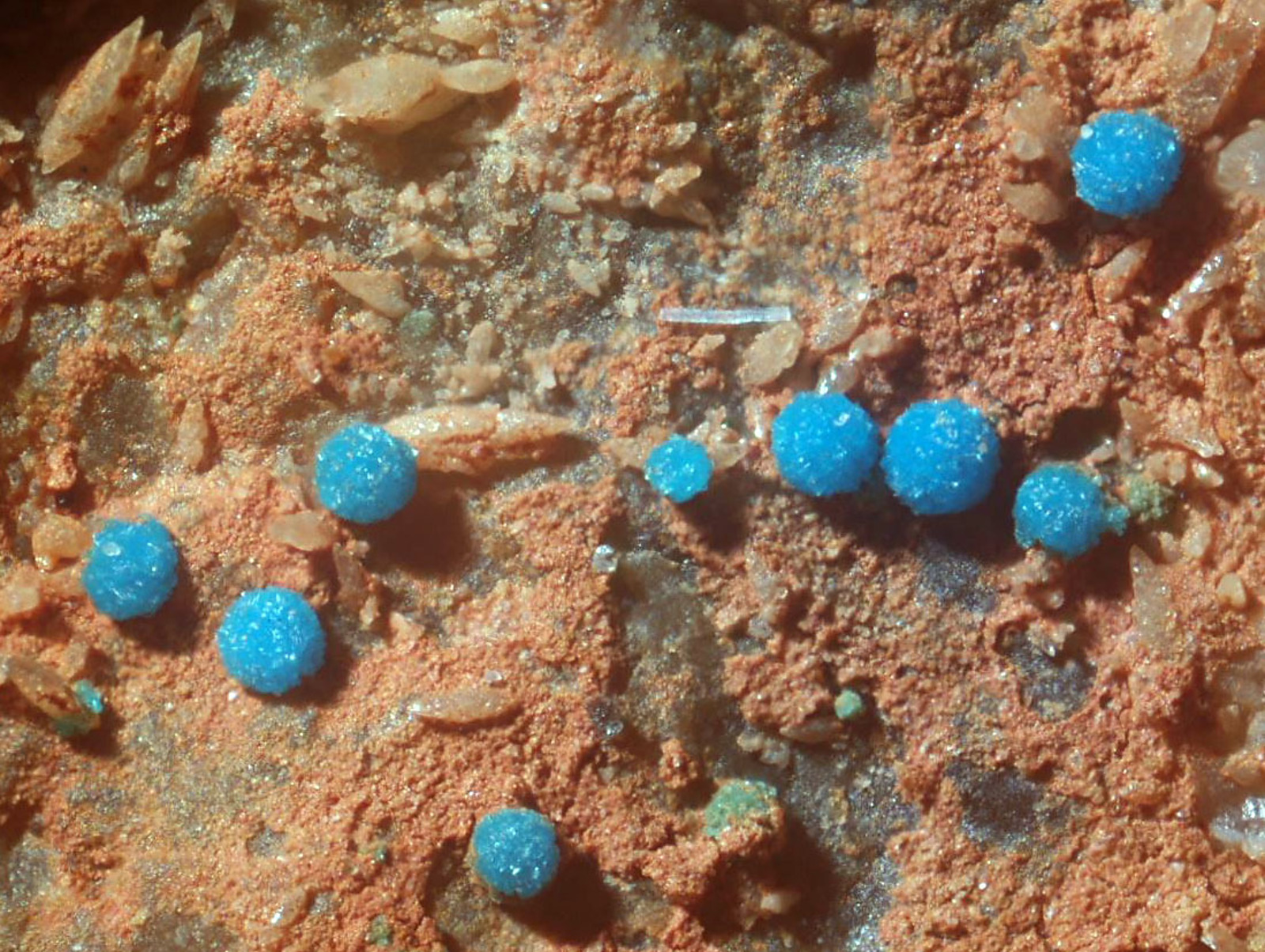
NaCaCu5(AsO4)4Cl · 3H2O
When love arrives at the crown, the one who loves discovers they were never separate.
Named in honour of Chester S. Lemanski, Jr., an American mineral collector and patron of mineralogical research. The name follows the standard IMA convention of adding the suffix -ite to the honouree's family name — Lemanski → Lemanskiite. The mineral was approved by the International Mineralogical Association's Commission on New Minerals and Mineral Names in 2006.
The architecture of lemanskiite belongs to the lavendulan group, a rare family of heteropolyhedral layered arsenates. The structure consists of sheets in which copper-centred square pyramidal polyhedra share corners with arsenate (AsO4) tetrahedra, building continuous two-dimensional layers stacked along the c-axis. Sodium and calcium cations sit in the interlayer galleries, while chloride ions and water molecules complete the coordination environment. This geometry is directly responsible for the perfect {001} cleavage and for the low hardness — the layers separate easily because the interlayer bonding is weak relative to the covalent framework within each sheet.
Lemanskiite was first described in 2006 from specimens collected at the Abundancia mine in the El Guanaco mining district, Antofagasta Region, northern Chile — a copper-rich deposit set in the hyper-arid Atacama Desert. The El Guanaco district has long been a source of rare secondary copper arsenate minerals formed through the oxidation of primary copper sulphides in extremely dry conditions, which allow delicate hydrated phases to survive at surface.
To date, lemanskiite remains known from this single mine complex. No confirmed occurrences have been reported elsewhere, making it one of the most geographically restricted minerals in the IMA-approved catalogue and placing collector specimens in an extreme rarity class.
Lemanskiite contains both copper (Cu) and arsenic (As) in significant quantities. Arsenic compounds are acutely toxic; copper salts are harmful if ingested or inhaled as dust. Do not grind, sand, or polish this mineral dry, and never use it to make crystal water or gem elixirs.
Wash hands thoroughly after handling. Keep away from children and pets. Store in a sealed container. For energetic work, placing the specimen nearby rather than in direct skin contact is recommended.
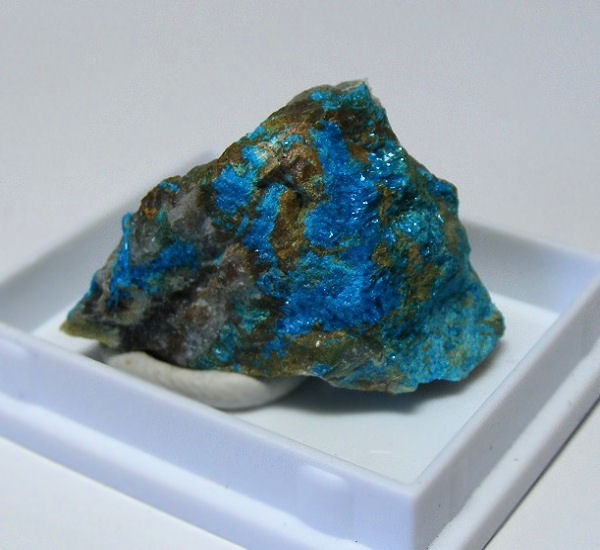


Lemanskiite displays pronounced pleochroism — rotating the crystal under polarised light shifts its colour from a deep green-blue to a pale icy turquoise. This directional colour change arises from anisotropic absorption of light by the copper d–d electronic transitions within the CuO4 square-planar polyhedra, which interact differently with light vibrating along each crystallographic axis. In hand specimens the effect is visible without polarisers when tilting under a directional light source.
Lemanskiite grows as elongated needles that radiate outward from a common centre, forming distinctive rosette-like clusters on the matrix. This habit is uncommon among arsenates and is a direct expression of the layered sheet structure: growth is fastest along the directions parallel to the Cu-As sheets, while the stacking direction (perpendicular to cleavage) grows more slowly, producing thin, blade-like individuals that splay into fans.
The heteropolyhedral layered architecture produces a textbook-perfect cleavage parallel to the {001} plane. Where the interlayer gap between consecutive Cu-As sheets is bridged only by weak electrostatic interactions between Na+/Ca2+ cations and water molecules, the crystal cleaves cleanly and easily along that plane, yielding mirror-flat surfaces. In thin cleavage flakes, transparency is sufficient to observe the pleochroic colour shift directly against transmitted light.
Lemanskiite holds an unusual position in the mineral kingdom: it is a Love-energy crystal whose centre of action is the crown chakra. Love is most often met at the heart; here it has traveled the entire length of the spine and arrived at sahasrara — the aperture where individual identity thins into unbound awareness. The effect is not warmth or sentiment. It is a specific quality of transparency: the membrane between "I" and "awareness" becomes thin enough to see through. F=7 means lemanskiite works on the finest layers — not the dense emotional turbulence of the lower centres, but the near-invisible residue of the sense that someone is present doing the dissolving.
Love at the CrownWhat practitioners report sitting with this stone is a gradual softening of the felt boundary at the crown — not a rush or surge, but a gentle permeability, as if the top of the skull had become porous to something that was always pressing quietly from above. This is Love operating at its most refined register: not as emotion or devotion, but as the recognition that awareness and what it meets are the same substance. Neem Karoli Baba's "Sub ek" — all one — was not a concept to be studied but a territory to be entered. Lemanskiite opens that territory not by force but by a patient dissolution of the boundary that appears to separate the one who loves from the one who is loved.
"I have come not to teach but to awaken."— Meher Baba
This is accurate to lemanskiite's action. It does not offer information about non-separation. It demonstrates it — gently, for the several hours that D=5 allows the field to hold after contact. P=5 means a specimen of moderate size placed in the meditation space or held during sitting is entirely adequate; no enormous piece is needed for full effect.
Joy as the Sign of RecognitionJoy appears as a secondary quality in lemanskiite's field, and this is reliable cartography. In the Dzogchen understanding of mind, there is a specific joy — dewa in Tibetan — that arises naturally when the nature of awareness is recognised: not manufactured happiness, not emotional bliss, but the specific lightness that follows when a weight you forgot you were carrying is set down. Lemanskiite's Joy element signals that this recognition, when it occurs, requires no effort — it is the natural aftermath of the Love current arriving fully at the crown. Tulku Urgyen's instruction to recognise, release, and relax maps precisely to the sequence this crystal supports.
The Kundalini element in lemanskiite's filter is not the initiating fire. This stone does not ignite kundalini at the root or accelerate its rise through the centres. It is active in the final register — the moment the ascending current reaches the crown and recognises itself as the awareness it was always trying to reach. For those already engaged in sustained kundalini practice, lemanskiite may serve as a crown-opening complement: a gentle confirmation that the journey, however long, leads here, to this transparency, to this simple knowing that was present all along and is now too obvious to overlook.