
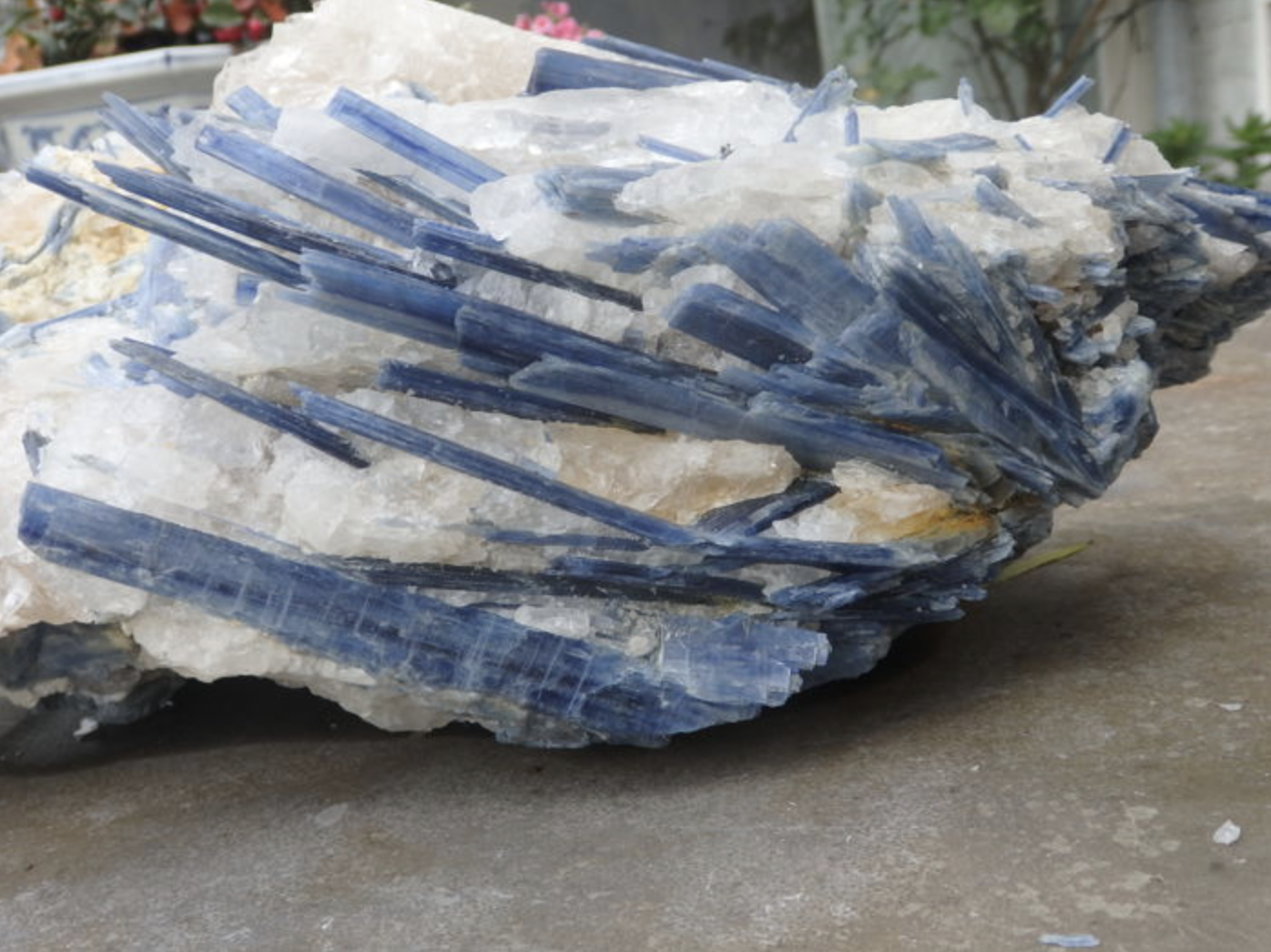
Al2SiO5
Look into the blue long enough and the boundary between seer and sky disappears.
The name kyanite was introduced by the German geologist Abraham Gottlob Werner in 1789, from the Greek kyanos (κυανός) meaning blue or dark blue — the colour most immediately associated with the mineral. The spelling cyanite was common in older English and French geological literature and persists in some historical texts. Werner had already coined an alternative name for the same mineral: Disthen, from the Greek dis (two) and sthenos (strength), a direct reference to kyanite's most extraordinary physical characteristic — its hardness is different depending on the direction in which it is measured within the same crystal. The "Disthen" name was adopted particularly in German and Scandinavian mineralogical literature and remains the standard name for kyanite in several European languages today.
Kyanite's formula Al2SiO5 is shared exactly with two other common minerals — andalusite and sillimanite. The three are polymorphs: identical in chemistry, fundamentally different in crystal structure, and stable under completely distinct combinations of pressure and temperature. Kyanite is the high-pressure form, crystallising in the triclinic system (the lowest possible crystal symmetry, with only a centre of inversion), while andalusite forms under low pressure and sillimanite at high temperature. In kyanite's structure, one aluminium occupies a regular octahedral site and the other occupies a more distorted site with mixed five- and six-fold coordination — the structural asymmetry responsible for the extraordinary anisotropy in its physical properties.
The most immediately remarkable physical property is anisotropic hardness: within the same crystal, hardness measured parallel to the long axis registers 4.5 on the Mohs scale, while the same measurement made perpendicular to the axis yields 6.5–7. No other common mineral shows a directional hardness difference this large. The blue colour — from pale sky-blue to intense deep blue — is caused by intervalence charge transfer between Fe²⁺ and Ti⁴⁺ impurities in the aluminium sites, a mechanism that produces an exceptionally pure spectral blue.
Kyanite is a mineral of metamorphic origin, forming when aluminium-rich sedimentary rocks — clay-rich mudstones and shales — are subjected to the elevated pressures of deep burial or collision tectonics. It grows within schists and gneisses at depths of 15 to 40 kilometres, crystallising as long, striated blades whose blue colour stands in vivid contrast against the white quartz and silvery mica matrix typical of its host rocks. Werner described it formally in 1789, though it had been known by various names in mining communities long before that.
Brazil — particularly the states of Minas Gerais and Bahia — is now the world's largest commercial source of kyanite, producing both the gem-quality blue crystals most familiar in the mineral market and vast quantities of industrial-grade material. Nepal and Tibet yield fine bladed crystals in association with the deep metamorphic belts of the Himalayan collision zone. Kenya and India are significant sources, as are the Blue Ridge and Appalachian mountain belts of the eastern United States (North Carolina and Virginia). The Swiss and Austrian Alps have produced classic association specimens — kyanite blades alongside staurolite, garnet, and chlorite — from localities including the Pizzo Forno area of Ticino and the Zillertal of Tyrol, where 19th-century collectors first systematically documented the mineral.

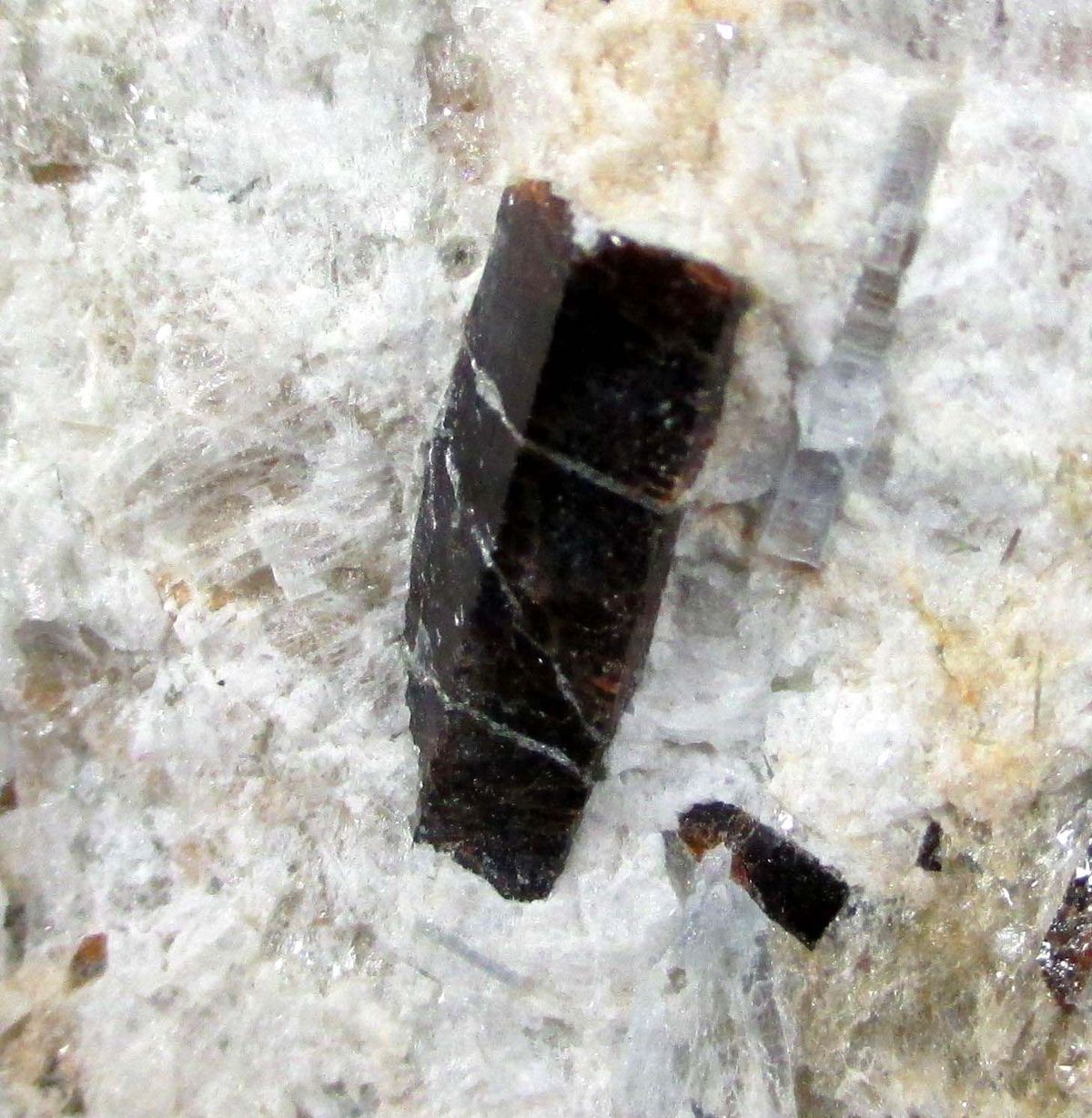
In a single kyanite blade, hardness measured along the long crystallographic axis yields Mohs 4.5 — roughly the hardness of a steel nail. The same measurement made perpendicular to that axis on the same specimen gives 6.5–7, harder than most glass. This directional variation — a difference of more than 2 full Mohs units within a single mineral — is almost without parallel in common mineralogy and arises directly from the asymmetry of the triclinic crystal structure, where aluminium atoms in two differently bonded environments respond very differently to mechanical stress depending on direction. It is one of the clearest demonstrations in nature that a crystal is not a uniform material but a directionally ordered architecture whose properties depend entirely on which way you look at it.
The triclinic crystal system — with only a single centre of inversion as its entire symmetry content — is the lowest possible symmetry in crystallography. It is most commonly found in complex, multi-element minerals where the structural asymmetry is forced by many different atom types competing for irregular sites. Finding it in a nesosilicate as compositionally simple as Al2SiO5 is genuinely unusual. The familiar nesosilicates — garnet (cubic), zircon (tetragonal), olivine (orthorhombic) — crystallise in much higher symmetries. Kyanite's triclinic structure is a consequence of the very specific way its two aluminium atoms occupy sites of different geometry and bonding environment, creating a framework that cannot achieve the higher symmetries its simple chemistry would seem to invite.
Because kyanite, andalusite, and sillimanite are all Al2SiO5 but stable under distinctly different pressure-temperature conditions, their boundaries have been precisely determined by thermodynamic experiments. Kyanite is stable at pressures above roughly 3.5–5 kbar and at temperatures from approximately 300–700°C — corresponding to burial depths of 12–18 kilometres or more. A rock containing kyanite is therefore a natural pressure gauge: its presence alone restricts the possible formation conditions to a specific, well-mapped region of pressure-temperature space. No calculation is required; the mineral itself records where and how deep the rock was made. This property makes kyanite one of the most geologically informative common minerals on Earth.
"Without relative bodhicitta — compassion — and ultimate bodhicitta — insight into emptiness — there is absolutely no way to take even one step closer towards buddhahood."— Chogye Trichen Rinpoche
Hold a blade of kyanite up to the light and the eye keeps travelling — past the surface, past the colour, into a blue that has no floor to it. That is the whole of the stone. It does not push, does not activate, does not stir anything up to be dealt with; it simply opens a high window in the field, up at the crown and above it, and through that window the tight, crowded sense of being a particular someone begins to thin out into something with no edge. You are still here — but "here" has quietly become enormous, and the small self that spends its days braced against the world discovers there is nothing left to brace against. Only the openness, and the still awareness in which the openness appears.
It does this work gently, and never by force. Rather than chasing a trouble around the body, it rests its clear light on whatever is clouding the seeing and lets the cloud burn off the way morning mist lifts — not driven away, simply gone — and it lingers long enough to reach the thing beneath the thing. What remains when a cloud goes is not an achievement but a plain, wordless gladness, the kind that arrives watching a sunset a moment before the mind starts talking about it. And kyanite asks for nothing in return: alone among stones it never needs cleansing, never drinks in the heaviness of a room, never loses its own clear note — which is only another way of saying it is always already in alignment, and quietly realigns whatever it rests beside, smoothing the places where understanding between people had snagged.
In that wide stillness the inner senses sharpen of their own accord: pictures held behind closed eyes grow vivid and steady, dreams turn lucid, old memory comes back clear. And when life crowds in, kyanite gives back a sense of proportion — not by shrinking the trouble but by restoring the sky it is measured against, so the storm is seen for the passing weather it always was. Look into the blue long enough and the one who is looking and the openness being looked into quietly stop being two; what is left is luminous, untroubled, and entirely at home.
"A quiet mind is all you need. All else will happen rightly, once your mind is quiet."— Nisargadatta Maharaj
The Structure section above mentions kyanite's two siblings; here they are. Sillimanite and andalusite have exactly the same composition as kyanite, Al2SiO5 — the three are polymorphs, the same atoms arranged three different ways under three different regimes of pressure and temperature. Kyanite is the high-pressure form (triclinic); andalusite forms at low pressure and sillimanite at high temperature, both crystallising in the orthorhombic, dipyramidal system. A single rock can even preserve all three. Energetically they are close cousins of kyanite — each a softer or warmer shade of the same blue clarity — and neither made the Top 200.

Sillimanite is almost the same as kyanite — chemically identical and structurally a polymorph of it — and it carries a kindred high, clear frequency, but with a distinctly softer touch. That softness is its gift: it calms the very-high frequencies in the body and mind that, when they run too strong, can surface as headaches and energetic spikes running through the body.
Where kyanite opens the high window wide, sillimanite gently turns the volume down on an over-bright field, smoothing the spikes and easing the head. Its power is light and its action brief — a quiet, settling counterpoint to too much intensity.

Andalusite shares kyanite's exact chemistry too, but it lacks the very top of kyanite's frequency — and in its place it offers something kyanite does not: warmth. It is a warm, comforting crystal that works on two things in particular.
It eases shoulder aches that come from energetic blockages — the tension carried across the upper back when the field is congested — and it gently clears heart sorrow, lifting old grief and the weight that settles on the chest. Soft in power and a little longer-lasting, it is the tender, embodied member of the trio.