
KHMg2B12O16(OH)10·4H2O
The quiet inner eye that dissolves what it sees
Kaliborite's name is purely a statement of its chemistry: kali, from the Latin kalium (potassium), joined to borite for its boron content — literally "the potassium borate." It is a member of the borate minerals that crystallise in salt deposits.
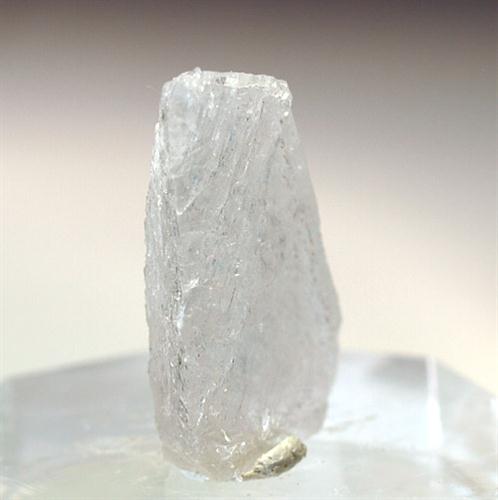
Kaliborite is a hydrated potassium–magnesium borate, a monoclinic mineral whose formula packs an unusually large borate group — twelve boron atoms in a single repeating unit — together with potassium, magnesium, hydroxyl and water. It is colourless to white, grey or reddish-brown, with a hardness around 4 to 4.5, and occurs as small crystals or granular, nodular masses.
It is an evaporite mineral, formed where ancient seas dried and concentrated their dissolved boron in marine salt deposits, so it keeps company with other borates and salts. Because it carries so much structural water and grew from brine, it slowly dissolves if wetted and should be kept dry.
Kaliborite was first described from the German salt deposits at Schmidtmannshall, near Aschersleben in Saxony-Anhalt, where it occurs among the borate minerals of the evaporite beds.
It has since been found at other evaporite localities, notably Lake Inder in Kazakhstan. It remains an uncommon, collector-oriented species, valued as one of the more structurally complex of the salt-deposit borates.
Kaliborite slowly dissolves in water. Never wet-clean or soak it, keep it out of damp rooms and away from humidity, and dust it only with a dry, soft brush.
Kaliborite carries one of the larger borate building-blocks in the mineral world — a polyanion of twelve boron atoms — binding potassium, magnesium and water into one structure.
An evaporite mineral, it grew from the concentrated brine of vanished oceans, locked among salt and other borates — which is also why water slowly unmakes it.
It forms small colourless-to-pale crystals and granular masses of modest hardness, an uncommon species sought mainly by borate collectors.
"Forgetting to embrace the self-god within, we search this wide world for various divine solutions."— Kaagapujandar
Kaliborite centres at the Third Eye — the ajna, the inner eye that can turn toward an issue anywhere in the energetic body and, simply by seeing it fully from within, dissolve it. This is the faculty behind vipassana, behind Dzogchen's tögal, behind self-enquiry: stay with what arises, look at it from the inside, and it loosens and goes. It is also the faculty every crystal depends on; when the third eye is shut, no stone can be felt at all. Kaliborite's frequency works at exactly that level — solid in its transmission, though brief, suited to one clear seeing at a time.
It is a Healing stone, which means its energy does not travel up or out but stays right at the centre, resting on the ajna like a lens and dissolving the cloudiness there in place. Rather than dramatic openings, it does the quiet work of clearing and steadying the inner sight itself, so that the gaze which dissolves all other issues grows clearer and more reliable.
"A quiet mind is all you need. All else will happen rightly, once your mind is quiet."— Nisargadatta Maharaj
And that is the whole of its counsel: stop hunting outside for the answer. Let the eye turn inward and grow still, and what it rests upon — quietly, without force — dissolves of its own accord.