
CaMn2+Mg2Fe3+2(PO4)4(OH)2·8H2O
Slow, steady fuel for the long road
Jahnsite was named in honour of Richard Henry Jahns (1915–1983), the American geologist of Stanford University renowned for his work on granite pegmatites. It was described by Paul B. Moore in 1974. The bracketed suffix in jahnsite-(CaMnMg) is a Levinson modifier, naming the dominant cations — calcium, manganese and magnesium — at its three key structural sites.
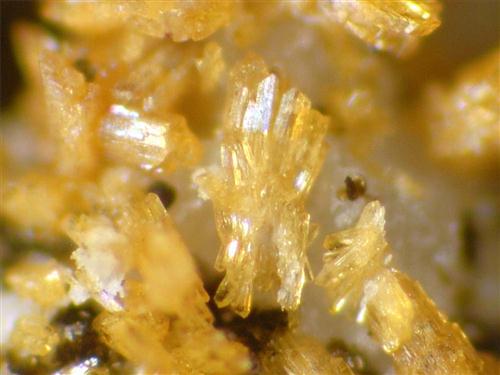
Jahnsite-(CaMnMg) is a hydrated calcium-manganese-magnesium-iron phosphate of the monoclinic system, carrying eight water molecules per formula unit. It forms brown, red-brown, orange to yellow prismatic — sometimes needle-like — crystals, vitreous and of moderate hardness, around 4 on the Mohs scale.
It is a secondary mineral, born when water alters primary pegmatite phosphates such as triphylite and lithiophilite. The jahnsite group is a model of site-specific nomenclature, where which cations dominate three structural sites defines a whole row of separate species.
The type locality is the famous Tip Top Mine in Custer County, South Dakota — one of the great phosphate-mineral localities of the Black Hills pegmatites — where jahnsite was first described in 1974.
It occurs wherever granite pegmatites carry primary iron-manganese phosphates that later weather and recrystallise, and is found at a scatter of such localities worldwide, always in small, well-formed crystals.
A brown-to-orange calcium-manganese-magnesium-iron phosphate, monoclinic and water-rich, born from the slow alteration of pegmatite ores.
Jahnsite anchors a whole group whose members differ only in which cations fill three structural sites — a living lesson in mineral nomenclature.
A secondary mineral of granite pegmatites, it grows where water reworks triphylite and lithiophilite into fresh, ordered crystals.

.jpg)
"This life is a flicker of lightning in a summer cloud. Do not mistake the reflection for the moon, and do not mistake the dream for the dreamer."— Khenchen Tsewang Rigdzin
Jahnsite works at the solar plexus — the fire-centre of will and the body's reservoir of energy, stored there like a battery. Its frequency is modest and its power gentle, but its duration is among the longest of any stone; this is exactly why its blurb speaks of energy for long-term projects, mental focus and stamina. It is not a surge but a slow, banked fire that simply keeps burning, the way the mineral itself crystallises slowly out of long-altered pegmatite.
As an Expanding stone, the energy it lends does not knot in the gut but radiates steadily outward from the centre, so a person feels broadened and at ease across a long stretch of effort rather than braced for a sprint. Where a high-power stone gives a push, jahnsite gives endurance — the quiet capacity to stay with a task day after day without the centre emptying out.
"After continuous meditation, samadhi comes, then God realization—this is tapas."— Shivabalayogi
That is its real teaching at this gentle frequency: stamina is itself a practice. Mental focus is not held by force but by the unbroken return to the work, and jahnsite supports precisely that — the long, level burn that outlasts enthusiasm and carries a thing through to its end.