
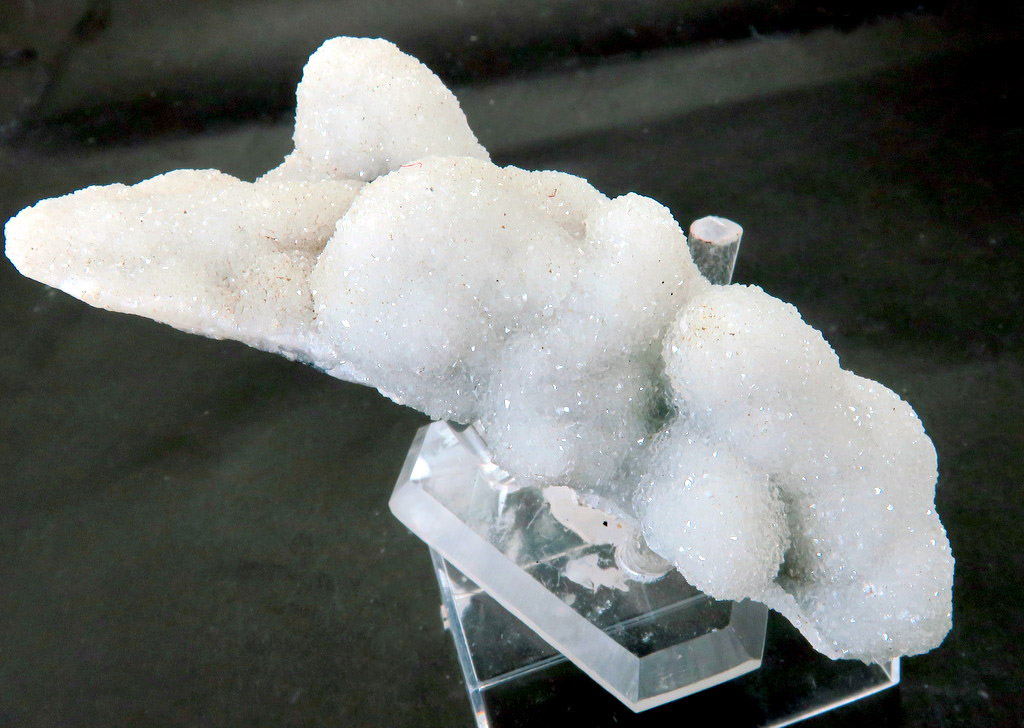
Zn5(CO3)2(OH)6
a soft chalk-white calm that quiets the inner eye for meditation
The name hydrozincite is a straightforward compound of three roots: Greek hydro (water, signalling the hydroxyl groups in the formula), the element name zinc (itself from German Zink, of uncertain origin — possibly related to the pointed shape of smelted zinc crystals, or to the Persian seng for stone), and the mineralogical suffix -ite. The older synonym zinc bloom describes the powdery or earthy white crusts that bloom across the surface of weathered zinc ore bodies. It is also occasionally called marionite after an early nineteenth-century locality reference. The mineral was formally described in 1853 from Bad Bleiberg in Carinthia, Austria.
Hydrozincite is a secondary zinc mineral — it does not form from primary magmatic or metamorphic processes but grows in the oxidation zones of zinc-bearing ore deposits, particularly where sphalerite (ZnS) has been weathered by groundwater carrying carbonate. The result is a pale, often chalky or silky mineral that coats and replaces the primary ore in white to cream-coloured crusts, lamellar masses, and occasionally fibrous or botryoidal aggregates. True single crystals are rare; most material is massive or earthy.
The structure is monoclinic, with alternating zinc hydroxide and carbonate layers — a zinc-analogue of the basic copper carbonates malachite and azurite, though hydrozincite belongs to its own structural type. Its most striking physical property is strong fluorescence: under short-wave ultraviolet light it glows a vivid pale blue to lilac, one of the brightest natural UV responses among common minerals. The mineral is biaxial negative with high birefringence (δ ≈ 0.120).
Hydrozincite was first formally described in 1853 from Bad Bleiberg (Bleiberg-Kreuth), a historic lead and zinc mining district in Carinthia, southern Austria. The region had been mined since antiquity, and the chalky white coatings on zinc ore walls were well known to miners long before the mineral received a scientific name.
Today it is found wherever zinc ore deposits have been exposed to near-surface oxidation and carbonate-rich groundwater. Notable occurrences include the mines of Sardinia (Italy), Laurion (Greece), Tsumeb (Namibia), the American West (Nevada, Utah), and the zinc-rich zones of the Spanish Pyrenees. It frequently appears alongside smithsonite, hemimorphite, willemite, aurichalcite, calcite, and limonite — the characteristic secondary assemblage of oxidised zinc deposits.
Hydrozincite's most remarkable physical trait is its powerful fluorescence under ultraviolet light — pale blue to lilac, among the brightest of any common mineral. A specimen that looks entirely unremarkable in daylight is transformed under UV into a glowing, almost spectral blue. This optical quality — hidden light revealed only by a specific frequency of radiation — is a fitting mirror of the stone's inner-eye theme.
Hydrozincite almost never forms sharp crystals. Instead it grows as earthy, chalky, or silky-fibrous coatings and crusts on oxidised zinc ores — soft enough to mark with a fingernail (Mohs 2–2.5). Its quiet white surface and gentle, powdery texture give it an unassuming, almost monastic quality that belies the cold luminous fire within.
As a zinc basic carbonate, hydrozincite is structurally related to the copper carbonates malachite and azurite — replacing copper with zinc. Where malachite is vivid green and azurite deep blue, hydrozincite is white and silent, the zinc family's quieter, more contemplative expression of the same carbonate architecture.
"Kriya is Truth, and the rest is false."— Lahiri Mahasaya
Sit with hydrozincite for a while and notice what happens. The mind, so used to casting outward, begins to quiet on its own — not through effort, not through any deliberate technique, but simply because something in the stone's frequency holds a steady, unhurried calm that the nervous system eventually recognises and matches. This is what it does. It works at the third eye not as a searchlight pointing outward into visions, but as a lens turned inward — softening the usual interior noise until the space behind thought becomes apparent.
There is something almost paradoxical about this stone. It looks like chalk. It is softer than a fingernail. In daylight it has no drama whatsoever — white, chalky, easy to miss. And then you hold it in darkness under an ultraviolet lamp and it blazes a cold, ghostly blue-white that has no business coming from something so unassuming. This is exactly the nature of what it transmits: the hidden light is already present. Stillness does not need to be manufactured. It is there when the surface noise stops.
Meditation · Inner PeaceThe blurb given for this mineral is simple and precise: it assists meditation and inner peace, and it is a soothing stone for the spirit. All three things point in one direction. The energy does not push or stimulate. It settles. It dissolves the low hum of mental agitation the way a heavy woollen blanket cuts sound — not dramatically, just by being present and dense enough to absorb. For anyone who sits in meditation and finds the mind persistently busy, carrying hydrozincite into the session introduces a frequency that the mind learns, over time, to recognise as a cue for quieting.
"If you meditate for one hour daily, your mind will come under control."— Shivabalayogi
The frequency here centres in the inner eye, and the inner eye works by looking — by staying with whatever arises and allowing it to dissolve under sustained, non-reactive attention. This is the principle of vipassana, of self-inquiry, of Togal: the issue cannot survive being truly seen. Hydrozincite supports exactly that faculty. It does not carry the long, sustained working of higher-duration stones — its action runs for several hours and then completes its session. But within that window it brings a quality of sober, gentle clarity to whatever is present. You might find emotions that were foggy and formless becoming visible enough to be seen through. You might find physical tension that was background noise rising briefly into awareness before releasing. The stone adds vitality and life energy to the inner-eye centre specifically, countering the fogged, leaden quality of a mind that has lost contact with the living moment. What comes through is joy in its simplest sense: the clean experience of perceiving without the overlay of accumulated comment and judgment.