
Fe2O3
The weight of the earth, anchoring and protecting
The name hematite comes from the Greek haima, blood — the same root as words like haemoglobin — because the mineral, however black and metallic its crystals, gives a deep red streak and grinds to a blood-red powder. Pliny the Elder recorded the name in antiquity for the "bloodstone," and the association with blood, iron and protection has clung to it ever since.
That red is no coincidence of language: the same iron oxide colours rust, red ochre, the soil of whole regions, and the dust of Mars — the "red planet" is red because its surface is rich in hematite.
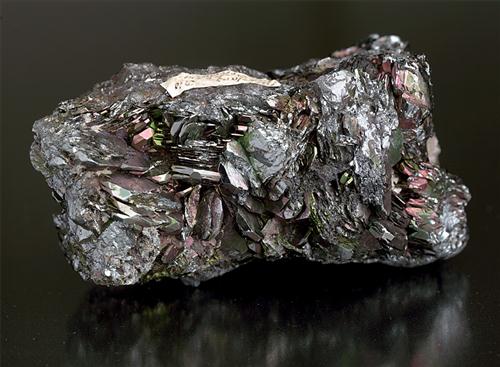
Hematite is ferric oxide, Fe2O3, crystallising in the trigonal system as the type mineral of its group. Iron and oxygen pack into a dense, ordered framework that gives the mineral its weight, its hardness of 5–6.5, and — on crystal faces — a brilliant metallic-to-mirror lustre. Despite the steel-grey to black appearance of its crystals, hematite always gives a tell-tale cherry-red streak.
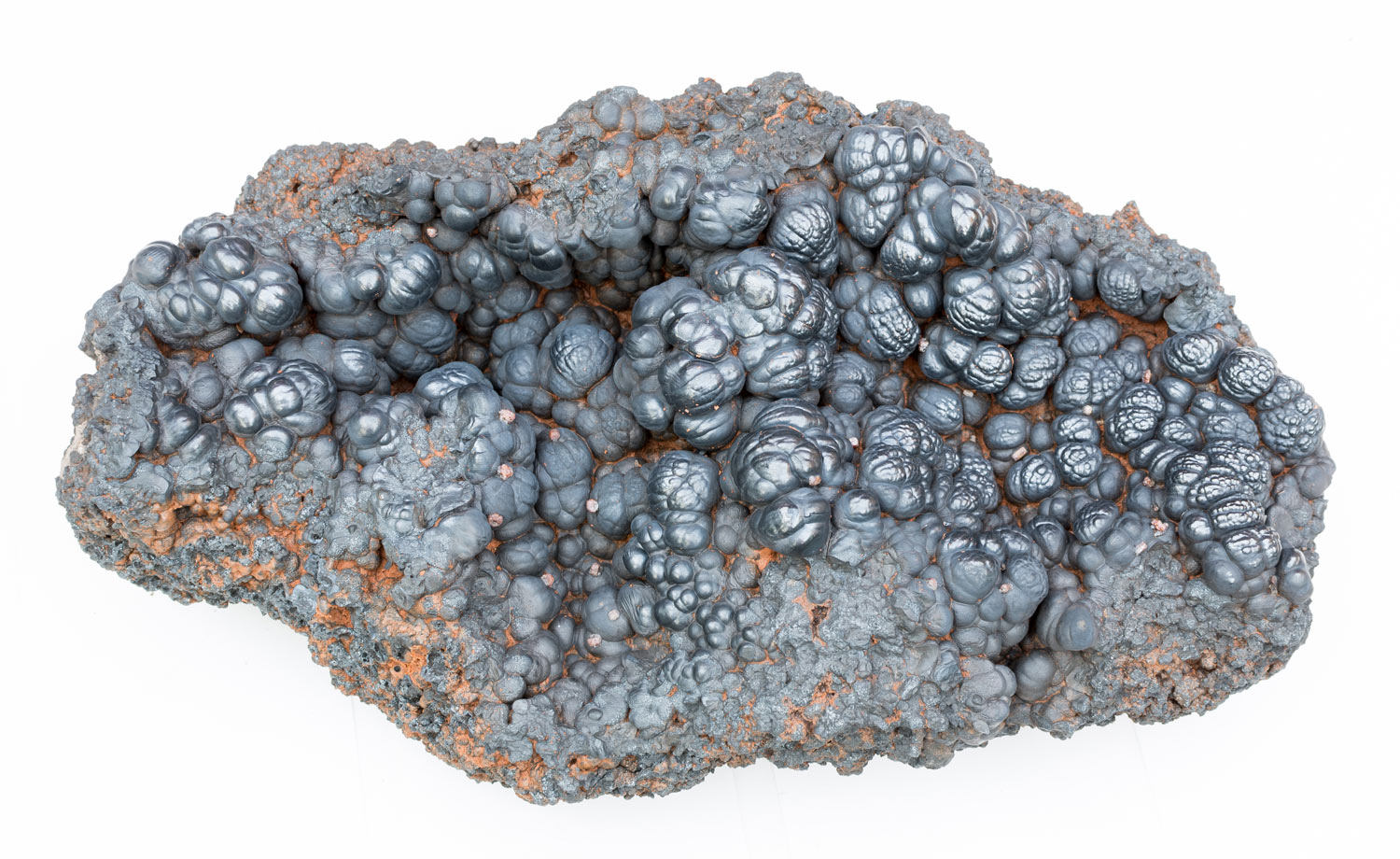
It takes an extraordinary variety of forms: mirror-bright tabular and rhombohedral crystals; rosette-like clusters called "iron roses"; rounded, smooth-skinned "kidney ore"; radiating and botryoidal masses; micaceous "specularite"; and earthy red ochre. It forms in almost every geological setting — sedimentary, igneous and metamorphic — and is, with magnetite, one of the two great ores of iron and a principal component of the banded iron formations that record the oxygenation of Earth's early oceans.
Hematite has been used by humankind for tens of thousands of years. Red ochre — powdered hematite — colours Palaeolithic cave paintings and prehistoric burials, where it was scattered over the dead, its blood-red hue tied to life and protection across countless cultures. As an iron ore it has underpinned civilisation since the Iron Age.
It is one of the most abundant and widespread minerals on Earth, found on every continent. Famous specimen localities include the "iron roses" of the Alps (Switzerland), the brilliant crystals of Brazil and Elba, the kidney ore of Cumbria in England, and the vast banded iron formations of the Lake Superior region, Australia and Brazil that supply much of the world's iron. Hematite has even been detected from orbit blanketing the surface of Mars.


Hematite is one of the two great ores of iron and a building block of the banded iron formations that record the oxygenation of Earth's oceans. It is, quite literally, the iron of the planet — dense, abundant, and fundamental.
However black and metallic its crystals, hematite always grinds to a deep red powder and gives a blood-red streak — the source of its name and its ancient link to blood, life and protection.
The same iron oxide that reddens rust, ochre and soil coats the surface of Mars and gives the red planet its colour — hematite is one of the most widespread minerals not only on Earth but across the inner solar system.
"The purpose of Dharma is to pacify and eliminate the delusional ignorance that causes suffering."— Rangjung Rigpe Dorje
Hematite is the great anchor. Its frequency is zero — the Earth Star — the densest, slowest, most fundamental vibration in the crystal world, the one that moves a person's centre of gravity down past the body and into the core of the planet itself. This is more than grounding: it is anchoring, dumping dense energy and old issues into the molten heart of the earth where they can be burned away, so that when this centre is open nothing can truly disturb a person, because it has all been given back to the ground.
Its Power of eight makes it a strong, certain stone, transmitting that grounding force with real weight, and its Duration of eight makes it a long, steady companion — protection and mental focus held continuously rather than in a brief flush. Grounding is its core nature: introverted, stabilising, flowing the energy down into the earth, and working with the body and mind to balance the two. With the lower channel open and grounded, negative energy drains away easily and the mind grows quiet and clear.
And though it sits at the very base, hematite carries Love, Life and Joy with it — the heart's warmth, the river of vitality, and the simple gladness of a settled system — so its grounding is not cold but a kind, protective steadiness, the reassurance of solid earth beneath the feet.
"Leave everything alone. Leave your mind alone. Leave the world alone. All is well."— Robert Adams