

CdS
Warms the belly and calls energy home to earth
Greenockite is named after Charles Murray Cathcart, the Lord Greenock, who brought specimens from Scotland to the attention of mineralogists. The mineral was formally described by the Scottish chemist Thomas Thomson in 1840, from specimens found on the Duke of Argyll's estate at Bishopston, near Greenock, Renfrewshire, Scotland. Cathcart later became the 2nd Earl Cathcart.
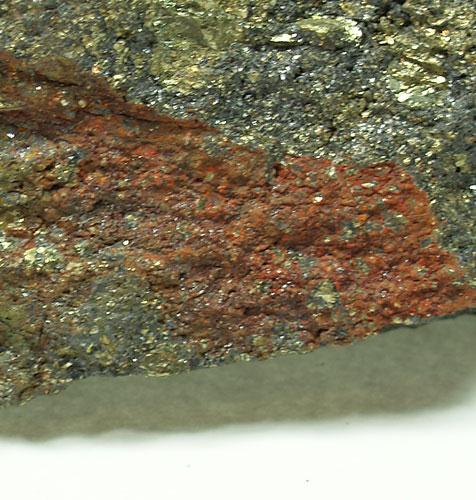
Greenockite is cadmium sulfide — just two atoms in a hexagonal wurtzite structure. This extreme chemical simplicity is shared with its close relative zincite (ZnO) and makes greenockite a direct crystalline semiconductor with a band gap of approximately 2.4 eV. The orange-yellow color is intrinsic to the cadmium-sulfide bond, not caused by trace impurities. Greenockite typically occurs as thin coatings, powdery encrustations, or small pyramidal crystals on sphalerite or zinc ores — it is a secondary mineral formed by the oxidation of sphalerite.
First described in 1840 from Bishopston, Renfrewshire, Scotland. Greenockite is a rare secondary mineral found in the oxidized zones of sphalerite-bearing zinc sulfide deposits worldwide. It typically forms as bright yellow-orange coatings on sphalerite and associated zinc minerals. Notable occurrences include the Tri-State mining district of Missouri, Kansas and Oklahoma (USA), Joplin, Missouri, and various localities in Europe and Australia. Fine free-standing crystals are exceptional and highly prized by collectors.
Because greenockite belongs to the non-centrosymmetric hexagonal class (6mm), it is both piezoelectric (generates charge under mechanical pressure) and pyroelectric (generates charge under temperature change). This makes greenockite one of the few natural minerals that directly converts physical force or heat into electrical current.
Greenockite is a natural direct-band-gap semiconductor. The 2.4 eV band gap falls within the visible spectrum — the crystal absorbs blue-green light and transmits orange-yellow, giving it its characteristic color. This is not a surface coating or impurity effect but the fundamental electronic structure of the cadmium-sulfide bond itself.
"All the buddhas of all the ages have been telling you a very simple fact: Be — don't try to become."— Osho
I find greenockite very similar to zincite but more grounding. They share the same simple two-atom makeup, yet they move in opposite directions: it really warms the belly and wants to draw the energy down, while zincite pulls it up.
The Downward CurrentThe pairing is one of the cleanest energetic contrasts in the mineral kingdom — two binary semiconductors of the same symmetry, one cadmium sulfide and one zinc oxide, both direct, powerful, low activators. Zincite draws the life force upward from the Sacral and Root, spiralling it toward the solar plexus and beyond. Greenockite moves the complementary way: the warmth it kindles in the belly wants to descend, to root, to return the energy to the earth. Centred at the Sacral, the Svadhisthana — the watery seat of feeling and creative flow — it is an Expanding energy of long duration, sustaining that settling, grounding current far longer than most sacral stones.
"Your duty is to be, and not to be this or that."— Ramana Maharshi
The warming of the belly that one notices with greenockite is not a metaphor — it is a felt, spreading thermal quality through the lower abdomen, quite unlike zincite's upward rush or the bright expansion of fire opal. It is a settling quality: the energy is already where it belongs, and greenockite simply confirms it there, deepens it, and connects it down into the earth beneath the body. As it warms the belly it also stirs the chakras to clear their stagnant energy, leaving a quiet joy and a renewed vitality in its wake.